





 Portuguese
  English
  Spanish
  5 min of reading
  0 comments


Challenge with identical numbers draws attention because it seems simple, but it depends on a mathematical rule that many people ignore when solving quick calculations. Understanding the correct order of operations helps avoid wrong answers and shows how small details change the entire calculation.
The expression 4 + 4 × 4 + 4 often confuses those who try to solve the calculation automatically, especially when the simple appearance leads the reader to ignore the correct order of mathematical operations.
Although all the numbers are the same and the calculation seems straightforward, the correct result depends on a basic rule of mathematics: multiplication must be done before addition.
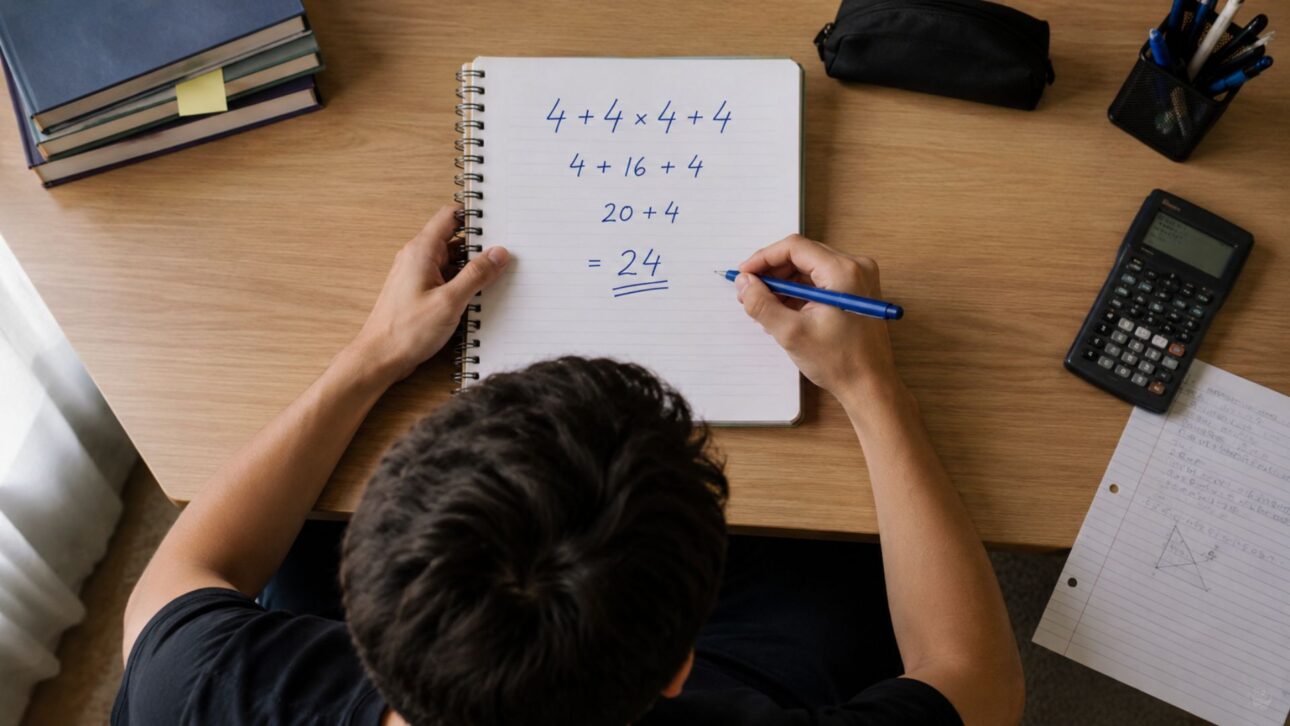
In this case, the correct value of the expression is 24, because the multiplication 4 × 4 needs to be resolved first, forming 16 before the other terms are added.
-
Fisherman found a giant pirarucu in the Paraguay River and the case exposed uncontrolled tanks, clandestine releases, and a silent risk to the native fish of the Pantanal.

-
Never throw away expired credit cards, they are a treasure: an object that millions discard without thinking can gain a surprising new function, require very little investment, and transform home organization in an unexpected way.
-
Beneath the asphalt of a neighborhood in São Paulo, there was a hidden community of fugitive slaves from the 19th century with more than 40,000 sacred objects. The discovery halted the metro construction and added R$ 3.6 billion to the project.

-
The position that no one can explain: why Brazil still spends R$ 8 million per year on elevator operators even after the government officially recognized that the role became obsolete decades ago.





After this first step, the calculation becomes 4 + 16 + 4, a sequence in which only additions remain and the calculation can proceed normally until reaching the final result.
The trap lies precisely in the simple appearance of the challenge, as the expression has no parentheses, uses small numbers, and seems to allow a quick resolution from left to right.
By this mistaken path, the person starts by adding 4 + 4, reaches 8, multiplies by 4 and gets 32, only then adding the last 4 to find 36.
Although it seems like a natural reasoning at first glance, this procedure disregards the hierarchy of operations and completely changes the result of the presented expression.
Why is the correct answer 24?
To avoid different interpretations in the same numerical expression, mathematics follows a conventional order of resolution, which defines which operations should be done before others.
This rule establishes that multiplications and divisions have priority over additions and subtractions, except when there are parentheses or other signs indicating a different order for the calculation.
In the expression 4 + 4 × 4 + 4, there are no parentheses altering the sequence, nor do powers, roots, or other elements appear capable of changing the priority of operations.
Therefore, the only step that needs to be resolved before the additions is the multiplication 4 × 4, whose result is 16.
With this part calculated, the expression becomes 4 + 16 + 4, and the remaining additions can be performed in sequence, reaching first 20 and then 24.
The result, therefore, does not depend on personal interpretation or a “trick question” in the informal sense, but on the correct application of a rule taught in the study of numerical expressions.
The most common error in mathematical expression
Among the incorrect answers, the most frequent mistake appears when a person reads the expression as a linear sequence, without differentiating the priority of each operation involved in the calculation.
This reading leads to the idea that it is enough to follow from left to right, solving each part as it appears, as if addition and multiplication had the same weight.
This method only works when the operations belong to the same level of priority, as occurs in expressions formed only by additions and subtractions.
When multiplication appears in the middle of the expression, the logic changes, because the × sign indicates an operation that must be executed before the surrounding additions.
Precisely for this reason, the result 36 does not represent a valid alternative answer, even if it seems coherent to someone who calculated quickly and without reviewing the order of operations.
The number arises from a step performed outside the correct sequence and, for this reason, does not respect the mathematical structure of the presented expression.
How the hierarchy of operations works
The hierarchy of operations works as a standardization rule, created so that different people solve the same expression and reach the same result.
Without this criterion, a simple calculation could generate different answers just because each person would choose their own order to add, multiply, or divide the terms.
In general, expressions with parentheses should start with what is inside them, as this sign indicates an explicit priority within the calculation.
Then come operations such as powers and roots, followed by multiplications and divisions, while additions and subtractions are left for the final stage of resolution.
When operations of the same level appear side by side, the reading usually follows from left to right, as happens with multiplications and divisions in the same expression.
In the calculation 4 + 4 × 4 + 4, the rule is simpler because there is only one multiplication, positioned between two additions.
As this multiplication has priority, it needs to be calculated before any addition, even when it is in the middle of the expression and surrounded by equal numbers.
Why do simple calculations confuse so many people?
Mathematical challenges of this type circulate because they exploit a common behavior: the tendency to overly trust the easy appearance of a calculation with small numbers.
When the calculation seems simple, the brain tries to save effort and seek a quick answer, without analyzing all the signs that appear in the expression.
This haste can make important details go unnoticed, especially when the person recognizes familiar numbers and believes they already understand the path to the solution.
Instead of observing the structure of the expression, many people calculate automatically and only realize later that they ignored an essential rule of mathematical order.
The case also shows the difference between knowing how to perform basic operations and correctly interpreting a numerical expression with more than one type of operation.
Adding and multiplying small numbers is not the hard part; the decisive point is identifying which operation should be done first.
In school activities, this type of exercise helps reinforce the importance of the hierarchy of operations and careful reading before calculation.
Outside the classroom, the same expression works as an attention test, since the error usually comes more from haste than from mathematical difficulty.
Step-by-step result of the calculation
The correct resolution starts by identifying the priority operation, as the expression mixes additions with a multiplication positioned in the middle of the sequence.
Since there is a multiplication between two additions, the calculation should start with 4 × 4, without altering the other terms that appear in the expression.
After this step, the expression changes from 4 + 4 × 4 + 4 to 4 + 16 + 4.
From there, as only additions remain, the sequence can proceed normally to the final result, without new priority rules to apply.
Adding 4 + 16, the calculation reaches 20; then, 20 + 4 results in 24, which is the correct value of the expression.
The calculation, therefore, does not require advanced formulas or complex calculations, but reinforces a central rule of mathematics applied to numerical expressions.
Before adding all the terms, it is necessary to check if there is any multiplication or division that must be resolved first, as this order defines the correct result.






Be the first to react!