





 English
  3 min of reading
  0 comments


Residential project signed by ADDP Architects bets on prefabricated volumetric construction, factory-finished modules, elevated green areas, and more efficient execution to reduce impacts on the construction site
Singapore is set to receive two 56-story residential towers built using the PPVC technique, an acronym for Prefabricated Prefinished Volumetric Construction, in a project that takes modular construction to a new urban scale.
Called Avenue South Residences, the development is planned by the ADDP Architects office and is expected to be completed by 2026. Each tower is expected to reach 200 meters in height.
The complex is set to become one of the world’s largest references in prefabricated residential buildings, surpassing previous modular constructions already erected in Singapore.
-
Commercial buildings emptied by remote work are in Australia’s sights, which wants to transform unused offices into apartments to alleviate the housing shortage.

-
A cabin of just 20 m² built over a vineyard operates without connection to the power grid, accommodates a complete bedroom, kitchen, and wine cellar, and features on the roof a replica of the footprint left on the Moon by astronaut Eugene Cernan in 1972.

-
Château Jardin Exto: the perfect synergy between luxury and architecture

-
From Elon Musk to Campos do Jordão, Boxabl’s compact modular house draws attention for combining quick construction, solar energy, lower cost, and a new discussion about housing in Brazil.


PPVC construction brings ready modules to the site
The PPVC technique divides the building into volumetric blocks produced off-site. After that, the modules are transported to the construction site and fitted into the main structure.
At Avenue South Residences, these units are expected to arrive at the site with advanced finishes. The modules will have waterproofing, tiles, paint, glass, cabinets, plumbing, and electrical installations.
According to ADDP Architects, about 80% of the work will be done off-site. This strategy tends to generate less waste, less noise, and less interference in the surroundings.
Manufacturing in a controlled environment allows for greater standardization. In this way, the company expects to improve quality control and reduce construction time.
Singapore government encourages high-rise prefabrication
The adoption of PPVC is also part of a policy encouraged by the Singapore government. In the case of Avenue South Residences, the use of the technique was mandated for the project.
The Building and Construction Authority, the regulatory agency for civil construction in the country, states that PPVC can improve productivity by up to 40%, considering labor and time savings.
Performance still depends on the complexity of each development. Therefore, the technique appears as an alternative for large-scale projects that require precision, repetition, and speed.

Towers should create contrast between old buildings and modern architecture
The project will be next to a tree-lined avenue and older buildings, about four stories high. This setting is expected to highlight the contrast between low-rise buildings and modern towers.
This meeting between the old and the contemporary appears as one of the hallmarks of Avenue South Residences. The verticality of the towers should reinforce this difference in the urban landscape.
In total, the development will have more than a thousand residences. Additionally, the complex will feature 16 small terraces distributed among the blocks.
Two large green areas are also planned on the 19th and 36th floors. These spaces are expected to enhance the presence of landscaping in the project and create communal areas at height.
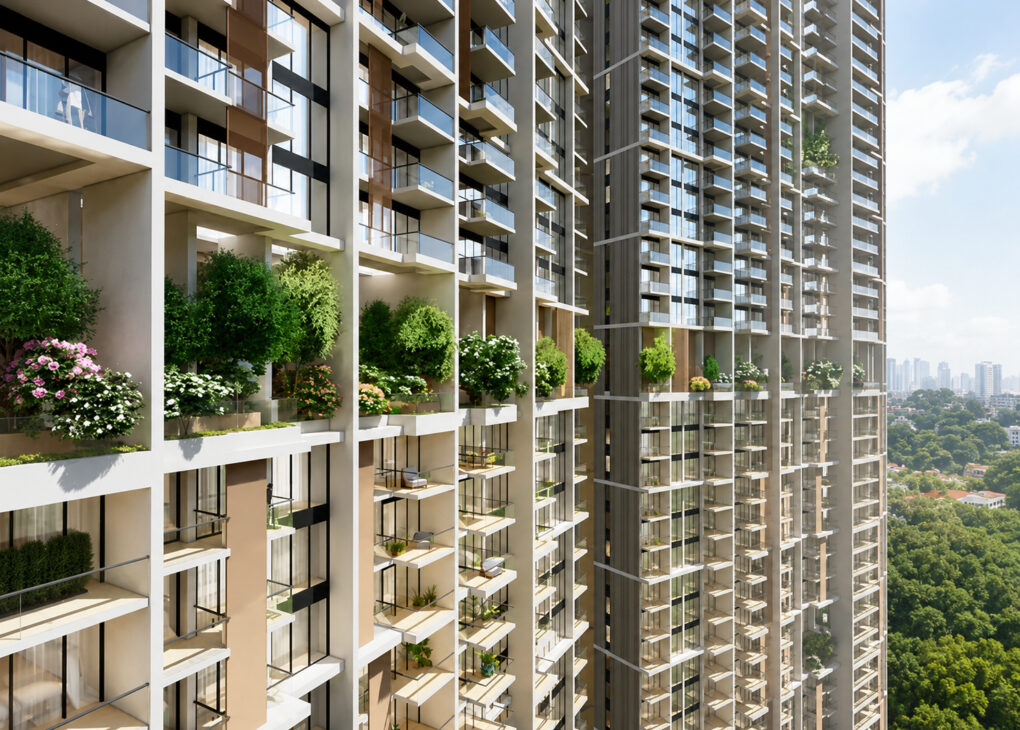
Straight lines, repeated modules, and green areas mark the development
Avenue South Residences bets on straight lines, modular organization, and punctual landscaping. The proposal combines construction efficiency with a contemporary architectural image.
The project also highlights the advancement of industrialized construction in tall buildings. Therefore, the case of Singapore should serve as a showcase for the use of prefabricated modules in large residential projects.
According to information released by ArchDaily, Architectural Digest, ADDP Architects, and Building and Construction Authority, the project brings together scale, technical repetition, and prior finishing as central elements of the work.
With completion expected in 2026, the 56-story towers are set to establish Avenue South Residences as a landmark of prefabricated high-rise construction.




Be the first to react!