





 Portuguese
  English
  Spanish
  3 min of reading
  0 comments


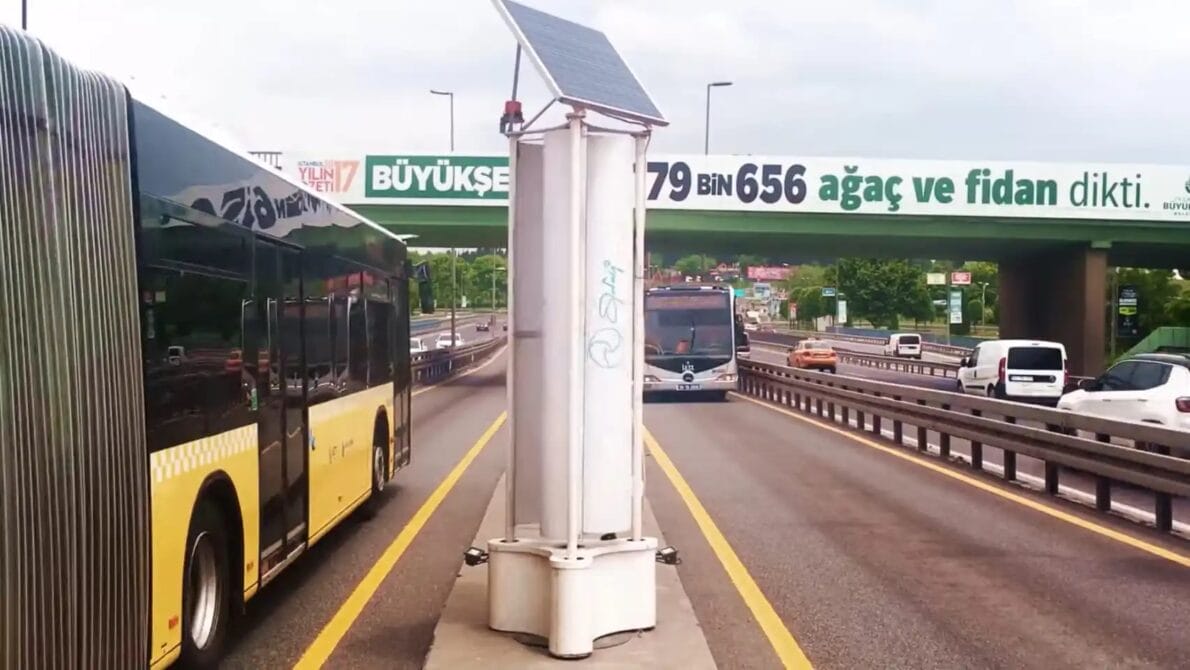
Company Develops New Technology Capable of Generating Electricity Through Car Movement. The Innovative Highway Wind Turbine Can Generate Up to 6 MW When Used in Combination.
England is leading the way and is installing wind turbines that generate clean, renewable electricity on motorway lampposts in England. The major innovation is the design of the highway wind turbine, which harnesses the wind produced by vehicle movement to spin the blades and generate electricity, without relying on natural wind.
Understand How the Highway Wind Turbine That Does Not Rely on Natural Winds Works
Barry Thompson, CEO of Alpha 311, the company that developed the project, guarantees that the highway wind turbine is a unique solution that can be a response to generate a nearly endless supply of clean, renewable electricity. According to the manufacturer, turbines mounted on lampposts along a highway could collectively generate around 6 MW, enough energy to supply a small community.
Barry Thompson’s home is powered by prototypes of the turbine. The executive explains that when he stands next to a highway and a truck passes by, you can feel the air it displaces. The company is responsible for capturing the energy from that wind.
-
Giant of the winds in Rio Grande do Norte: Serra do Tigre Wind Complex receives new investments and accelerates the expansion of clean energy generation to supply millions of Brazilian homes.
-
Petrobras reaffirms its commitment to the market and ensures that it will carry out the energy transition safely to maintain national sovereignty.

-
Researchers discover a possible hydrogen deposit of up to 46 million tons beneath an ancient coal basin, and the volume could exceed half of the entire global production.

-
China bets on the Fishery-PV model and transforms fish farms into giant solar plants, covering ponds with panels that generate energy while utilizing the same space for large-scale aquaculture production.

As an example, the CEO cites Thanet Way, a road less than 30 km long with 1,114 lighting poles. The wind turbines could be installed in the central part of the highway and generate electricity from the wind created by cars passing in both directions.
For Thompson, electricity generation would utilize infrastructure that already exists on-site. He states that the company is not installing huge turbines in the landscape; it is simply taking advantage of what is available.
How Much Does Each Wind Turbine Used on Highways Cost?
The new energy capture modality could help the United Kingdom achieve its goal of being carbon-neutral by 2050. The Alpha 31 vertical axis wind turbine is smaller, cheaper, and easier to install than traditional wind energy turbines.
Each turbine built by the company stands 2 meters tall and currently costs around £26,000 to manufacture, equivalent to R$ 190,000 in direct conversion. These devices can initially be used to power the lights to which they are connected. They can generate as much electricity as 21 square meters of solar panels.
According to the CEO of Alpha 311, in the early stages of the project, the company was only looking to power lamp posts on highways and streets.
However, the highway wind turbine has already exceeded that expectation. Currently, the team is forming partnerships with train lines, e-bike charging stations, community shelters, maritime distribution companies, and even 5G networks.
Additionally, the company is in negotiations with authorities to test the technology on more roads in the United Kingdom. Some smaller cities in the USA are also already testing these turbines.
Other Initiatives to Generate Energy in the Urban Environment
In addition to this highway wind turbine, England also has a street that generates electricity from pedestrian footsteps. The world’s first “Smart Street” was launched in London by the technology company Pavegen.
Referred to as a smart street, the initiative spans 107 square meters and was developed with kinetic paving panels that generate electricity from pedestrians’ footsteps.
Users can also download an app providing information about the amount of energy being generated from their efforts, and in turn, vouchers and discounts at various stores are made available. To generate energy, the system uses electromagnetic induction generators.
When the pavement is pressed down by a person’s weight, energy storage flywheels spin to convert kinetic energy into electrical energy.









-

Uma pessoa reagiu a isso.