Portuguese
  Spanish



China Just Installed The Largest Energy Storage Flow Battery in The World
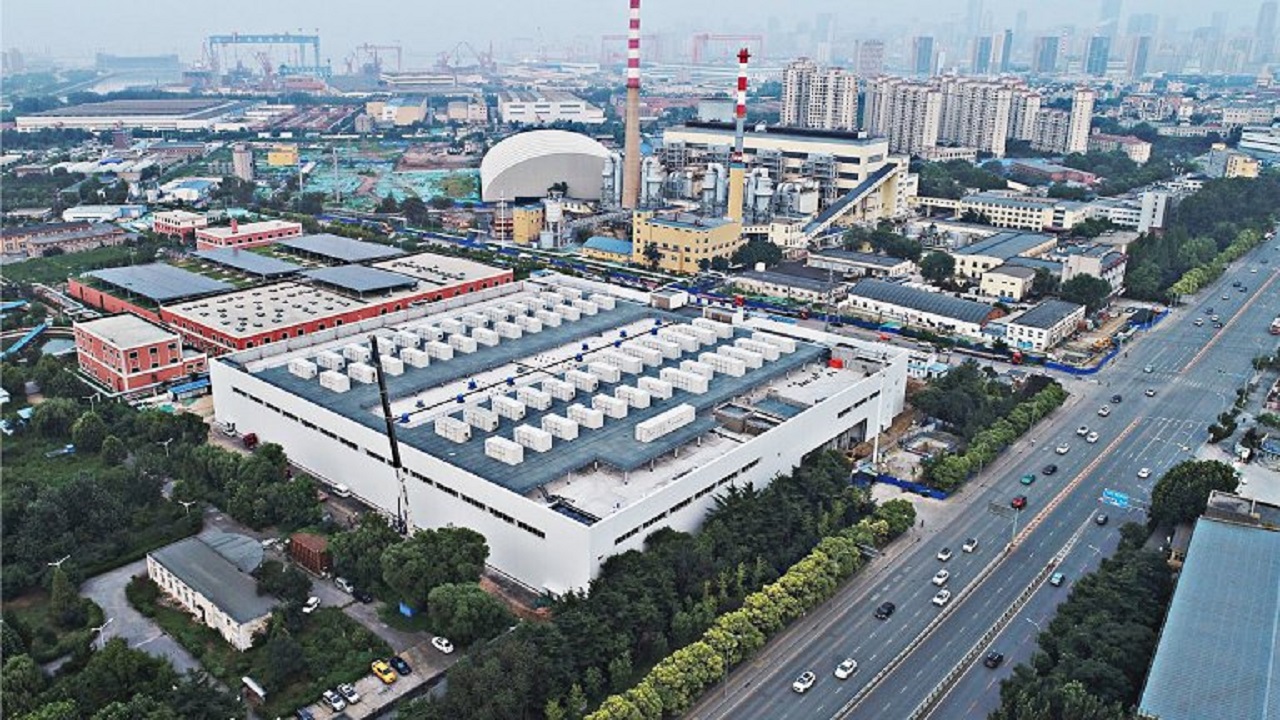
Last week, China connected the largest power and energy storage flow battery ever produced to its electrical grid. The flow battery, called Dalian, has a capacity of 100 MW, which will be used to smooth out the peaks and valleys of renewable energy generation, providing energy at a constant level even when the wind isn’t turning the wind turbines or at night when the solar panels are generating energy.
China’s Energy Storage Project Could Reach 800 MWh
The flow battery project was developed by the group of Professor Dalian Xianfeng Li, from the Chinese Academy of Sciences, and the system was created and integrated by Rongke Power Co.
The stage that was inaugurated now by scientists is just the first one, for demonstrating large-scale chemical energy storage. The complete project is expected to reach 200 Megawatts or 800 megawatt-hours of electricity.
-
A newly discovered caterpillar in Hawaii wears the remains of its prey that it devoured as a macabre armor, stitching bones and insect shells to its own back for camouflage.

-
She heard for decades that space was not a place for women, became a pioneer in aviation, was part of the Mercury 13, and at 82, finally traveled with Jeff Bezos before dying at 87.
-
Scientists investigate microplastics in the airways of patients with sleep apnea and reveal a new focus for research on environmental pollution, human exposure, and possible impacts on breathing quality.
-
For the first time, scientists have seen the ocean floor open up in real-time—plates moving apart by two meters in a few days and 160 million cubic meters of lava emerging on the seafloor.



In this first stage, the battery capacity is 100 MW/400 MWh. Based on the average daily electricity consumption in China of 2 kWh per capita, the flow battery could meet the energy needs of 200,000 inhabitants per day, thereby reducing the pressure on energy supply during peak periods and improving the reliability of electricity supply.
Energy storage technology can help power systems meet peak demands and is also particularly essential for facilitating the use of sustainable energy.
Flow Battery Uses Vanadium for Energy Storage
The Dalian installation in China uses vanadium flow battery energy storage technology. Since electricity is chemically stored in tanks, expanding long-term storage capacity is merely a matter of adding more tanks, thus this technology is also called a flow battery.
The flow battery operates through a reversible process called intercalation, where positively charged zinc ions are oxidized at the negative metallic zinc electrode, travel through the electrolyte, and insert themselves between the layers of vanadium oxide. This generates a flow of electrons in the external circuit, developing an electric current.
During charging, the reverse process occurs. This is a well-known and relatively simple technology; however, it is not considered the most environmentally friendly due to its chemically aggressive compounds.
Aneel Approves First Energy Storage Project in Brazil
The Brazilian National Electric Energy Agency (ANEEL) approved last year the first large-scale lithium battery energy storage project in the Brazilian transmission system.
The initiative is led by Isa Cteep, which will invest about R$ 146 million in a 30 MW energy storage system that will be installed at the Registro (SP) substation, aimed at supplying the Southern São Paulo coastline.