






 Portuguese
  Spanish


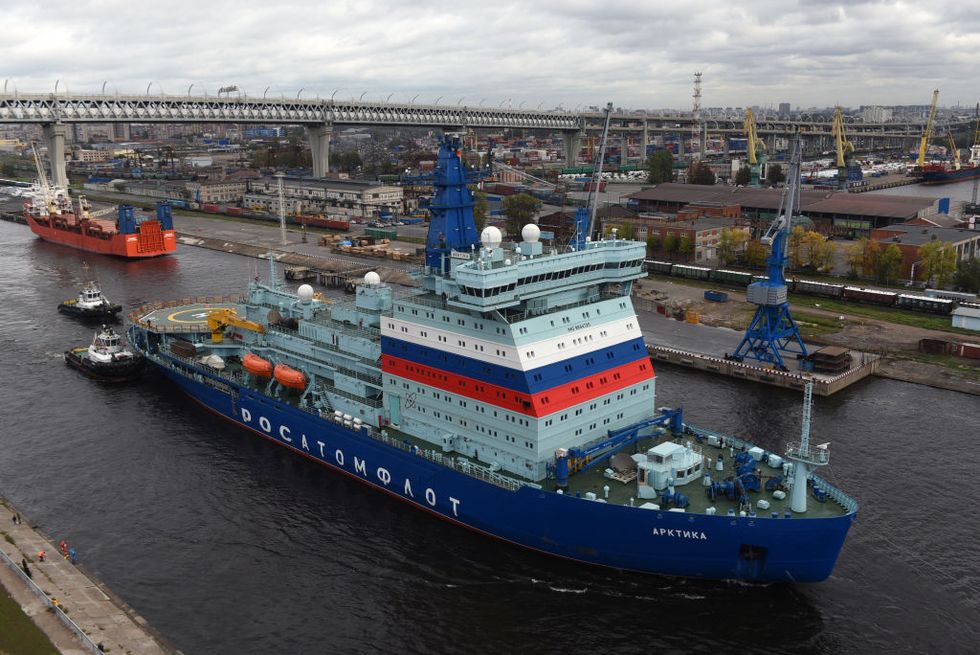

The Most Powerful Nuclear Icebreaker in the World, Akrtika, Began Operations on Wednesday in the City of Murmansk, Northern Russia.
The Russian flag was raised on the ship in the presence of Prime Minister Mikhail Mishustin. Earlier today (21), the government stated in a release that Russian Prime Minister Mikhail Mishustin signed a decree allowing the Arktika to enter into operation. “This decision will enable the icebreaker to begin operations in the waters of the Northern Sea Route starting in December 2020,” the government statement says.
Read Also
- Meet the Haliade-X Wind Turbine That Will Provide Power to the Largest Offshore Wind Farm in the World
- Fuel Ice Will Be the Energy of the Future: China Has Finally Managed to Extract This New Source
- BR Distribuidora Donates Over 16,000 Online Medical Consultations for Truck Drivers Across the Country
- Despite Quarantine Due to Coronavirus, Semalo Factory Maintains Over 200 Employees
The Largest and Most Powerful Ship in the World
According to the government, a new engine with increased capacity will be installed on the starboard side of the Arktika in 2021. The Arktika successfully arrived at the port city of Murmansk, to the north, after completing the final phase of its sea trials. Also on Wednesday, a ceremony will take place to mark the delivery of the ship from United Shipbuilding Corporation to Rosatom, the Russian state nuclear agency.
The Arktika, one of the classes of the Russian icebreaker fleet of Project 22220, will be able to escort convoys of ships in Arctic conditions, breaking through up to 3 meters of ice.
-
Eni Acquires 25% Stake in Chilean Lithium Project, Plans to Invest Up to $225 Million in Eco-Friendly Extraction Method

-
French Brand Transforms 6 Million Brazilian PET Bottles into Sustainable Sneakers for Global Fashion Market
-
Abandoned Factory in Rio’s North Zone Becomes Urban Hazard with Standing Water and Debris

-
The U.S. Navy Conducts Submarine Tests in Idaho Lake to Detect Underwater Noises Hidden by the Ocean


The icebreakers are designed to accompany ships transporting hydrocarbons from the Yamal and Gydan peninsulas and the Kara Sea shelf to markets in the Asia-Pacific.
Ice Tests Were Recently Conducted
“Ice tests are still ahead, probably this year, because the ice tests now did not work, the thickness of the ice was 1.1 to 1.2 meters. It was thin and loose, the icebreaker encountered no resistance,” says Shchapin.
He adds: “We tried to find a three-meter thick ice block, but they did not find it.” Shchapin did not provide details on where to find three-meter thick ice. Currently, the entire Northern Sea Route north of Siberia, from the Kara Sea to the Bering Strait, is in open water.
The polar ice cap in the northernmost region has never been reported as being weaker and thinner than this year. Multi-year sea ice is currently only found in the waters north of Canada, Alaska, and Greenland. Departing from the Baltic Shipyard in Saint Petersburg on September 22, Arktika sailed directly to the North Pole before heading south and stopping at its new port, Murmansk, on October 12.







