





 Portuguese
  English
  Spanish
  5 min of reading
  2 comments


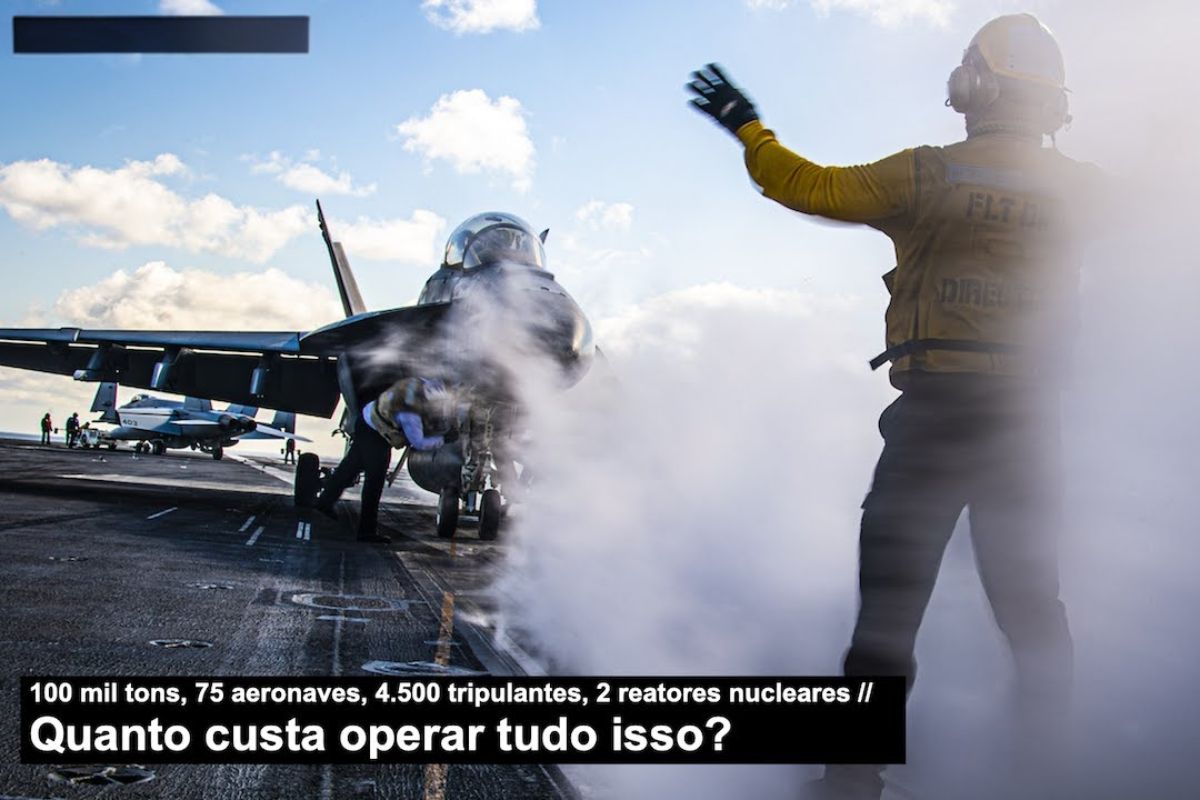


Displacement Above 100 Thousand Tons, Air Wing with About 75 Aircraft, Two Nuclear Reactors and Up to 4,500 Military Personnel On Board Make a Nuclear Aircraft Carrier One of the Most Expensive Military Structures in the World to Keep Active, Especially in an Operational Scenario in the Caribbean
A nuclear aircraft carrier moving to the Caribbean, like the Gerald Ford class cited in the database, represents not only symbolic power. It represents a daily expense starting in the millions of dollars and varying according to the level of flight activity, the mission intensity, and the size of the strike group accompanying it. The presence of a nuclear aircraft carrier off the Venezuelan coast, for example, involves costs for food, logistics, aviation fuel, ammunition, and support, even in peacetime.
The central point is that the 100,000-ton hull and being nuclear do not make operation cheap. On the contrary. The nuclear reactor allows the ship to avoid refueling for decades, but the entire ecosystem surrounding the nuclear aircraft carrier remains dependent on fuel, parts, and highly trained personnel. Just the ship, in basic operation and without intense use of embarked aviation, can exceed 2 million dollars a day, a value that quickly grows when the mission requires constant flights.
Why the Nuclear Aircraft Carrier is Expensive Even in Transit
A nuclear aircraft carrier moving from the Atlantic to the Caribbean operates in a mode of reduced activity, but never in a cheap mode. In transit, the navy maintains routine flights for pilot training, early air control, and environmental surveillance, which already consumes part of the aviation fuel JP-5 stored on board.
-
A forgotten cord on the floor of a basement in Vienna leads a plumber to a box containing 30 kilograms of gold with Mozart’s face, hidden before World War II. The treasure, worth 2.3 million euros, was just centimeters away from a worker who ignored the sign a day earlier.

-
A couple buys an old chalet, breaks the kitchen floor for renovation, and finds over a thousand coins of gold and silver hidden since the English Civil War over 4 centuries ago.

-
Rigid bags with their days numbered: new trend prioritizes comfort in 2026.

-
YouTuber creates an excavator equipped with a giant 4.5-meter sword to challenge his brother to a rematch, and the invention quickly goes viral on social media.


Even so, this is the moment of lowest cost, because the focus is on efficient navigation, regular maintenance, and crew support.
The issue is that the nuclear aircraft carrier does not navigate alone. In a real scenario, the ship is the core of a strike group that includes destroyers, cruisers, submarines, and support ships, raising the total number of personnel to around 7,500 military personnel.
When considering the entire group, the daily cost becomes more sensitive to fuel, parts, and personnel. In transit, this package can range from 2 to 4 million dollars a day, just to keep the fleet moving safely.
Feeding and Logistics for 4,500 People Every Day
Maintaining about 4,500 crew members on the nuclear aircraft carrier means serving approximately 18,000 meals a day, within the navy’s nutritional standard, with constant supply of meats, vegetables, fruits, and desserts.
The United States Navy itself estimates that direct food costs for the large ship are in the range of 50 to 55 thousand dollars a day.
The problem is that this number is just the baseline. When adding the transportation of fresh food, at-sea replenishment, and the need to maintain the supply rate every three or four days, this daily cost rises to the hundreds of thousands of dollars.
Feeding thousands of military personnel at sea, with strict caloric standards and freshness requirements, is one of the most expensive and non-negotiable routines of a nuclear aircraft carrier.
Embarked Aviation: The Point That Makes the Bill Explode
What truly transforms the nuclear aircraft carrier into a very expensive operation is its primary function, which is to launch and recover aircraft. In peacetime, JP-5 consumption is around 20,000 gallons per day, focused on training and surveillance.
In an operational scenario or intense exercise in the Caribbean, with frequent takeoffs of fighter jets, early warning aircraft, rescue helicopters, and even refueling planes, consumption can easily exceed 150,000 gallons per day.
The navy’s own data indicates that, with this level of flight activity, just the fuel for the aircraft can exceed 350,000 dollars in a single day.
And this does not account for the accelerated wear on equipment, the need for more maintenance cycles, and the use of live ammunition in case of advanced exercises. The more the nuclear aircraft carrier does what it was designed for, the more expensive its stay in the theater of operations becomes.
Ammunition and Tactical Support Increase the Combat Day Cost
In combat operations, high-complexity exercises, or show of force, the nuclear aircraft carrier does not just launch the fighter jet. It launches the fighter, the rescue helicopter, the early warning plane, the electronic warfare vector, and, if necessary, the aircraft for in-flight refueling.
All this in the air at the same time, ensuring security and situational awareness of the strike group.
When there is actual use of armaments, the daily cost starts to depend on the type of ammunition used. Air-to-air missiles, cruise missiles launched by escort ships, and precision bombs have unit prices that reach hundreds of thousands of dollars.
On days of intense operations, this cost alone can total millions. That is why internal estimates indicate that the cost of a strike group centered on a nuclear aircraft carrier can exceed 20 million dollars a day when everything is active.
Why the Caribbean is Not Synonymous with Cheap Operation
Operating in the Caribbean is often seen as simpler than operating in the Middle East or the Pacific, but the nuclear aircraft carrier must maintain the same level of readiness. It is necessary to move tankers, ammunition transport ships, and support vessels to the area of interest.
Each at-sea replenishment requires planning, escort, and a safety window. Each replacement part arriving by helicopter has an associated logistical cost.
Furthermore, the presence near the Venezuelan coast cited in the database requires constant surveillance and area control flights, which increases fuel consumption and flight hours. The theater of operations changes, but the readiness requirement remains, so the daily cost does not drop significantly.
Maintaining a nuclear aircraft carrier operating in the Caribbean is more than supporting a large ship. It is sustaining a floating war ecosystem that eats, flies, trains, replenishes, and fires every day. Even in transit, the bill is already in the millions.

In an operational scenario, the daily value can reach around 20 million dollars, especially when the entire air wing is activated.
What part do you think weighs more in the cost of a nuclear aircraft carrier in the Caribbean: the daily operation of embarked aviation or the logistics of feeding thousands of military personnel at sea? Comment.








Most of your numbers are incorrect. You need to proofread this article and fix all the numbers.
100,000 tons… get your facts right.