





 Portuguese
  English
  Spanish
  5 min of reading
  1 comment


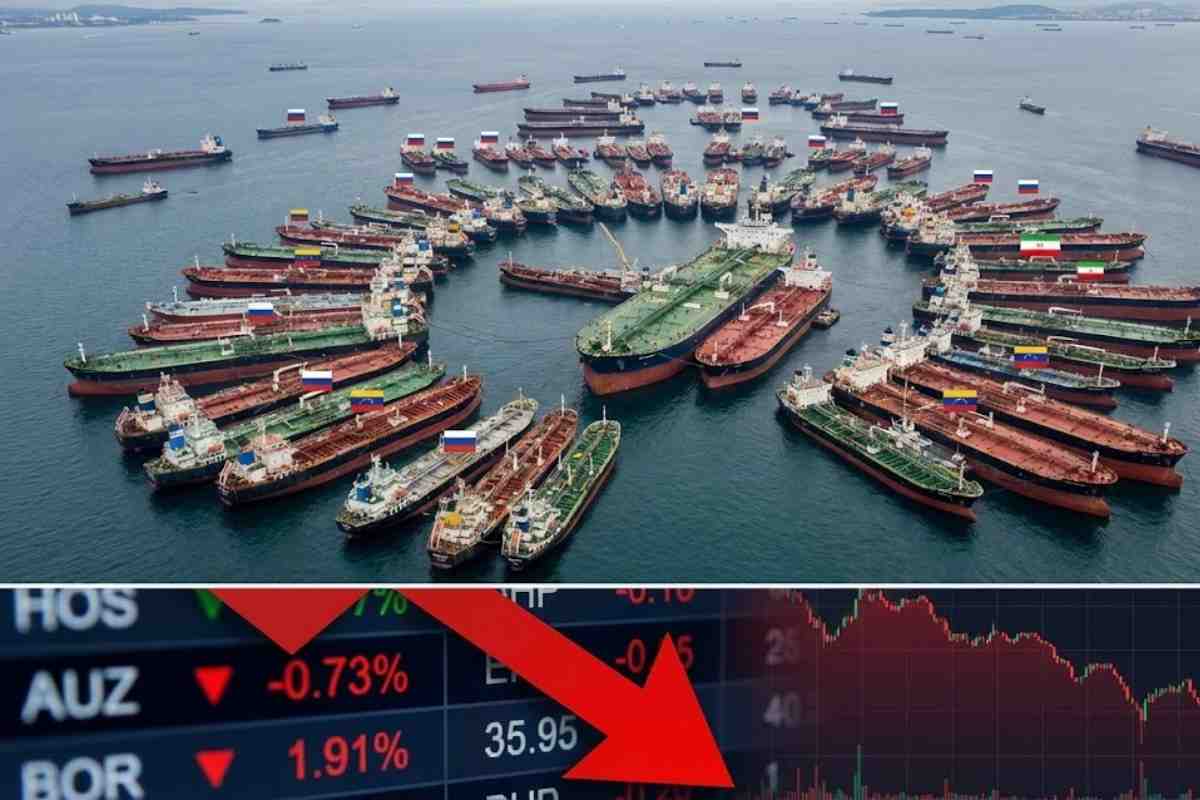


With 1.4 Billion Barrels of Oil Stopped at Sea, Sanctions Against Russia, Iran, and Venezuela Create a Ghost Stock That Confuses Global Supply Calculations, Hinders Business with India and China, and Can Trigger a Brutal Drop in International Brent Prices, Shaking All Energy Geopolitics.
More than 1.4 billion barrels of oil are today literally on the water, a surplus of 24% above the average for this time of year between 2016 and 2024, fueled by sanctions imposed in October against major Russian producers and new restrictions on Asian terminals receiving Iranian oil. The result is a sea of loaded ships with no clear destination and explosive potential for prices.
At the same time, Brent has been unusually stable for about two months between US$ 61 and US$ 66 per barrel, while the market tries to decide whether this entire volume should be counted as available supply. If the stuck surplus migrates to onshore stocks, the floor for this price could simply disappear.
Record Surplus of Barrels of Oil on the Water
According to Vortexa, a company specialized in tracking shipping flows, there are currently 1.4 billion barrels of oil “on the water”, a term used to define cargoes en route to a port or waiting for a buyer offshore.
-
Offshore industrial demand in Macaé skyrockets with the recovery of oil and gas and could grow by up to 396% by 2026 in the Campos Basin.
-
Offshore industrial demand in Macaé surges with the recovery of oil and gas and could grow by up to 396% by 2026 in the Campos Basin.
-
Brazilian giant expands borders in the Southeast: Petrobras confirms new oil discovery in ultra-deep waters in the pre-salt of the Campos Basin.

-
Alert in the global energy market: Severe tropical cyclone hits the coast and disrupts gas production at major plants in Australia, threatening global supply.


This volume is 24% higher than the average for the same period between 2016 and 2024, a jump that completely deviates from the recent historical pattern.
This sea of barrels does not come from a single origin. Vortexa itself identifies a 16% annual increase in the volume shipped by traditional producers, precisely at the moment when OPEC+ is unwinding some production cuts that had been supporting prices.
At the same time, exporters outside the cartel, such as Brazil, Guyana, and the United States, have also increased supply, putting even more barrels of oil on the ships that traverse the world’s main energy maritime corridors.
Dark Barrels: The Oil Under Sanctions That No One Knows How to Count
The most sensitive component of this surplus is made up of the so-called “dark barrels”, a label used for oil sailing under sanctions, with origin or destination deliberately obscured.
In just one year, the volume of dark barrels at sea has grown by 82%, with a strong acceleration in the last three months, especially from Russia, Iran, and Venezuela.
According to the consultancy Kpler, 15% of the entire global oil supply is currently under some form of sanction, a large enough share to be ignored by supply and demand models.
The dilemma is that, without clear buyers and defined routes, a significant portion of these barrels of oil remains stranded, creating an invisible stock that threatens prices but does not appear in traditional market indicators.
Analysts are divided: some argue that these sanctioned volumes should be excluded from available supply calculations since they do not find buyers easily.
Others warn that, as soon as an alternative route emerges, these barrels of oil could flood the market all at once, crashing Brent in a sudden movement.
Sanctions, India, China, and the Russian Shadow Fleet
Geopolitics explains much of the confusion. India and China, traditionally the largest buyers of Russian oil, have been avoiding new purchases since the White House sanctioned producers Lukoil and Rosneft in October.
At the same time, the United States targeted a terminal in the Chinese province of Shandong that was receiving Iranian oil, tightening the noose on flows considered sensitive.
These sanctions did not prevent Russia and Iran from continuing to pump barrels of oil, but they made it much harder to find buyers willing to take on the risk.
The practical result is a growing line of ships that remain at sea for days or weeks, waiting for a last-minute deal or for a triangulation that allows masking the origin of the oil.
There is an important precedent. In previous rounds of sanctions against Moscow, Russian oil eventually found a destination after a few months, when the so-called “shadow fleet” of the country established new logistics chains, often combining ship-to-ship cargo exchanges and shell companies to sign contracts.
Last week, during a visit to New Delhi, Vladimir Putin promised “uninterrupted” fuel shipments to India, which the market reads as another sign that Russia is trying to reactivate or expand export channels to India and China.
If successful, the demand for barrels of oil from non-sanctioned producers may drop, increasing bearish pressure on Brent and intensifying global competition for customers.
China Transforms Surplus into Silent Strategic Reserve
Another factor that helps explain why the increase in supply has not yet driven prices down lies in Beijing.
China has been putting about 290,000 barrels per day into storage this year, according to Rystad Energy. Instead of letting the surplus compete for space in commercial terminals, the country converts some barrels of oil into a sort of energy insurance.
Global tensions and the risk of import disruptions have led the Chinese government to treat these stocks as strategic reserves, which do not move as frequently as commercial inventories and therefore impact daily price formation less directly.
Rystad estimates that China has accumulated 97 million barrels this year. If half of that had appeared in major pricing centers monitored by the OECD, the picture would be very different.
In the case of Cushing, Oklahoma, this extra volume would have raised local stocks to around 70 million barrels, a level slightly above the one that helped push WTI futures contracts into negative territory in April 2020, when sellers had to pay to get rid of barrels without storage space.
In other words: a significant portion of the supply shock is being hidden inside Chinese tanks, which helps keep Brent seemingly calm, although the system is under significant stress.
An Artificially Stable Price on a Fragile Ground
The combined effect of sanctions, the rise of dark barrels, and the Chinese storage strategy is a market where prices seem stable, but the balance is precarious.
Brent has remained for two months between US$ 61 and US$ 66 per barrel, an unusual behavior for a scenario of such uncertainty.
As long as the surplus remains mostly on the water or in opaque strategic reserves, the market can pretend that nothing extraordinary is happening.
However, any sign that a significant portion of these barrels of oil is migrating to commercial stocks on land could trigger alarms.
In that case, the current price floor could quickly give way, opening space for a violent correction.
For refineries, governments, and consumers, the picture is ambiguous. In the short term, there is a kind of “insurance” built into the existence of so many stranded barrels of oil, ready to alleviate supply shocks.
In your opinion, will this sea of stranded barrels of oil abruptly drive down Brent prices, or will the market still find a way to silently absorb this gigantic surplus?









Não acredito