





 Portuguese
  English
  Spanish
  5 min of reading
  0 comments


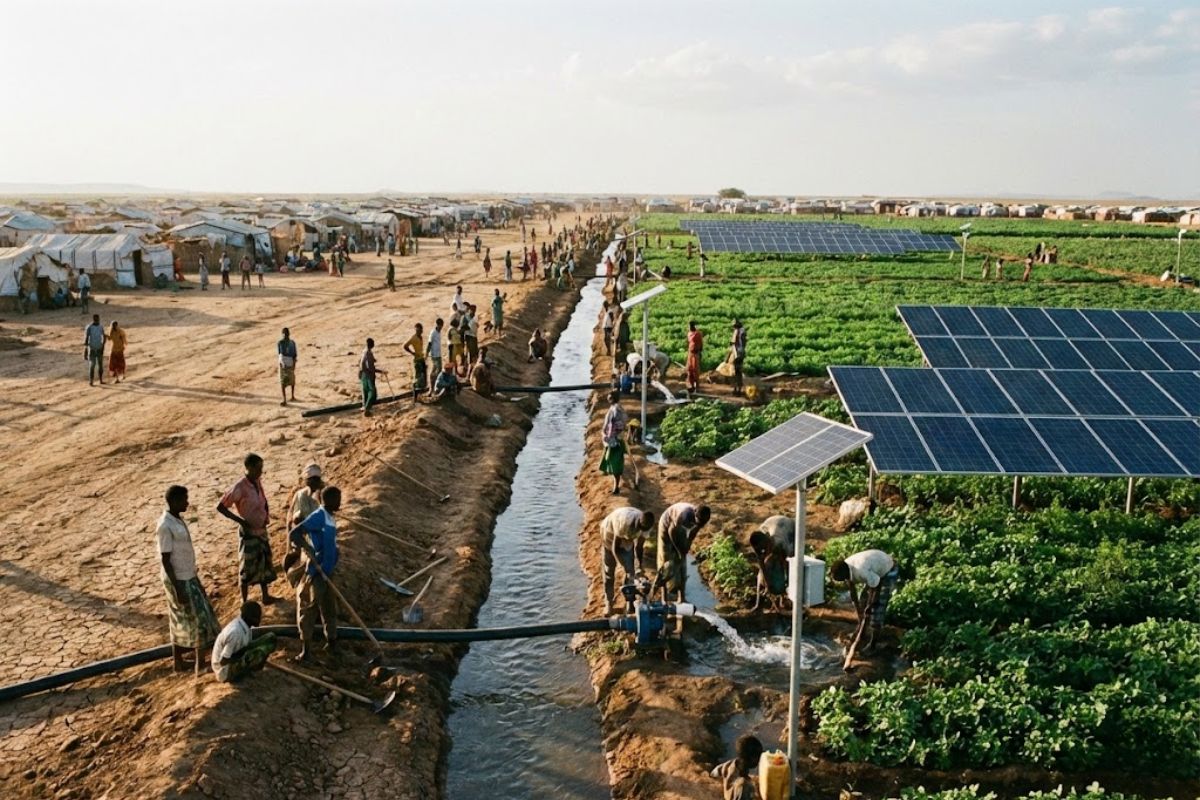
In Melkadida, In Southeast Ethiopia, The Pressure of 200 Thousand Refugees on An Already Fragile Desert Seemed to Forecast Hunger, Conflict and Irreversible Erosion, But An Arrangement Between Local Communities, Mixed Cooperatives, Solar Irrigation and Soil Management Recovered More Than A Thousand Hectares and Rewrote the Sustainable Regional Economy There.
In the semi-arid desert of Melkadida, in southeastern Ethiopia, the arrival of more than 200 thousand Somali refugees between 2009 and 2011 put pressure on a landscape that was already living on the edge: little rainfall, temperatures above 40 °C, soil with very low organic matter, and virtually non-existent infrastructure. The initial scenario brought together all the factors of a prolonged crisis.
The change came when an emergency response began to be treated as a long-term strategy. With irrigation channels, solar-powered pumping, soil restoration, and mixed cooperatives between refugees and host communities, the region shifted from a trajectory of continuous degradation to a cycle of agricultural production, local income, and social reorganization.
When 200 Thousand People Arrive In An Already Strained Territory

Before the peak of forced displacement, the region was already facing severe signs of environmental exhaustion. Low annual precipitation, often below what is necessary for rainfed agriculture, combined with extreme temperatures, made the soil more susceptible to compaction, erosion, and loss of fertility. The problem was not just a lack of water; it was the soil’s inability to absorb and retain water.
-
Friends have been building a small “town” for 30 years to grow old together, with compact houses, a common area, nature surrounding it, and a collective life project designed for friendship, coexistence, and simplicity.

-
This small town in Germany created its own currency 24 years ago, today it circulates millions per year, is accepted in over 300 stores, and the German government allowed all of this to happen under one condition.

-
Curitiba is shrinking and is expected to lose 97,000 residents by 2050, while inland cities in Paraná such as Sarandi, Araucária, and Toledo are experiencing accelerated growth that is changing the entire state’s map.

-
Tourists were poisoned on Everest in a million-dollar fraud scheme involving helicopters that diverted over $19 million and shocked international authorities.


With the rapid growth of the fields around Dollo Ado, the pressure for firewood, grazing, and water increased at a pace far exceeding the local capacity for replenishment.
Trees were cut down, ground cover diminished, and tensions between residents and newcomers intensified. In this context, the desert was advancing not only due to the climate but also due to an accumulation of immediate survival decisions.
The Turning Point: Channels, Solar Energy, and Benefit Sharing

The turning point began with a long-term project funded by the IKEA Foundation, in partnership with UNHCR and Ethiopian authorities, with significant scale investment.

Instead of relying solely on spot assistance, the design included productive infrastructure: approximately 20 kilometers of irrigation channels and solar-powered pumping, a coherent solution for an area with many hours of sunlight and a distant electrical grid.
The technical choice came alongside a political choice: divide land, access, and results 50/50 between refugees and host community. This rule reduced the risk of economic exclusion on either side and helped to contain resentments.
In the desert, where resources are scarce and contested, this type of shared governance became as important as the physical work.
How the Soil Came Back From the Collapse Path to Producing Again

The recovery was not just about moving water from one point to another. In soils with less than 1% organic matter, infiltration is low and the surface tends to seal.
Without proper management correction, irrigation can even worsen the scenario due to salinization. Therefore, the technical package included crop rotation, returning biomass to the soil, and irrigation planning to reduce evaporation.

Over time, root systems and organic residues helped open up porosity in the ground, gradually increasing the capacity for infiltration and water retention.
This process made it possible to stabilize productive cycles in an arid environment and expand cultivation to more than a thousand hectares recovered. It was a step-by-step recovery, not an “instant miracle” in the desert.
From Survival to Income: Cooperatives, Markets, and Energy


With a more functional soil, 13 crops began to be planted, with cases of up to three harvests a year. Corn, onion, tomato, beans, sorghum, watermelon, and other crops changed the local economic logic: an area previously dependent on imports began to generate surplus and trade. Meanwhile, mixed cooperatives gained scale and social participation.
Another relevant axis was the management of invasive species transformed into fuel. Groups, including women’s cooperatives, began converting biomass into briquettes, reducing dependence on firewood and creating new income.
When environmental control becomes a viable economic activity, restoration stops relying solely on a project and begins to depend on continuous local interest. This was one of the elements that connected ecological recovery, domestic security, and financial autonomy.
What Satellites Registered and What the Numbers Really Show
Satellite images began to show, in a few years, a sharp contrast between areas previously classified as bare soil and zones with active agricultural coverage.
This “before and after” helped to prove that the intervention was not limited to discourse: there was observable territorial change. In academic evaluation, indicators also pointed to advances in income, productive cooperation, and financial inclusion for some participants.
At the same time, the results require a reading without euphoria. Not everyone kept the same pace: some cooperatives thrived more than others, governance was uneven in some areas, and many refugees continued to rely on food assistance.
The experience shows a real capacity for transformation in the desert, but also makes it clear that scale, stability, and institutional continuity are ongoing challenges.
The Political Legacy and the Risks That Still Surround the Model
The experience in Melkadida influenced broader debates about refugee policy in Ethiopia, with advances in rights and economic integration, including access to work, services, and formal instruments like bank accounts.
In the institutional field, the case reinforced the idea that refugees can act as economic agents rather than just recipients of aid.
But the future sustainability depends on critical variables. The local water system is linked to the behavior of the river that supplies the region, subject to climatic variability and upstream usage disputes.
If the flow significantly reduces, the entire productive arrangement of the desert is under pressure. In other words: the proof of concept has been given; the proof of permanence is still ongoing.
The story of Melkadida does not eliminate the harshness of the climate crisis nor simplify the drama of forced displacement.
What it highlights is that under extreme conditions, well-designed projects can combine engineering, soil science, social governance, and market to reduce vulnerability and rebuild long-term prospects.
Now it’s time for a concrete reflection: in your region, which resource today treated as a problem seasonal water, invasive biomass, degraded soil, or expensive energy could become a production base without increasing local conflict? And in your view, what should come first to work: infrastructure, rules for profit-sharing, or access to market?










-

-

-

-

-

18 pessoas reagiram a isso.