





 Portuguese
  English
  Spanish
  7 min of reading
  0 comments


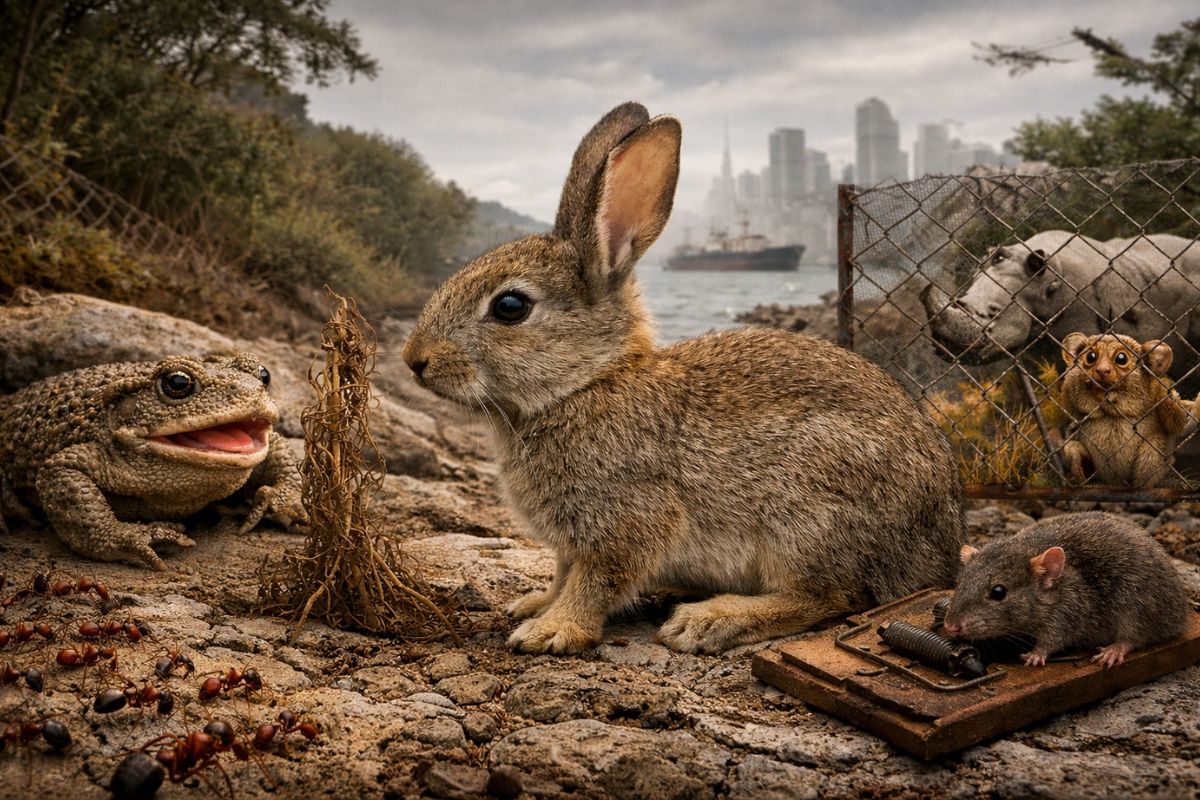
Study Maps 36 Species That Cause Ecological Collapses and Enormous Costs When They Invade New Territories, but Are Threatened or Unique in Their Native Area. With Data from InvaCost and IUCN Categories, Research Shows Why Controlling and Conserving the Same Fauna Requires International Coordination to Avoid Future Errors and Losses.
The 36 species gathered in the so-called conservation paradox expose a rare clash between ecology, economy, and environmental politics. In several countries, they are treated as pests for establishing themselves outside their native range and negatively impacting local biodiversity, paving the way for chain damages that disorganize entire habitats and require costly containment, control, and removal responses.
At the same time, in the original cradle of these same 36 species, the reality can be the opposite: some appear as vulnerable, endangered, or critically endangered in global assessments, while others, even if not officially threatened, are considered priorities due to their evolutionary or ecological characteristics so unique that losing them would mean irreversibly impoverishing biological diversity.
What Makes a Species “Invasive” and Why This Becomes a Global Problem
An invasive exotic species is one that can establish itself in nature outside its native distribution area, whether by accidental or deliberate introduction, and begins to cause a negative impact in the environment it invades.
-
Millions of people have been eating yam for centuries without knowing that this humble tuber contains a compound called diosgenin, which scientists have now discovered can improve memory and help control blood sugar levels.

-
Scientists from an international project drill 1,800 meters of ice in Antarctica using hot water and discover details about one of the most intriguing places on planet Earth.
-
Seen from space, a colossal volcano nearly 5,000 meters high in Russia has released 1,600 km of smoke over the Pacific, forming “devil’s horns” of lava and revealing the brutal force of the Ring of Fire.
-
Expedition 501: Scientists drill into the ocean floor and discover a giant reserve of fresh water hidden beneath the sea, extracting nearly 50,000 liters and revealing an invisible system that could reshape the map of water scarcity.


This impact does not need to be subtle: it can involve declines in native populations, alterations in food chains, changes in breeding areas, vegetation degradation, and reconfiguration of ecosystem functioning.
This type of invasion is treated as a significant driver of biodiversity loss. The point that makes the topic explosive is that the label “invasive” applies to a specific territory.
It does not automatically erase the ecological value of the species within its original habitat.
This is where the paradox arises: the same species can be “combated here” and “protected there”, without biological contradiction, but with enormous practical tension.
The Size of the Damages When Invasion Becomes a Public Cost
In addition to environmental damage, invasions can generate high economic costs, which appear both in direct damages and disruptions caused by invasive populations, as well as in management costs to contain, control, or remove them.
In the European Union, addressing invasive exotic species is guided by rules that define which organisms fall into the “concern” category and therefore have prioritized control measures.
In 2022, the cited list included 47 animals and 41 plants, and was later updated to a total of 114 species.
In this context, the total economic impact of invasives in the EU had already been estimated at around 12 billion euros per year, with expectations that more recent revisions would drive this value higher.
This backdrop helps explain why, when a species is labeled as “invasive” on one continent, the political impulse is often aggressive: quickly reducing the population, preventing expansion, and minimizing damage.
The problem is that within the scope of the 36 species, this response can collide with an uncomfortable reality on the other side of the planet.
How Scientists Arrived at the 36 Species and Why This Changes the Debate
The research identifying the 36 species aimed to capture a phenomenon that previous studies had already suggested, but without the same focus. Here, the approach was to intersect two different sources of information.
On one side, the researchers turned to the open database InvaCost, which compiles records of damages and management costs for invasive species by country over decades, covering the period from 1960 to 2020.
The scope is relevant because the database quantifies associated costs, and this changes the weight of the argument: it is no longer just “it does harm” but also “it costs a lot.”
On the other side, they compared this information with the IUCN Red List, which classifies species’ threat levels based on the status of wild populations within their native area, ranging from “least concern” to “extinct,” passing through categories like vulnerable, endangered, and critically endangered.
By analyzing 355 species of mammals, birds, and plants, the team identified a hard core of the paradox.
Within this universe, five mammals and five plants appeared as threatened and at the same time associated with relevant economic impacts as invaders outside their cradle.
It is from this type of collision that the central question arises: what to do when the species you are trying to eliminate in one place is precisely the one you need to save in another?
The “Conservation Paradox” and the Examples That Make the Topic Hard to Ignore

The study refers to this scenario as the conservation paradox because it demands two opposing actions regarding the same organism, depending on the territory.
In the invaded area, the priority tends to be containment and population reduction.
In the native area, the priority may be to preserve and recover declining populations.
An example cited is the European rabbit (Oryctolagus cuniculus), classified as endangered and simultaneously described as one of the most costly invasive species in the world within the scope of the analysis linked to InvaCost.
This type of case helps to understand why the debate is not only academic.
It places governments, scientists, and managers before decisions that seem simple in discourse but are complex in practice.
And it is here that the 36 species gain importance.
They do not represent “all invasives,” nor “all threatened.”
They represent a group in which any poorly coordinated policy can generate collateral effects in another country, whether due to pressure on populations or decisions that undermine conservation strategies on a global scale.
When a Species Is Not Threatened, but Still Becomes a Priority
The research also broadens the lens beyond “threatened with extinction.”
The argument is straightforward: prioritizing only already threatened species tends to be a reactive response.
A proactive approach, as presented, tries to prevent key species from collapsing, avoiding greater costs and challenges in the future.
At this point, two ideas come into play: evolutionary distinction and functional distinction.
Some species have few closely related evolutionary relatives, carrying a very unique evolutionary history.
Others have very distinctive functional characteristics, whether in diet, activity, or body mass, making them specific pieces in the functioning of ecosystems.
Following this reasoning, the study identified nine evolutionarily distinct invasive species and 17 functionally distinct ones.

The researchers did not find any species that were, at the same time, distinct in both aspects but pointed out one case that combines challenge and paradox: the koala (Phascolarctos cinereus), described as endangered and, at the same time, evolutionarily distinct.
Also appearing as examples of high cost and functional distinction are the American mink (Neovison vison) and the common starling (Sturnus vulgaris).
Adding up paradoxes, challenges, and combinations, the work arrives at a total of 36 species that require more careful management, precisely because the “manual” changes as the map does.
Why Control in One Country Can Hinder Conservation in Another
When a species is controlled in one place and protected in another, the risk is not only in “removing too much” or “leaving too much.”
The real risk is breaking coordination between decisions, creating a scenario in which management measures in invaded territories have unexpected consequences on conservation strategies in the native area.
The research suggests, for example, that individuals captured from invasive populations could, in some cases, be used to establish or complement wild populations within their native distribution area.
This would open up an alternative to removing individuals from already weakened populations in the original cradle.
Along the same lines, studies on invasive populations can produce valuable information on behavior, adaptation, and population dynamics, supporting conservation decisions.
The critical point is that this only works with communication and coordination among authorities and managers from different territories.
Without this, an aggressive control policy may eliminate the chance to take advantage of individuals, data, and learnings that would be useful for conservation elsewhere.
Limits of the Study and Why the Real Number May Be Higher
The work focused on mammals, birds, and plants because there was enough data for analysis within these groups.
Even so, the researchers point out an important structural limitation: InvaCost does not represent a complete survey of all costs of invasive species.
Costs were recorded for less than 10% of known invasive species, suggesting that many others may have generated significant economic impacts without being formally accounted for in the database.
There is also another caveat: the analysis considered the global conservation status of the species.
This leaves room for additional paradoxes, involving species that are not globally threatened but are threatened in specific parts of their geographic distribution.
In other words, the scope of the 36 species may be just the most visible part of a larger problem.
The researchers also note that other types of paradoxes may exist, including invasive species that generate economic benefits in addition to costs, such as the cited case of species associated with tourism revenue.
This complicates public policy design even further because the debate shifts from “damage versus protection” to “damage, protection, and economic interest at the same time.”
In the end, the 36 species become a practical warning: combating invasions may be essential to save local ecosystems and reduce billion-dollar bills, but in some cases, doing so without a global strategy may push the species toward collapse precisely where it should continue to exist.
Do you think it makes sense for a country to use captured individuals from invasive populations to help conserve the same species in its original habitat, or does that open too great a risk?









-

-

-

-

-

7 pessoas reagiram a isso.