





 Portuguese
  English
  Spanish
  9 min of reading
  0 comments


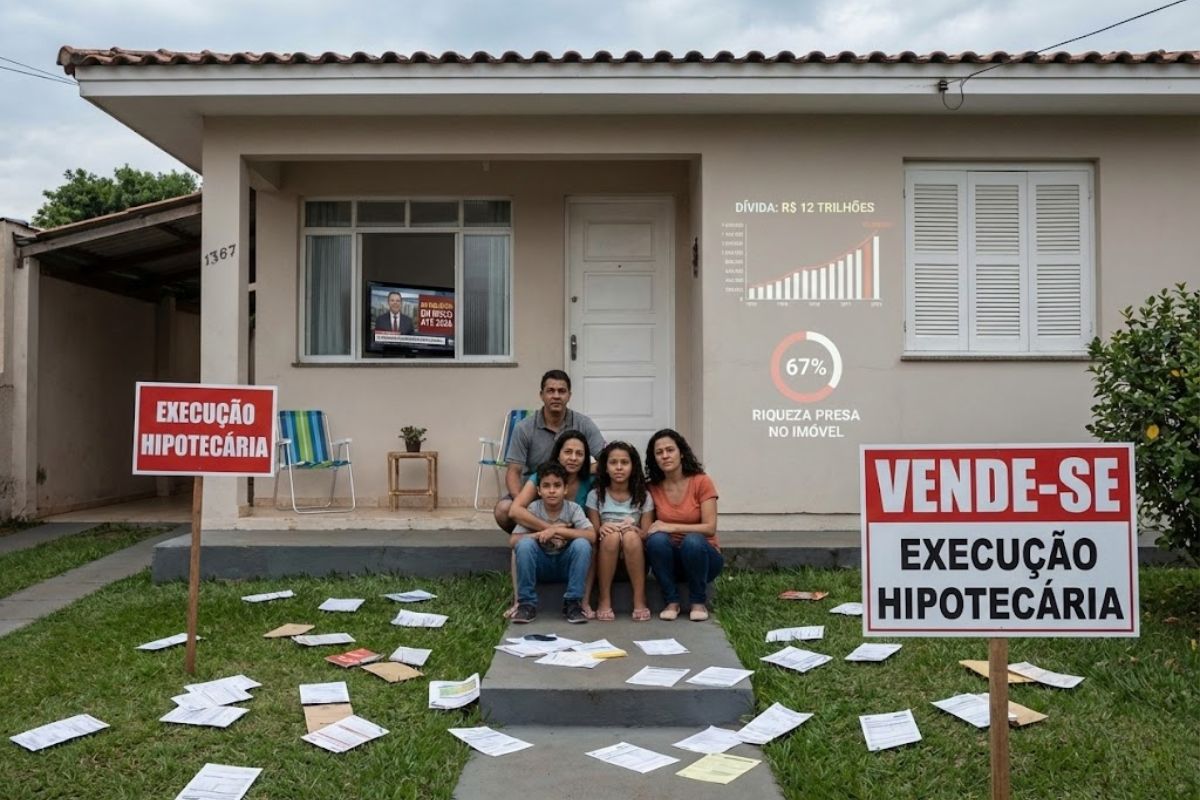
With US$ 12 Trillion in Mortgages, 67% of Average Net Wealth Trapped in Real Estate and Easy Credit Turning into Debt, the Leverage Ladder Advances to Trigger Stage. If Confidence Breaks, the Cascade Dismantles Prices in Weeks and Redistributes Fortunes Without Warning, with Banks Exiting Quietly.
The real estate is at the center of a trap that could hit 40 million homeowners by 2026, not due to irresponsibility, nor by wrong decisions, but because they believed in an “absolute truth” repeated over the last 4 years: that equity in the house always protects, always rises, always allows time to react.
The warning is described as a silent bomb within the American real estate market: US$ 12 trillion and a fact that “should send chills down your spine,” 67% of average net wealth trapped in the home itself. With all eggs in one basket, it only takes one trigger to start a cascade that transfers fortunes silently.
The Silent Bomb of US$ 12 Trillion and Real Estate as Trapped Wealth
The logic presented begins with a simple and uncomfortable fact: for the average American, 67% of net wealth is trapped inside their own home, that is, within a single asset, real estate.
-
Unemployment rises again to 5.8% at the beginning of 2026, raising alarms about the end of temporary positions and its impact on the Brazilian job market.

-
Document organization can cut invisible costs in small businesses, a simple step that prevents waste, rework, and losses in daily operations.

-
Chinese giant worth nearly R$ 4 billion that manufactures cables for electric cars, solar energy, and robotics wants to open a factory in SC.

-
Many employers do not know, but the law guarantees domestic workers a 25% increase in salary during trips, 50% for overtime, 20% for night shifts, and 17 additional benefits that can lead to labor lawsuits if not paid.


This creates a structural vulnerability because the wealth appears large on the screen, but only becomes real protection when there is a buyer, credit, and liquidity.
When the basket drops, there is no warning or time to react. The value of the property ceases to be the number displayed in apps and turns into what someone is willing to pay amidst the panic. The difference between price and value becomes the breaking point.
Leverage Ladder: The Sequence that Transforms Real Estate into a Trap
The narrative organizes the risk into the same historical choreography, called the leverage ladder, which appears in every relevant financial collapse and repeats in the same order.
The first stage is the foundation, when everyone feels rich: prices rise month after month, credit flows easily, refinancing turns into cash for consumption, approvals happen without criteria, and no one questions because “on the surface” everyone seems to be winning. This is not real growth; it’s leverage disguised as prosperity.
The second stage is the trap: for the public, the party continues, and the headlines reassure, but behind the scenes, those who understand the signs start moving toward the exits.
Tension forms when interest rates rise and real estate prices do not correct, creating an imbalance that seems stable until the exact second it stops being so.
The third stage is the trigger, which “never comes from where everyone is looking.” It seems small, isolated, manageable, until it is no longer.
The fourth stage is the cascade, when time compresses: what took a decade to build unravels in weeks, liquidity disappears, forced sales appear, credit freezes, and real estate ceases to be a safe haven to become the wrong asset at the wrong moment.
Debt, Mortgage, and the Role of the Treasury: Exit Signs Before the Public
Among the elements described as backstage signs, a specific movement appears: the Treasury absorbed between 2 and 3 trillion dollars in mortgage-backed securities in just 6 months.
At the same time, giant banks began quietly unloading entire portfolios of real estate.
The suggested reading is straightforward: it is not a coincidence, but a planned exit. The “smart money” would have already left, leaving the common public holding the weight of the property and the debt, while the machine continues to operate until the breaking point.
2021 and 2022: When Real Estate Rose Supported by Over 20 Trillion in Debt
The recent foundation of the ladder is described with a central number: between 2021 and 2022, mortgage debt in the United States exploded to over 20 trillion dollars.
Borrowed money fueling artificial optimism reinforces the thesis that all borrowed optimism has an expiration date because someone will want the money back.
In this picture, real estate does not grow through real wealth generation, but through leverage. And when leverage needs to be unwound, it tends to be undone in the most painful way for those trapped in the asset.
1926 in Florida: Real Estate as the True Beginning of the Crisis that Exploded in 1929
The cited historical sequence emphasizes that the pattern has already appeared three times in the last century. And the first lesson comes from a little-remembered detail: the crisis associated with 1929 did not originate on Wall Street, but in the Florida real estate market, 3 years prior, in early 1926.
The example is Miami in collective delirium: people were buying flooded lots without stepping on them; developers were selling plots through ads to buyers in New York and Chicago; the plan was to make a small down payment, transfer before the next installment, and profit.
In September 1926, a Category 4 hurricane hit Miami and forced many to face what they had bought: much of the land was permanently underwater, it was swamp.
Overnight, about 1 billion dollars in real estate value evaporated, equivalent to approximately 18 billion dollars in current values.
The dominant discourse treated it as a regional problem, but the businesses were financed by banks spread across the country. In 1929, over 600 banks had already collapsed even before “Black Tuesday.” The stock market crash appears as a final symptom, not a cause.
And there is a detail that reinforces the thesis of silent transfer: a year before the collapse of 1929, wealthy and well-informed people were already moving, with names transferring fortunes out of the system exposed to risk, migrating to gold and Treasury securities.
1933: When the Homeowner Realizes the Contract Becomes a Survival Instrument
The story also highlights a cruel delay between shock and loss: “the average citizen did not lose their home in 1929, they lost it in 1933,” 4 years later, when banks began demanding early payments to survive.
The point is that these people did not stop paying and did everything right. The problem arises when the system goes into panic and contracts stop being moral promises and become survival instruments. In this scenario, the homeowner’s property becomes a bank’s emergency exit.
1986 and Slow Poisoning: When Risky Real Estate Destroys Its Own Savings
The second repetition of the script is positioned in 1986, in a scenario of easy credit and optimism. Behind the scenes, however, hundreds of institutions would be rotting from within.
Regulators knew that nearly 500 savings and loan institutions were technically insolvent and would have hidden reports to avoid scaring the market, trying to let everything die slowly.
When the dam broke at the end of the 80s, the cost to taxpayers was described as massive, with thousands of institutions disappearing.
Mortgages that belonged to trusted local banks were sold to funds uninterested in human negotiation, and the rules changed overnight.
The imagery used is strong: the savings of families financed risky real estate projects that ultimately destroyed those savings.
The crisis ends because property prices in coastal regions continued to rise and masked the problem, like a disease that shifts places in the body.
2004 to 2008: Bank Leverage and the Collapse that Returns to Real Estate
The most recent dress rehearsal is associated with the collapse of September 2008 and is described as something that did not start with subprime mortgages but had a visible trigger. The origin pointed out is a regulatory change made in 2004, when the securities commission altered the net capital rule and allowed investment banks to leverage themselves in much greater proportions.
The presented numerical example is explicit: before, they could bet 12 to every real dollar; then, they began betting 30 to every dollar.
The system becomes a pile of matches, and the spark appears when low-quality mortgages are bundled into complex products and sold as safe investments to pension and retirement funds.
One case from 2006, when a major institution allegedly created a product designed to fail, sold to customers while the bank itself bet against it.
When the product imploded, clients lost everything, and the bank made billions, described as something documented in official hearings.
The final outcome is the link to real estate: tens of millions of Americans lost their homes in a few years, not due to irresponsibility, but because the system depended on infinite growth based on debt.
2020 to 2023: Cheap Money, 40% Rise, and Inflated Real Estate as a Response to the Crisis
After 2008, a response that amplified fragility: the Central Bank zeroed interest rates and poured trillions into the economy. Where did it go? Into assets, primarily into the real estate market. The debt crisis would have been fought with more debt.
Between 2020 and 2023, the first stage of the ladder is described as completed, the foundation. During the pandemic, mortgage rates plummeted to historically low levels, with cheap money and easy credit. In just three years, average home values are said to have risen by about 40%, at a pace unrelated to income, productivity, or real growth.
There is a direct example: anyone who bought a house for 300,000 at the beginning of 2020 began to believe it was worth more than 400,000 a few years later. The warning comes next: price is not value, and value only exists when someone can afford to pay.
2024: Affordability, Compromised Income, and Real Estate Trapped by Credit
An affordability indicator to show the tight squeeze coming for the homeowner. By the end of 2024, an average family would need to commit more than 40% of gross income just to maintain a median-priced home. Historically, this number hovers around 25%.
The interpretation is that this is not a healthy market, but a structural imbalance. The system stands as long as there is a constant influx of new buyers willing to accept increasingly worse conditions. When this source dries up, the trap closes.
Derivatives, Confidence, and Freezing: When Real Estate Loses Buyers Overnight
From there, the narrative shifts focus from what usually dominates the news to what it calls the hidden trigger: the derivatives market, a tangle of interconnected contracts based on promises of future payment. They function while there is confidence. When confidence breaks, everything freezes at once.
The explanation proceeds with a chain of dependency among banks: A depends on B, B depends on C, C depends on A. A single failed link can break the entire chain at once, not like a slow domino effect, but like an explosion.
In 2008, a major bank did not collapse because its mortgages went wrong that day, but because no one else trusted it could meet its commitments.
When confidence disappears, liquidity evaporates instantly. Banks stop lending and trading, credit freezes. And, as most real estate purchases depend on financing, without credit, there are no buyers. Without buyers, prices plummet.
Commercial Real Estate, Regional Banks, and the Cascade that Begins in the Corners of the System
Another growing problem silently: commercial real estate loans, empty buildings, unoccupied offices, and huge financings reaching maturity. When these assets are liquidated for a fraction of their original value, the losses enter directly into the balance sheets of the same banks securing residential mortgages.
Nothing would be isolated. The problems would start in regional banks, primarily those concentrated in commercial real estate.
And modern propagation does not occur in lines at the door, but in silent clicks on the cell phone, overnight, as thousands transfer money simultaneously.
Next, the tightening reaches the consumer: credit cards are delayed, small loans go unpaid, and people choose which bills to pay first. The mortgage becomes just another bill, by mathematics, not by morals.
The Silent Transfer: Why Real Estate Does Not Destroy Fortunes, It Moves Them
The closing of the logic is straightforward: in every crisis, fortunes are not destroyed, they are transferred. They leave the hands of those who believed nothing would change and go to those who read the pattern before the majority.
And there is a limit pointed out for the idea of a bailout: in 2008, direct and indirect bailouts totaled trillions. Today, the size of the real estate market would be larger, total debt higher, and maneuvering room smaller.
The Central Bank’s balance sheet would already be inflated to historical limits, with national debt growing and annual deficits consuming political space. Bailing out again would mean printing money on a scale that would risk the currency itself, transforming financial crisis into a crisis of confidence.
If the real estate is where most of the wealth is trapped, do you think the majority will perceive the trap before the trigger, or only understand it when the cascade has already begun?










-

Uma pessoa reagiu a isso.