





 Portuguese
  English
  Spanish
  6 min of reading
  0 comments


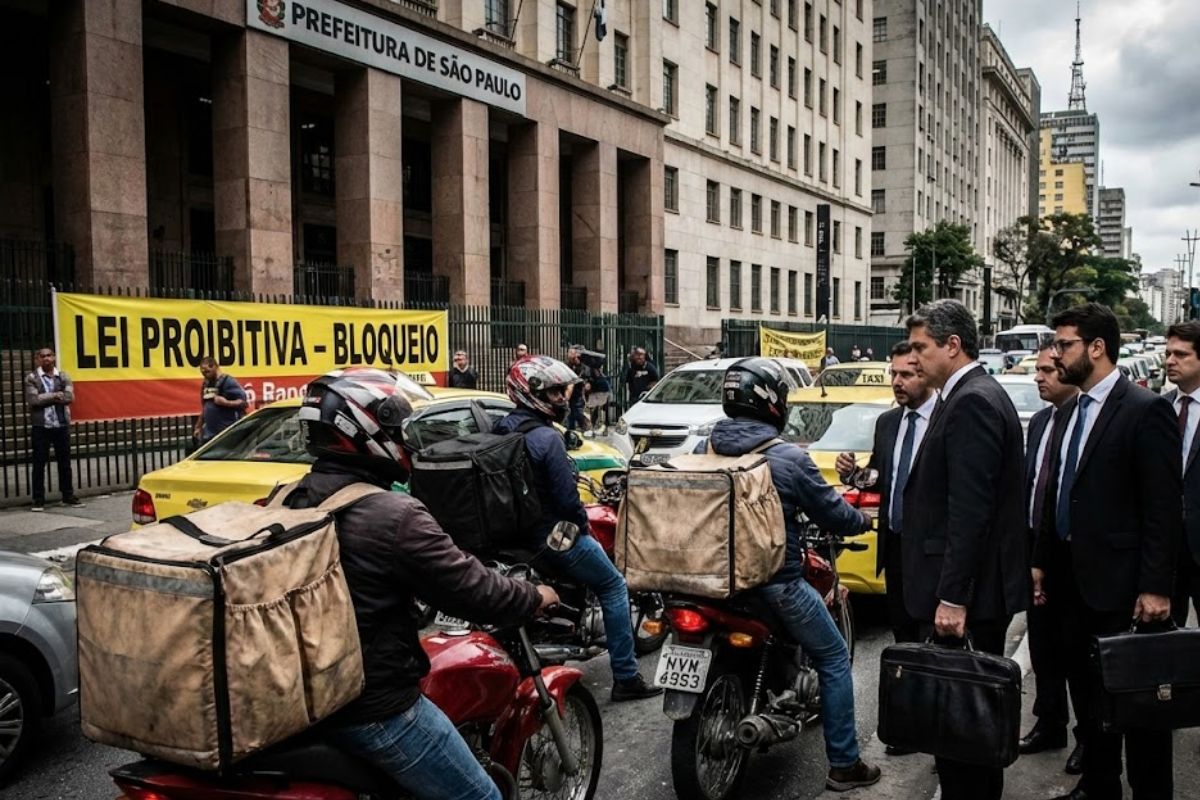
Represented by Amobitec, 99 and Uber Cancel the Return of Motorcycles for Ride-Hailing in São Paulo This Thursday 11 After Law 18.349 Signed on December 10, Classifying Rules as Prohibitive, Illegal and Unconstitutional and Announcing They Will Go to Court Against the Municipal Ban on the Motoapp Service in the Capital.
On Wednesday, December 10, 2025, after the signing of Law 18.349 by Mayor Ricardo Nunes, 99 and Uber decided to suspend the immediate return of motorcycles for ride-hailing in São Paulo, which was scheduled for this Thursday 11, just one day after the deadline set by the São Paulo Court of Justice for the regulation of the service.
The companies, represented by the Brazilian Mobility and Technology Association, claim that the new municipal framework is prohibitive, illegal, and unconstitutional, in disagreement with decisions from the TJ-SP and the Federal Supreme Court, and announced that they will file a lawsuit to try to overturn the rules before resuming the motoapp operation in the capital.
Why 99 and Uber Abandoned the Date of December 11
Days before the vote in the City Council, 99 and Uber had promised to put ride-hailing motorcycles on the streets of São Paulo this week, with or without regulation from the municipality.
-
Larger than entire cities in Brazil: BYD is building a 4.6 km² complex in Bahia with a capacity for 600,000 vehicles per year, but the discovery of 163 workers in conditions analogous to slavery has shaken the entire project.

-
With an investment of R$ 612 million, a capacity to process 1.2 million liters of milk per day, Piracanjuba inaugurates a mega cheese factory that increases national production, reduces dependence on imports, and repositions Brazil on the global dairy map.

-
Brazilian city gains industrial hub for 85 companies that is equivalent to 55 football fields.

-
Peugeot and Citroën factory in Argentina cuts production by half and opens a layoff program for more than 2,000 employees after Brazil drastically reduced purchases of Argentine vehicles.


December 11 was chosen precisely because it falls after the deadline defined by the Court of Justice for the municipality to present a norm for the sector.
With Law 18.349 signed in the Official Gazette on Wednesday 10, the companies assessed, in a meeting at Amobitec’s headquarters, that it would be risky to resume the service under the new set of requirements.
According to the association, operating in this scenario could be interpreted as non-compliance with municipal legislation and would open the door for daily fines considered million-dollar against the platforms.
Amobitec Discusses the Blocking of Motoapp and Challenges Federal Legislation
In a statement, the Brazilian Mobility and Technology Association stated that Law 18.349, signed by the São Paulo City Hall, is an illegal regulation that, in practice, functions as a prohibition on the operation of motorcycles for ride-hailing in the city.
The entity argues that the text contradicts recent decisions from the São Paulo Court of Justice and the Federal Supreme Court, which have already acknowledged that municipalities cannot block the motoapp service.
Amobitec maintains that individual motorcycle transport mediated by apps is a private activity regulated by the National Urban Mobility Policy and by Federal Law 13,640, which authorizes the operation of platforms throughout the national territory.
For the entity, municipalities cannot create disproportionate barriers or impose rules that are not provided for in national legislation, especially when they are not directly related to traffic regulation.
According to the statement, by gathering impossible-to-fulfill requirements, the municipal legislation ends up preventing the start of operations in São Paulo and removes the right to mobility from millions of São Paulo residents and the source of income from thousands of motorcyclists, unlike what happens in other capitals that already have the service.
Main Requirements for Motorcyclists
The law signed by Ricardo Nunes establishes a series of requirements for motorcyclists to operate in the motorcycle ride-hailing service in the São Paulo capital. Among the main requirements are:
• Minimum age of 21 years to operate in the service.
• Prohibition of circulation in the area of the mini-ring road, corresponding to the expanded center of São Paulo, in addition to fast traffic roads, such as the Marginal Pinheiros and Tietê and the North-South corridor.
• Prohibition of operation on days of heavy rain and strong winds.
• Obligation to stay out of exclusive bus lanes and corridors.
• Pre-registration with the municipality, with the possibility of forming cooperatives and creating their own apps by motorcyclists.
• Requirement for a National Driver’s License in categories A or B for at least 2 years.
• Completion of a specialized 30-hour course for transporting passengers on motorcycles, funded by the ride-hailing companies.
• Toxicology exam valid for 3 months.
• Provision of a certified helmet for the passenger.
• Mandatory use of a red license plate, identifying vehicles for paid passenger transport, with the motorcycle registered in the rental category.
• Limitation on the age of the motorcycle, which must be at most 8 years old and have rear and side metal handles for passenger support, protection for the legs and motor in case of tipping, and a line cutter device to avoid accidents with kites.
• Definition that motorcycles eligible for the service must have over 150cc, which, according to Amobitec’s criticism, may exclude a large number of drivers, who generally use 125cc motorcycles.
The law also stipulates that in cases of severe or very serious bodily injury or intentional homicide of a passenger, the registration of the responsible driver will be revoked by the municipality.
Obligations and Punishments for Ride-Hailing Companies
In addition to the obligations imposed on motorcyclists, Law 18.349 defines specific duties for companies like 99 and Uber.
The platforms must maintain a register of motorcycle taxi drivers, ensuring that each driver is linked to only one motorcycle, and provide insurance for passengers, including funeral coverage.
The companies must also cover the costs of personal protective equipment, the registration process, and the creation of rest and parking points for motorcyclists.
The text also requires that the apps implement a speed limiting device on the platform, informing drivers and passengers in real-time, and prohibits the granting of bonuses per trip, a mechanism that, according to critics, encourages excessive ride-hailing.
If they fail to comply with the rules, companies will be subject to daily fines ranging from 4,000 reais to 1.5 million reais.
For Amobitec, this set of obligations and sanctions constitutes a regulatory environment that dissuades the entry of platforms and makes it economically unfeasible to operate the motoapp in São Paulo.
Processing in the Council and Differences Among Councilors
The project that resulted in Law 18.349 was approved in the second round in the São Paulo City Council by 32 votes in favor and 16 against.
Councilor Paulo Frange presented a substitute text, articulated with party leaders, which included changes such as the creation of specific funeral insurance and the prohibition of bonuses per trip.
In the second vote, there were shifts in positions among parliamentarians. The chairwoman of the subcommittee that analyzed the theme, Renata Falzoni, who had voted in favor in the first round, started to oppose the proposal.
Councilor Janaína Pascoal abstained. The strategy of approving a substitute sought to avoid the introduction of new amendments, which could delay the conclusion of the analysis of the project.
Mayor Ricardo Nunes had previously indicated that he intended to regulate the motorcycle ride-hailing service by December 8, through a decree.
However, the signing of the law occurred on December 10, the last day of the deadline set by the São Paulo Court for the municipality to regulate the service, consolidating in legislation the most controversial points criticized by the companies.
Reactions from Mayor Ricardo Nunes
After the announcement that 99 and Uber would not resume motorcycles for ride-hailing this Thursday 11, Mayor Ricardo Nunes reacted ironically to the platforms’ decision.
He declared: “Life thanks. They wanted to make money regardless of the risks to people’s lives. With rules, they don’t want criteria.”
For the municipal administration, the requirements established by Law 18.349 seek to increase road safety and reduce the number of accidents involving motorcyclists and passengers in the city.
The city hall defends that the regulation does not impede the service, but only conditions the operation to compliance with minimum safety and responsibility standards by companies and drivers.
Legal Impasse and Next Steps
As the rules come into effect in São Paulo, 99 and Uber state that there is no new date to resume the motorcycle ride-hailing service in the city.
The decision to maintain the suspension is directly tied to the strategy of challenging the law in court, arguing that the municipal norm exceeds legal limits and violates federal legislation that supports the service.
Amobitec reinforces that it will continue to be available to dialogue with the city hall and councilors in search of regulation considered fair, balanced, and aligned with national legislation, which allows the reconciliation of income for motorcyclists and the offer of a mobility service for São Paulo’s population.
In light of this impasse between the city hall and ride-hailing companies, do you believe that the rules for motorcycles for ride-hailing in São Paulo are protecting the safety of the population or exaggerating restrictions and preventing an important transportation option in the city?









Seja o primeiro a reagir!