





 Portuguese
  English
  Spanish
  3 min of reading
  0 comments


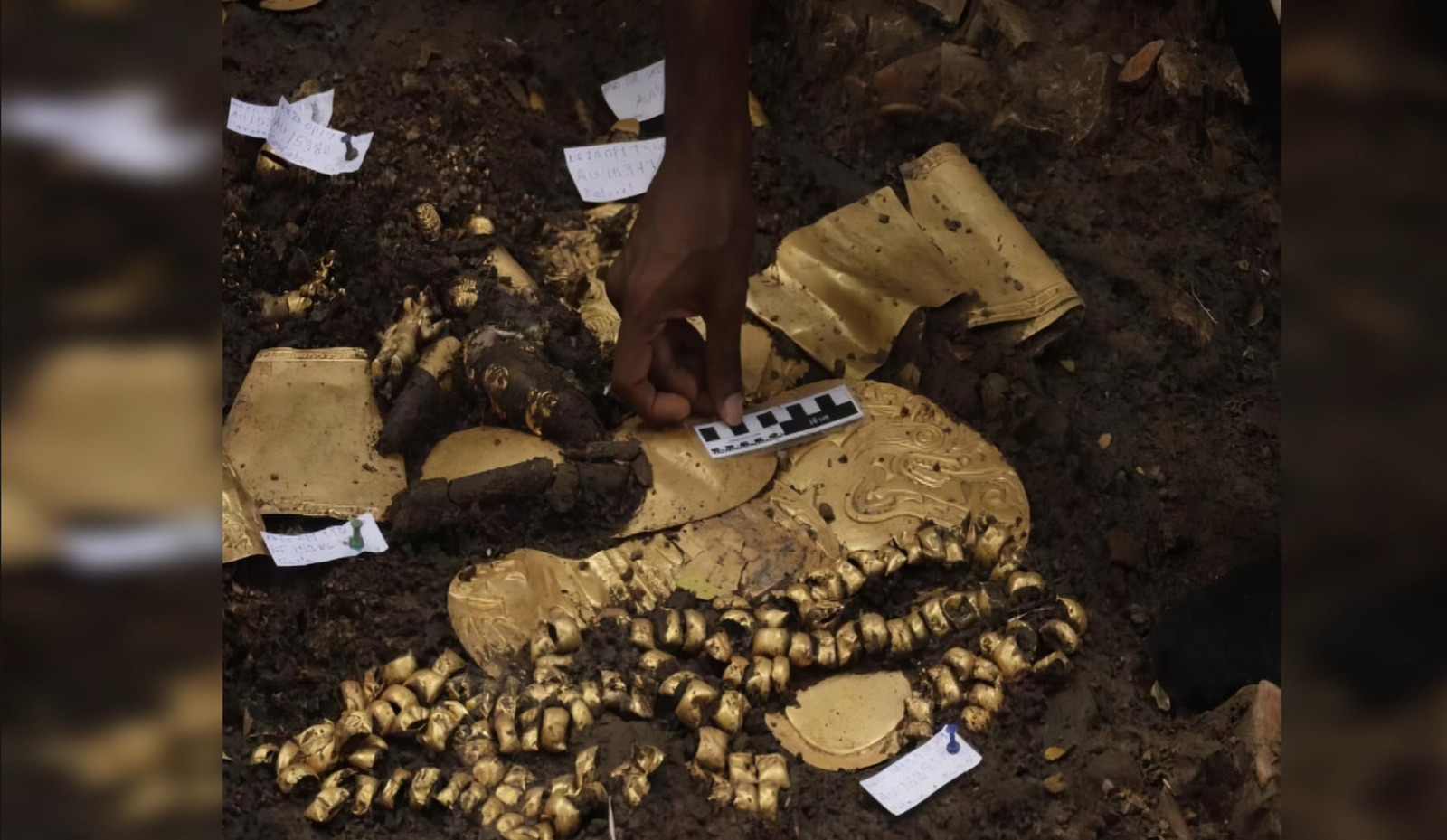
Tomb 3 With About 1,000 Years and Dozens of Gold Pieces Discovered at the El Caño Archaeological Park Museum, Expanding Evidence of the Coclé Royalty in Panama
The discovery of Tomb 3, about 1,000 years old and filled with gold pieces, was announced on February 20 by the Ministry of Culture of Panama at the El Caño Archaeological Park Museum, reinforcing the archaeological relevance of the site and expanding knowledge about the Coclé royalty.
The funerary structure, attributed to the Coclé royalty, was located at the El Caño archaeological site in the province of Coclé. The indigenous people inhabited the region before Spanish explorers arrived at the isthmus in 1501.
The Ministry of Culture classified the find as a highly significant event for Panamanian archaeology and for the study of pre-Hispanic societies of the Central American isthmus. The ministry also highlighted the scientific and educational potential of the excavation.
-
Motorola launched the Signature with a gold seal from DxOMark, tying with the iPhone 17 Pro in camera performance, Snapdragon 8 Gen 5 that surpassed 3 million in benchmarks, and a zoom that impresses even at night.

-
Satellites reveal beneath the Sahara a giant river buried for thousands of kilometers: study shows that the largest hot desert on the planet was once traversed by a river system comparable to the largest on Earth.

-
Scientists have captured something never seen in space: newly born stars are creating gigantic rings of light a thousand times larger than the distance between the Earth and the Sun, and this changes everything we knew about stellar birth.

-
Geologists find traces of a continent that disappeared 155 million years ago after separating from Australia and reveal that it did not sink, but broke into fragments scattered across Southeast Asia.

According to María Eugenia Herrera, Minister of Culture of Panama, the objective is to establish the El Caño Museum as a research and education center aimed at Panamanians and visitors interested in the origins and history of the country.

Tomb 3 Initially Identified in 2009
Although the excavation was completed only in 2026, the identification of Tomb 3 dates back to 2009. That year, researchers detected a high concentration of ceramic materials and metallic fragments in the area.
The confirmation that it was a large tomb led to an in-depth archaeological work. From that moment on, investigations progressed systematically until the recent conclusion.
Structure Reveals Multiple Burials and Signs of Hierarchy
The excavations revealed a complex structure, composed of offerings and a multiple burial. In the center of the tomb, an extended individual was found, surrounded by other bodies.
The arrangement of the burials suggests hierarchy. According to Eco TV Panama, the central position and the objects associated with the main buried individual reinforce their high sociopolitical status within the community.
Among the recovered artifacts are metallic ornaments and various gold pieces, such as pectorals, ear protectors, and bracelets.
Elaborate ceramics were also found, some decorated with iconography linked to the local artistic tradition.
The collection indicates material wealth and technical mastery in areas such as goldsmithing and pottery production, evidencing the sophistication achieved by the social group related to Tomb 3.

Previous Discoveries Reinforce Importance of El Caño
The archaeological site had been presenting significant vestiges of the pre-Hispanic past. In 2024, archaeologists identified another tomb at the location, dated to 750 A.D., attributed to a member of the Coclé high society.
The new discovery broadens the overview of power structures and funerary rituals practiced by this people.
Tomb 3 contributes to deepening the understanding of the period of greatest sociopolitical development in El Caño.
Ministry Anticipates Update of Historical Narratives
According to the Ministry of Culture, Tomb 3 is expected to provide essential data for re-evaluating regional historical relationships and dynamics.
The agency stated that the tomb will enrich educational content and allow for the updating of narratives about the pre-Hispanic past.
The ministry also highlighted the contemporary impact of the discovery. For the current communities in the region, the findings strengthen cultural identity and the recognition of a delicately crafted ancestral past.
With the completion of the excavation, Tomb 3 becomes part of the evidence that helps reconstruct the history of societies that flourished in the Central American isthmus before European colonization, solidifying El Caño as an archaeological reference in Panama and expanding regional historical understanding.
With information from Aventuras na História.







-

Uma pessoa reagiu a isso.