





 Portuguese
  English
  Spanish
  4 min of reading
  0 comments


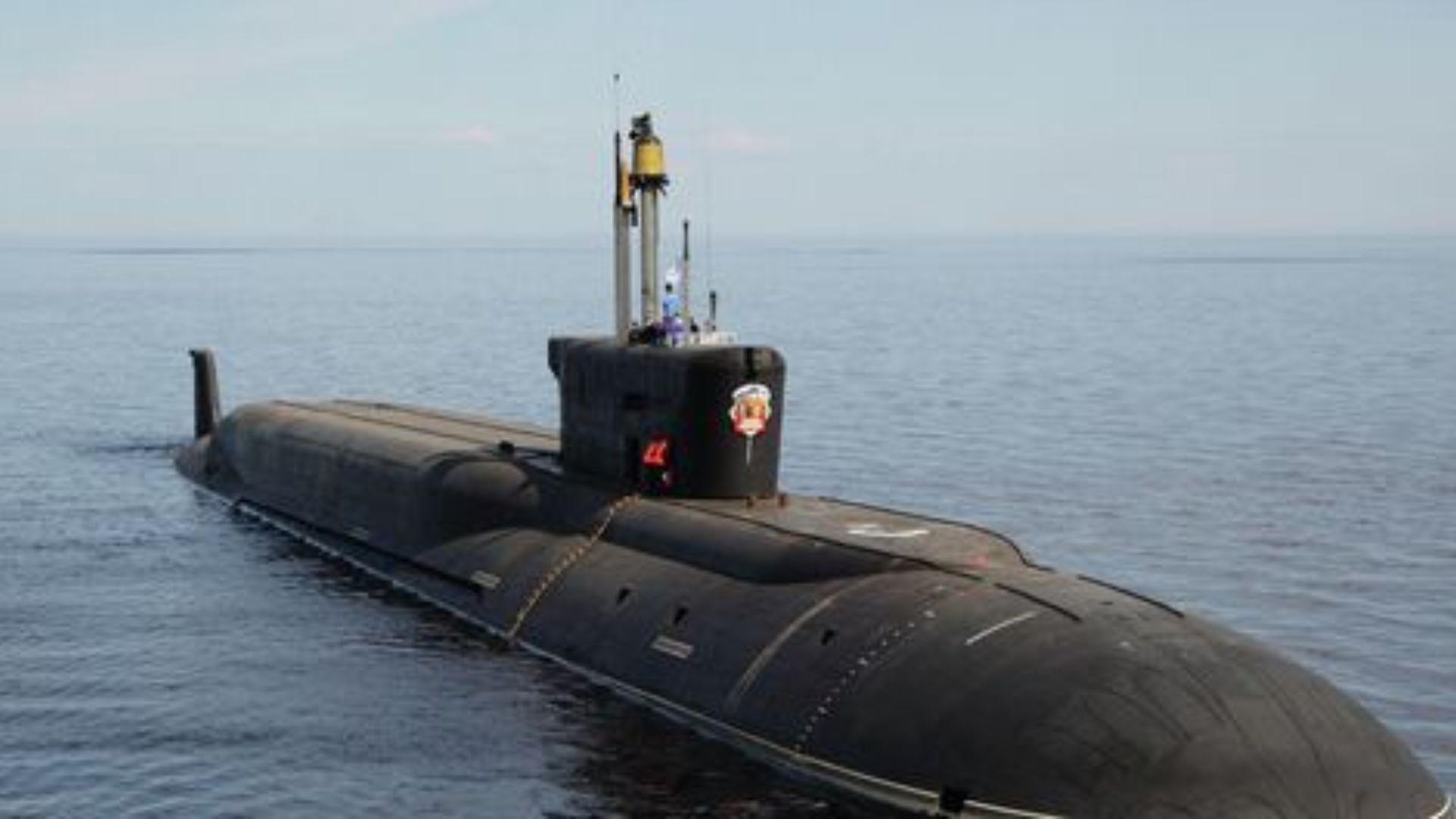
Russian Nuclear Submarine Adapted to Operate at the Seafloor Combines 174 Meters in Length, Nuclear Propulsion, and Capacity to Transport Deep Submersibles. Soviet-Era Converted Platform Acts as a “Mother Submarine” in Covert Missions Linked to Submarine Cables and Strategic Infrastructure.
The Russian nuclear submarine BS-64 Podmoskovye, approximately 174 meters long, appears in defense analyses as a “special purpose” platform adapted to carry smaller submersibles and support covert operations at the seafloor, away from surface sensors.
Public records indicate that the ship was built during the Soviet era as a ballistic missile submarine of the 667BDRM project, known in the West as the Delta IV class, and years later underwent extensive conversion for another employment profile.
The modernization is described by experts as a process that replaced the section associated with missiles with a special compartment, making room for coupling systems and internal structures aimed at submersible vehicles and missions that are not usually detailed officially.
-
Friends have been building a small “town” for 30 years to grow old together, with compact houses, a common area, nature surrounding it, and a collective life project designed for friendship, coexistence, and simplicity.

-
This small town in Germany created its own currency 24 years ago, today it circulates millions per year, is accepted in over 300 stores, and the German government allowed all of this to happen under one condition.

-
Curitiba is shrinking and is expected to lose 97,000 residents by 2050, while inland cities in Paraná such as Sarandi, Araucária, and Toledo are experiencing accelerated growth that is changing the entire state’s map.

-
Tourists were poisoned on Everest in a million-dollar fraud scheme involving helicopters that diverted over $19 million and shocked international authorities.


Although not all features are available in open documents, the operational logic of this conversion recurs: to use a large hull, with nuclear propulsion capability, to reach remote areas and remain there for long periods without relying on frequent support.
How the Mother Submarine Concept Works

The expression “to swallow” a mini-sub, used figuratively, refers to the role of a mother submarine, in which the larger vessel carries an attached submersible and takes it to the area of interest with more discretion, range, and protection.
In this architecture, the smaller vehicle avoids long crossings on its own, reduces exposure during movements, and can be launched closer to the operational point, while the main platform provides support, technical shelter, and a base for recovery.
The result is an unusual combination: a submarine of dimensions associated with strategic deterrence, but employed as a backdrop for high-complexity tasks, in an environment where permanent monitoring is difficult and actions may not always be immediately identified.
Losharik and Deep Depth Operations
Among the most cited names in open analyses is AS-12 Losharik, described as a nuclear deep-operating submersible operated by a Russian directorate focused on research and deep-sea missions, with little public disclosure of exact parameters.

Analysts often highlight a technical element attributed to the project: the presence of internal spherical titanium modules, a solution noted as suitable to withstand pressure at great depths, although performance details remain beyond the reach of open sources.
Attention outside specialized circles increased after the fire on July 1, 2019, when Russian officials reported the deaths of 14 crew members in a submersible described as a research vessel, an episode widely covered by the international press.
In the coverage of the case, different outlets reported that the involved vessel was associated with Losharik, while the Russian government disclosed limited information about the mission, reinforcing the perception of underwater capabilities with a high degree of confidentiality.

Optical Fiber Cables and Strategic Submarine Infrastructure
The relevance of this type of platform connects to submarine infrastructure, especially optical fiber cables, which form the physical foundation of much of the international data traffic and support essential services of the contemporary digital economy.
While there are sections close to the coast with more possibilities for protection and repair, maritime security analyses recall that, in deep waters, the scale of the ocean and the dispersion of assets make continuous surveillance more costly and technically limited.
In recent years, governments and international organizations have begun to address this issue more explicitly, with initiatives aimed at protecting critical underwater infrastructure and coordinating with industry, in light of increasing alerts and incidents.
In such a scenario, the existence of special purpose submarines is cited in studies as an element that enhances the capacity to reach the ocean floor, interact with equipment, map areas, and execute tasks that require precision at depth.

Strategic Discretion at the Ocean Floor
The Podmoskovye often appears in compilations and analyses as a case of repurposing a large Soviet hull, maintaining characteristics of autonomy and range associated with nuclear propulsion, but directing its employment toward missions that prioritize discretion and persistence.
This type of capability also draws attention because the underwater environment complicates the immediate attribution of responsibilities, as events at depth can be perceived with delay, investigated with technical limitations, and in some cases, remain publicly unexplained.
Nonetheless, public debate tends to grow when the subject involves civil infrastructure, such as telecommunications, and when authorities point to risks of sabotage or hybrid actions, especially in areas of intense traffic and economic relevance.
Without resorting to hypotheses about specific operations, what can be safely asserted is that the combination of mother submarine and deep submersible illustrates how the ocean floor has ceased to be merely a research space and has come to incorporate security concerns.
If a 174-meter vessel can take a submersible to regions where cables and sensors are exposed and far from any constant patrol, which sections of the ocean floor today are treated as strategic without the majority of people even knowing where they are?









-

Uma pessoa reagiu a isso.