





 Portuguese
  English
  Spanish
  10 min of reading
  3 comments




The Journey of Ma Sanxiao in Planting 17,000 Trees and Restoring a Region Threatened by Desertification
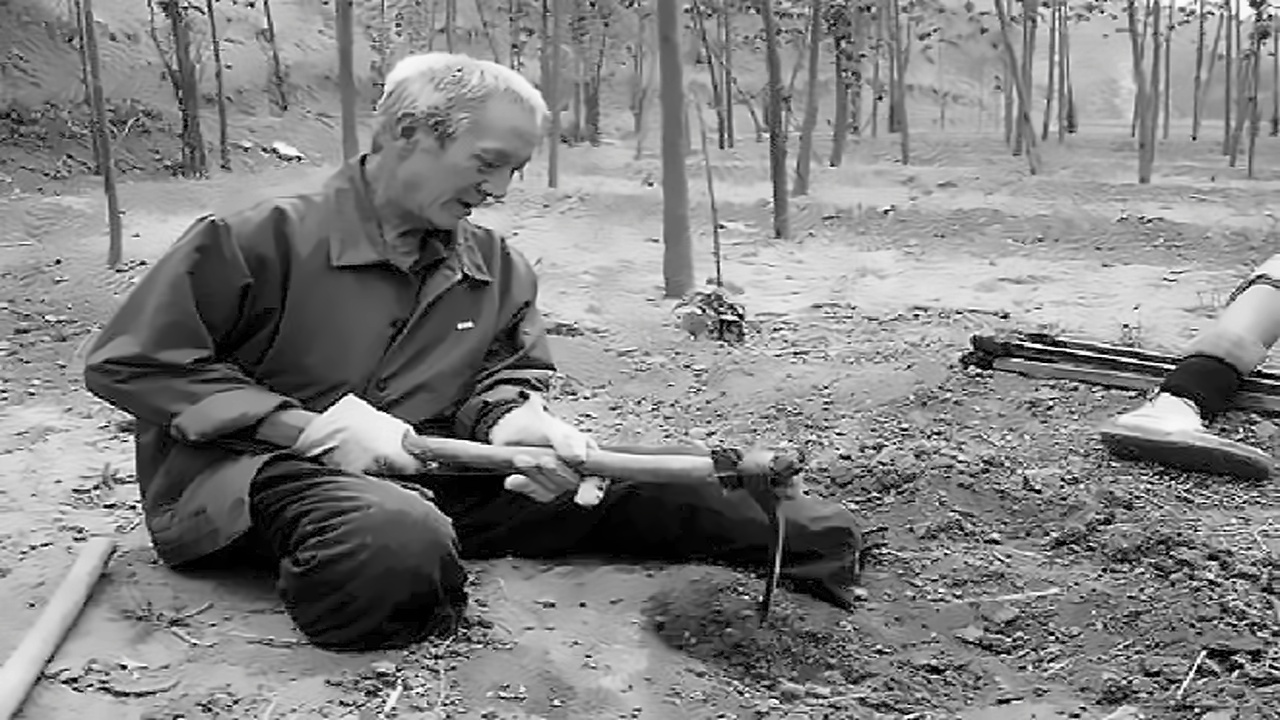
Every day, Ma Sanxiao wakes up, puts on his worn prosthetics, grabs his tools, a shovel, and a pickaxe, and begins the one-hour walk to the foot of the mountain. He doesn’t have breakfast. He only takes a few steamed buns (mantou) wrapped in cloth to eat during breaks. The walk is just the beginning. Ahead of him is a rocky, steep mountain in Jingxing County, Hebei Province, in northern China. To climb hundreds of meters, Ma takes more than 40 minutes. Sometimes he has to crawl through ditches. Other times, he crosses slopes covered in thorns that tear his thick gloves in a matter of days. Ma Sanxiao is 74 years old. And he has no legs.
Both were amputated, the right leg in 1985, the left in 2005, due to septicemia (blood poisoning) he contracted while serving as a reconnaissance soldier in the People’s Liberation Army of China.
But since 2000, Ma has climbed this mountain almost every day. He dug holes. Planted seedlings. Carried water. Crawled when necessary. And over the course of 19 years, he transformed 800 mu (approximately 53 hectares) of barren hills into a lush forest with more than 17,000 trees.
-
Friends have been building a small “town” for 30 years to grow old together, with compact houses, a common area, nature surrounding it, and a collective life project designed for friendship, coexistence, and simplicity.

-
This small town in Germany created its own currency 24 years ago, today it circulates millions per year, is accepted in over 300 stores, and the German government allowed all of this to happen under one condition.

-
Curitiba is shrinking and is expected to lose 97,000 residents by 2050, while inland cities in Paraná such as Sarandi, Araucária, and Toledo are experiencing accelerated growth that is changing the entire state’s map.

-
Tourists were poisoned on Everest in a million-dollar fraud scheme involving helicopters that diverted over $19 million and shocked international authorities.


“To me, they are not trees”, says Ma, looking at the green landscape he created with his own hands. “I consider them as the soldiers I commanded. They make me feel very accomplished.”
The Story of a Soldier: From the Battlefield to the Surgery Table
The tragedy of Ma Sanxiao began decades before he planted his first tree. In 1974, at 23 years old, Ma was serving as a reconnaissance soldier in the Chinese army when he contracted septicemia — an extreme response of the body to an infection that can quickly lead to multiple organ failure and death. According to some reports, the infection began with a leech bite that was not properly treated.
Septicemia forced Ma to retire from military service while still young. He tried to live as a normal civilian, working as a teacher and farmer. But the disease never completely left him.

In the following years, Ma underwent seven major surgeries. The medical costs devastated his family financially. They sold everything of value. They accumulated debts that seemed impossible to pay. According to Chinese reports, at one point, “his family couldn’t even buy a box of matches”.
In 1985, after years of unsuccessful treatment, doctors had no choice but to amputate his right leg.
Ma was 34 years old. He had a family to support. Without a leg, with crushing debts, and living in a poor rural village, his prospects were bleak.
But worse was yet to come. In June 2005, after another 20 years of battling complications from septicemia, Ma lost his second leg. The left one was amputated. At 54 years old, Ma Sanxiao was a double amputee.
His family fell apart under the emotional and financial burden. He was left alone. Desperate and hopeless, Ma began to build his own coffin.
The Decision That Changed Everything: Planting to Survive
In 2000, still with one leg, Ma watched a television program about a person who had planted trees and sold them for profit. An idea began to take root in his mind.
The hills around Mayu Village, where he lived, were completely barren, rocky desert land where almost nothing grew. But perhaps, Ma thought, he could plant trees there. And when they grew, he could sell them to pay off his medical debts. It wasn’t an ambitious or noble plan. It was simply survival.
“Originally in 2000, I wanted to grow trees and then sell them to make a living”, Ma admitted years later. “At that time, my family had fallen apart due to my illness and disability.”
So, with one leg, crutches, a shovel, and a pickaxe, Ma Sanxiao began to climb the mountain.
Planting trees on barren hills is difficult for healthy people. For Ma, it was almost impossible. It took him more than 40 minutes to climb just a few hundred meters. Each hole dug in the rocky soil required immense effort. Carrying water from the nearest spring was a trial.
But he persisted. Day after day. Month after month. Year after year.
The Transformation: From Business to Life Mission
Something unexpected happened as Ma planted his trees. He began to see them grow. Small seedlings turned into young trees. Young trees grew strong and green. The barren hills began to change color from dusty brown to vibrant green.
And some of the trees died. The conditions were harsh — rocky soil, little water, harsh winters. When Ma saw a tree he had planted months earlier wilt and die, he felt genuine pain.
“After watching the trees grow before my eyes every day and dealing with the sadness of some of them dying due to the severe conditions in the area”, Ma became so attached to his small forest that he made a radical decision.
He would not sell the trees. Ever. By around 2005, Ma’s financial situation improved slightly. The Chinese government increased pensions for injured veterans in rural areas. For the first time in decades, Ma had enough income to cover his medications and basic needs.
And then he decided: he would continue to plant trees, but no longer for personal profit. He would plant for future generations. To improve the environment. To leave a green legacy.
“I will never sell these trees”, declared Ma. “It’s a great sense of accomplishment. I will continue to plant trees until my last breath and leave this green wealth for the country and future generations.”
The Brutal Routine: How to Plant Trees Without Legs
To understand what Ma Sanxiao accomplishes every day, one must grasp the physical logistics of his work.
5:00 AM: Ma wakes up before dawn. First, he needs to prepare the stumps of his legs — applying extra protection where they were amputated to avoid sores. Then, he puts on his worn prosthetics. The process takes time.
6:00 AM: He puts on thick gloves, grabs his shovel, pickaxe, and tree seedlings. He fills a bottle with water. Wraps some steamed buns. He doesn’t have breakfast — he prefers to save time.
7:00 AM: He arrives at the foot of the mountain after walking an hour from the village. The real journey begins here.
7:00 – 8:00+ AM: He climbs the mountain using crutches. Every movement is calculated. Hundreds of meters take more than 40 minutes. Sometimes the crutches slip on loose rocks. Sometimes he has to crawl through ditches or climb thorn-covered steep slopes.
8:00 AM – 5:00 PM: Work. Digging holes in the rocky soil. Planting seedlings. Crawling to the nearest spring to fetch water. Returning. Watering the trees. Repeating. During the day, he takes short breaks to eat his buns and rest.
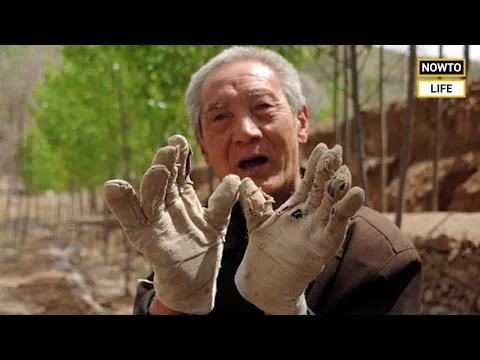
A pair of thick gloves lasts only five days before being destroyed by rocks and tools. Ma goes through dozens of pairs a year.
The prosthetics often need maintenance. His body suffers — constant pain in the stumps of his legs, his back, his arms. But he doesn’t stop.
“Sometimes I have to crawl to cross a ditch and climb thorn-covered slopes”, says Ma. It’s not a metaphor. It’s literal.
The Numbers: From 3,000 to 17,000 Trees
Ma Sanxiao’s journey is well documented over the years, allowing us to see his progress:
2011 (10 Years of Work):
- More than 3,000 trees planted
- Ma was 62 years old
- Worked alone
2019 (19 Years of Work):
- More than 17,000 trees planted
- Ma was 70 years old
- Had begun receiving help from volunteers
2023 (23 Years of Work):
- Exact number not disclosed, but likely over 20,000 trees
- Ma was 74 years old
- Continued climbing the mountain daily
The math is impressive: even using the conservative estimate of 17,000 trees in 19 years, Ma planted an average of 895 trees per year, or approximately 2.5 trees per day — every day, for nearly two decades, while crawling through rocky mountains without legs.
The Transformation of the Landscape: From Desert to Forest
Hebei Province, where Ma lives, has a serious pollution problem. According to the South China Morning Post, Hebei is home to six of the ten most polluted cities in China, largely due to heavy steel industry. As the province surrounds Beijing, the pollution produced in Hebei directly affects air quality in the nation’s capital.
The barren hills around Mayu Village were part of the problem, desolate land that did not filter air pollution or prevent erosion.
But today, thanks to Ma’s work, these hills are green. Parasol trees (wutong) grow densely where there were once just rocks and dust. The forest that Ma created:
- Improves air quality in the region
- Prevents soil erosion
- Provides habitat for wildlife
- Regulates local temperature
- Sequesters carbon
- Inspires other local residents
The Recognition: From Solitary to National Hero
For years, Ma worked completely alone. No one helped him. No one seemed to care. But slowly, as his forest grew and his story spread, things changed.
In 2011, Xinhua (the Chinese state news agency) and China Daily published the first reports about Ma. Photos of him wearing worn prosthetics, climbing mountains with crutches, and showing torn gloves circulated nationally. The reaction was immediate. Donations began to arrive, not much, but enough to buy more seedlings and better tools.
More importantly: volunteers showed up. In 2018, over 30 people volunteered to help Ma with his difficult work. “The man who used to go alone to plant trees is now in good company”, reported one news piece. But Ma didn’t stop. Even with help, he continues to climb the mountain alone almost every day.
“As long as I live, I will continue to plant trees for future generations”, he says. “They make me feel accomplished.”
The Trees Are His Soldiers
To understand Ma Sanxiao, it’s essential to grasp how he sees his trees.
“To me, they are not trees”, he explains. “I consider them as the soldiers I commanded.”
It’s a powerful metaphor from a former soldier who lost the ability to serve his country in a conventional way but found a new way to serve — through a green army.
“If that’s the case”, wrote a journalist, “he has about 17,000 soldiers under his command.”
Each tree is a soldier. Each row of trees is a battalion. Each green-covered slope is a brigade. And Ma, the double amputee commander, leads his green army on crutches and knees. It’s a way of recontextualizing his loss. He lost his legs serving his country. He lost his family due to illness. He lost almost everything.
But he gained 17,000 soldiers who will never abandon him, will never die prematurely (if he takes good care of them), and will stand long after he’s gone.
The Family That Pleads for Him to Stop
Not everyone applauds Ma’s dedication.
His family, what remains of it, pleads for him to stop, or at least slow down. “Relax and spend more time at home”, they say. “You’ve done enough. You’re already 74 years old. You have no legs. Please rest.”
But Ma refuses.
“As long as I can breathe, I will continue to plant”, he replies stubbornly.
There is something almost obsessive about his dedication. Something that goes beyond rationality or self-care. It’s a mission that has become identity. A way to give meaning to decades of suffering. An absolute refusal to be defined by his limitations.
Ma Sanxiao has no legs. But he has purpose. And for him, that is enough.
The Legacy of Ma Sanxiao That Will Grow for Centuries
Parasol trees can live for 100 years or more. This means that the first trees Ma planted in 2000 will be alive until at least 2100. His last trees — if he continues to plant — may live into the 22nd century.
Long after Ma is gone, his green army will continue to stand. It will continue filtering air pollution. It will continue preventing erosion. It will continue providing shade and habitat.
Children yet to be born will play under these trees. Families will picnic. Birds will build nests. And perhaps — if the story is preserved — some visitors will stop and think: “A man without legs planted all this. A man who lost everything but refused to give up.”
Ma Sanxiao: An Inspiration Beyond Borders
The story of Ma Sanxiao is not isolated. It echoes another equally extraordinary story, that of Jadav Payeng, the “Forest Man” of India, who single-handedly planted a forest of 550 hectares over 40 years.
Both demonstrate the same principle: an ordinary person, with extraordinary determination, can literally change the landscape. Not through advanced technology or massive investment, but through persistent manual labor, day after day, year after year, decade after decade.
“I plant more trees to make the mountains greener”, Ma simply says.
There’s no grand rhetoric. No complex philosophy. Just action. Persistence. A refusal to accept that physical limitations define what is possible.
The Lesson of a Man Without Legs Who Doesn’t Stop Climbing Mountains
The story of Ma Sanxiao is not just about ecology or reforestation. It’s about human dignity in the face of adversity.
He could have stayed home, living off his veteran’s pension, accepting government assistance as a severely disabled person. No one would judge him. He lost both legs serving his country. He endured decades of pain and medical treatment. He lost his family. He has every excuse in the world to do nothing.
But instead, every day at 5 AM, he climbs a mountain.
“It’s a great sense of accomplishment”, says Ma about his work. “I will continue to plant trees until my last breath.”
And when that last breath finally comes, when Ma Sanxiao plants his last tree and rests for the last time, he will leave behind more than 17,000 trees.
He will leave behind a lesson: that the value of a life is not measured by what you lost, but by what you built with what remained. That physical limitations may restrict movements but not purpose. That a man without legs can climb mountains — literally — if he is willing to crawl.
And that sometimes, when you lose everything, the best response is not to give up, but to start planting. One tree at a time. Until you have an army.










17 árboles?
Fenomenal, parabéns para este comandante da natureza.
Lindo demais o resiliência dele!