





 Portuguese
  English
  Spanish
  4 min of reading
  0 comments


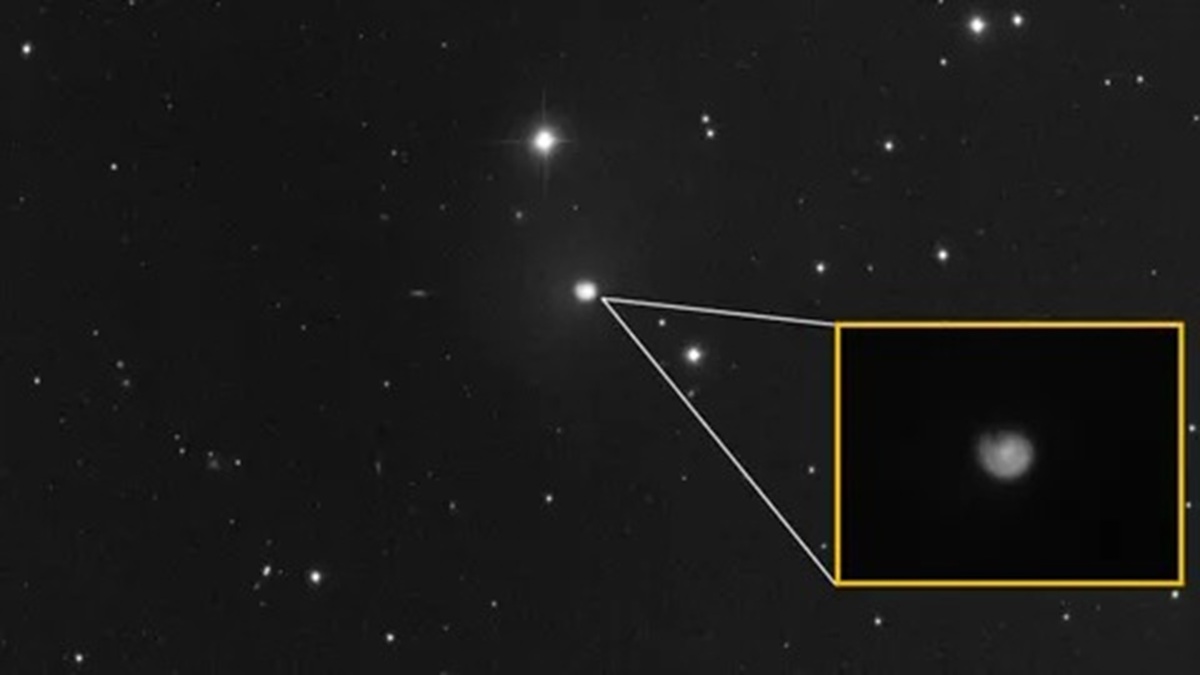
Comet The Size Of A City, With About 60 Kilometers In Diameter, Registered Explosion On February 10, Raised Brightness By About 100 Times And Formed Rare Spiral In The Coma After One Of The Five Largest Eruptions In 25 Years
A comet the size of a city, with cold volcanic activity, transformed into a bright “snail shell” after an explosion on February 10 that increased its brightness by about 100 times, making it one of the five largest eruptions recorded in 25 years.
The object, identified as 29P/Schwassmann-Wachmann, experienced a sudden increase in brightness that signaled a major eruption, according to Spaceweather.com. The event is among the five largest explosions of the comet in the past two and a half decades.
Known as 29P, the celestial body has a diameter of about 60 kilometers, roughly three times the length of Manhattan. It is part of a rare group of about 500 objects called centaurs, which orbit the inner solar system.
-
Motorola launched the Signature with a gold seal from DxOMark, tying with the iPhone 17 Pro in camera performance, Snapdragon 8 Gen 5 that surpassed 3 million in benchmarks, and a zoom that impresses even at night.

-
Satellites reveal beneath the Sahara a giant river buried for thousands of kilometers: study shows that the largest hot desert on the planet was once traversed by a river system comparable to the largest on Earth.

-
Scientists have captured something never seen in space: newly born stars are creating gigantic rings of light a thousand times larger than the distance between the Earth and the Sun, and this changes everything we knew about stellar birth.

-
Geologists find traces of a continent that disappeared 155 million years ago after separating from Australia and reveal that it did not sink, but broke into fragments scattered across Southeast Asia.
Additionally, it belongs to an even more restricted set of cryovolcanic comets, capable of expelling gas and ice through the cosmic neighborhood. This type of activity occurs when the nucleus absorbs excess solar radiation, triggering an internal sublimation process.
Comet The Size Of A City And The Explosion Of February 10
On February 10, the comet exhibited an approximate increase of 100 times in its brightness. Experts informed Spaceweather.com that the eruption was the most powerful since October 2024, when a quadruple explosion made the comet shine 300 times brighter than normal.
In the following days, the coma, a diffuse cloud surrounding the nucleus, expanded significantly. By reflecting more sunlight, it became even more visible in the night sky.
However, researchers noted that the expansion did not occur uniformly. The coma took on a distinct spiral shape, unusual in previous events of the same object.
Amateur astronomer Eliot Herman recorded the asymmetrical structure in the Hurtado River Valley in Chile. He compared the shape to an ammonoid fossil. Photographer Anthony Kroes, in Wisconsin, described the appearance as a snail shell.

Comet The Size Of A City And The Cryovolcanic Mechanism
The phenomenon observed in the comet the size of a city is related to cryovolcanism. When the nucleus absorbs additional radiation, the internal mixture of frozen gas and dust, called cry magma, is superheated.
This heating causes sublimation. The generated gas increases internal pressure until it forces the opening of a crack in the icy surface, allowing the release of material into space.
According to Spaceweather.com, the spiral shape likely results from an internal rotation of the comet’s interior in relation to the nucleus, causing irregular ejection of cry magma through a newly formed opening.
A similar process was observed in the 12P/Pons-Brooks comet, nicknamed the devil’s comet, which exhibited horn-like formations at the end of 2023. At that time, experts attributed the shape to a crack that partially blocked the flow of cry magma.
The interstellar comet 3I/ATLAS also showed signs of cryovolcanism and multiple jets of cry magma as it traversed the inner solar system last year.
Unusual Orbit And Unexplained Explosions
Unlike most cryovolcanic comets, which are long-period and approach the Sun only every hundreds or thousands of years, the comet the size of a city orbits the Sun in an approximately circular path.
It is located between Jupiter and Saturn, about six times farther from our star than Earth. By maintaining a relatively constant distance, it does not receive a significant variation in solar radiation.
Even so, it records an average of 20 eruptions per year. Most are small, but larger explosions can release up to 1 million tons of cry magma into space.
Researchers report difficulty in explaining what triggers the largest explosions, since the conditions of the comet seem to remain stable.
In April 2023, scientists predicted a major eruption after observing a small darkening event before the explosion. Nevertheless, they did not determine the exact cause of the behavior.
How To Observe The Comet The Size Of A City
The comet has already passed its peak brightness. However, it remained exceptionally luminous after a second smaller explosion on February 15, which added a new portion of cry magma to the coma.
It is still unclear whether this renewed coma will also take on a spiral shape. Nonetheless, the object can be observed with a telescope or astronomical binoculars.
Currently, it is located in the constellation Leo, according to TheSkyLive.com. Experts indicate that large eruptions are often followed by smaller replicas in the days or weeks following.
Richard Miles from the British Astronomical Association stated to Spaceweather.com that new explosions may occur soon.
Besides 29P, other comets are in the spotlight. The C/2024 E1 Wierzchoś shone brightly after passing the closest point to Earth on February 17. Researchers predict that it may be expelled from the solar system.
In April, two other comets are expected to draw attention: C/2026 A1 MAPS, which may be visible to the naked eye during the day, and C/2025 R3 PanSTARRS, which may become visible at night without a telescope.
The behavior of the comet the size of a city reinforces the enigmatic nature of these planetary remnants, whose activity continues to challenge researchers and attract night sky observers in search of new records of this cosmic spectacle.








-

-

3 pessoas reagiram a isso.