





 Portuguese
  English
  Spanish
  5 min of reading
  1 comment


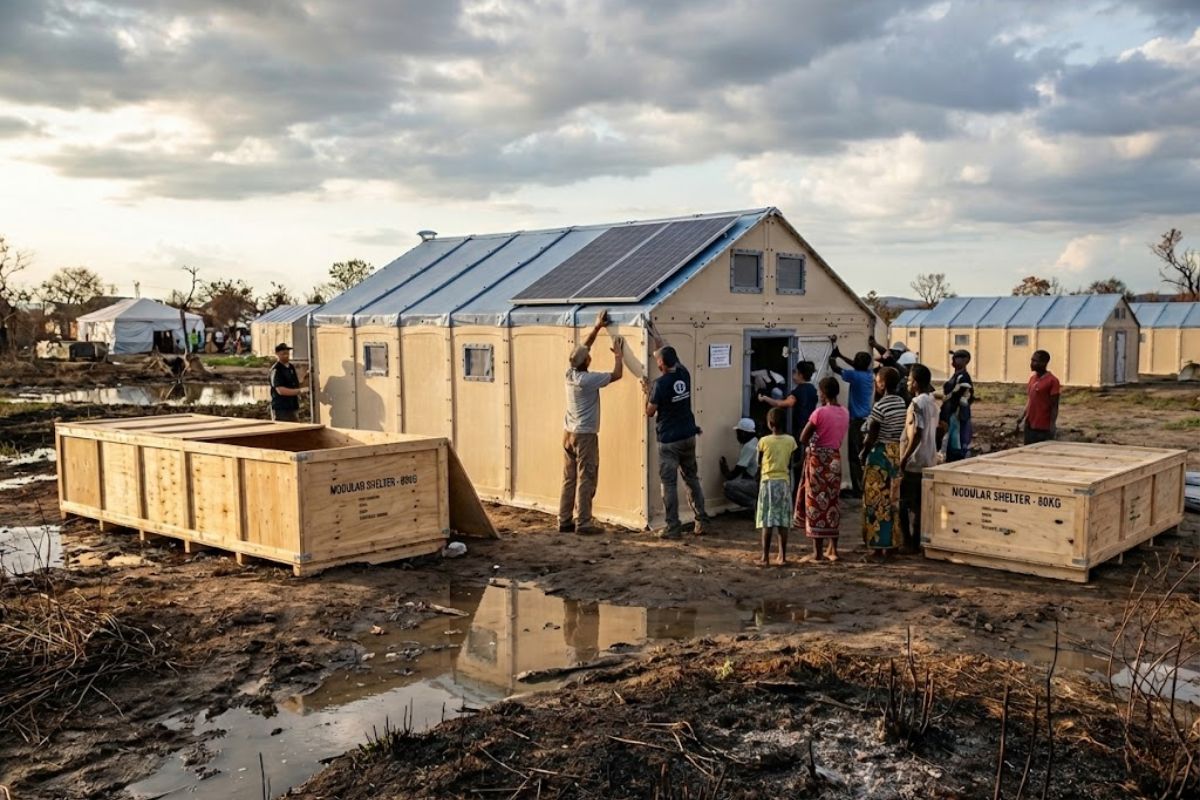


Developed From an Unease in 2010 and Refined With the Flat-Pack Concept From IKEA, the Better Shelter House Became a Modular Shelter in 80 Countries, Welcoming 90 Thousand Families With Quick Setup, Solar Panels, Windows and a Structure Designed to Withstand Disasters for at Least Three Years.
The idea of a house assembled in just 4 hours seems unlikely when the scenario involves floods, fires, and forced displacements lasting for years. Nevertheless, a modular model designed to arrive in boxes and turn into a real shelter has started to occupy vulnerable areas with a simple promise: to provide physical safety and a minimum of normalcy when everything else has failed.
What places this house at the center of the debate is not only the speed but also the set of design choices: fire and puncture resistance, privacy with doors and windows, and basic autonomy with solar energy for lighting and mobile phone charging. In 80 countries, the solution has already been used as a safe shelter by around 90 thousand families, bringing a standard closer to housing than to tents into emergency life.
From an Uncomfortable Question to the Birth of Better Shelter
The starting point was an unease from industrial designer Johan Karlsson in 2010: why do shelters for refugees still seem like fragile tents, even when many families remain displaced for long periods, averaging around 17 years?
-
Motorola launched the Signature with a gold seal from DxOMark, tying with the iPhone 17 Pro in camera performance, Snapdragon 8 Gen 5 that surpassed 3 million in benchmarks, and a zoom that impresses even at night.

-
Satellites reveal beneath the Sahara a giant river buried for thousands of kilometers: study shows that the largest hot desert on the planet was once traversed by a river system comparable to the largest on Earth.

-
Scientists have captured something never seen in space: newly born stars are creating gigantic rings of light a thousand times larger than the distance between the Earth and the Sun, and this changes everything we knew about stellar birth.

-
Geologists find traces of a continent that disappeared 155 million years ago after separating from Australia and reveal that it did not sink, but broke into fragments scattered across Southeast Asia.

The question was not aesthetic; it was functional and human, because a provisional house often becomes a routine, and routine demands more than tarpaulin.
The answer came by bringing design and logistics together. Karlsson sought the philanthropic arm of IKEA to adapt the logic of “flat packaging” and assembly by fitting, and thus Better Shelter was born, in partnership with the UN Refugee Agency (UNHCR).
The proposal positions itself as a middle ground between the urgency of immediate shelter and the need for a minimally stable space, with a rigid structure and components designed to last.
How the House Becomes Housing in a Single Afternoon

The assembly is a central part of the concept. The house arrives in just two boxes weighing 80 kg each and has been designed not to require special tools or engineers on site.
Instead of traditional construction, the logic is modular, like LEGO pieces, allowing a group of four people to complete the installation in a single afternoon, within the approximately 4-hour window in the design.

This detail silently answers a practical question: where and when does a shelter need to arise? In disaster-affected areas, response time defines risk, exposure, and even safety.
The modular house reduces steps, facilitates transportation, and speeds up the moment when the family stops being exposed to improvisation, wind, humidity, and insecurity without turning the location into a difficult-to-operate construction site in the midst of a crisis.
What Fits in the 17.5 m² and Why It Matters

With 17.5 m², the house has been designed to comfortably accommodate up to five people. It’s not a large space, but the metric gains weight when compared to the emergency standard: the difference between “a shelter” and “a place to live for some time” usually lies in details of daily use, circulation, ventilation, and the ability to organize belongings.

And there’s a component that often goes unnoticed in discussions about rapid housing: energy. Each unit comes with a solar panel on the roof that powers an LED light and allows charging cell phones via USB.
In a displacement situation, light at night and a charged phone are not conveniences; they are tools for safety, communication, access to services, and contact with family.
Safety, Privacy, and Resistance in Risk Areas

The house is made of metal sheeting with polypropylene facades, a material described as capable of slowing the spread of flames and resisting punctures.
This set directly addresses the context of use: vulnerable areas to fires, weather events, and situations where the shelter may be subjected to impacts, break-in attempts, or accelerated degradation.
Privacy and control also come as design requirements.
Unlike common tents, the house has a door with a lock and four windows, changes associated with direct requests from refugees who tested prototypes and reinforced the need for security and the ability to close their own door.
Being able to lock a door may sound simple, but in a collective shelter, it alters the feeling of dignity, protection, and autonomy, especially for families with children.
Impact in 80 Countries and What Is Still at Stake
The outreach to 90 thousand families in 80 countries helps to understand why the house has gained reference status: it operates on a global scale and in distinct scenarios.
In 2023, for example, over 6.6 thousand units were sent to help victims of the earthquakes in Turkey and Syria, showing how the solution is activated in large-scale emergencies.
Durability and cost-effectiveness enter as an argument for continuity: the mentioned expectation is for at least three years of use per unit, a horizon that changes assistance planning because it reduces the need for immediate replacements and offers a longer time for other housing solutions to be structured.
At the same time, the project sets a declared goal of helping 1 million people by 2030, which raises an inevitable question at the center: how far can rapid housing go without becoming “permanent provisional” and how can public policies and humanitarian aid prevent this cycle.
The house that arrives in boxes and turns into shelter in a few hours does not solve the long-term housing problem by itself, but it changes a critical point: the interval between losing everything and recovering a minimum of safety.
By combining simple assembly, resistance to fire and floods, privacy with doors and windows, and solar energy for basic needs, it attempts to transform emergency shelter into a more dignified space, especially when the “temporary” lasts for years.
SITE: Better Shelter
Now I want to hear from you in a very specific way: if you had to choose only one priority for an emergency house, what would it be: resistance to flooding, fire protection, privacy with a locked door, or solar energy for lighting and cellphone charging?
And, thinking about your city, where would this type of house make the most sense: in flood-prone areas, slopes, fire-prone regions, or in overcrowded urban shelters?








Adoraria ter acesso a esse tipo de construção! Principalmente por motivos de enchentes e porta trancada ☺️