





 Portuguese
  English
  Spanish
  6 min of reading
  0 comments


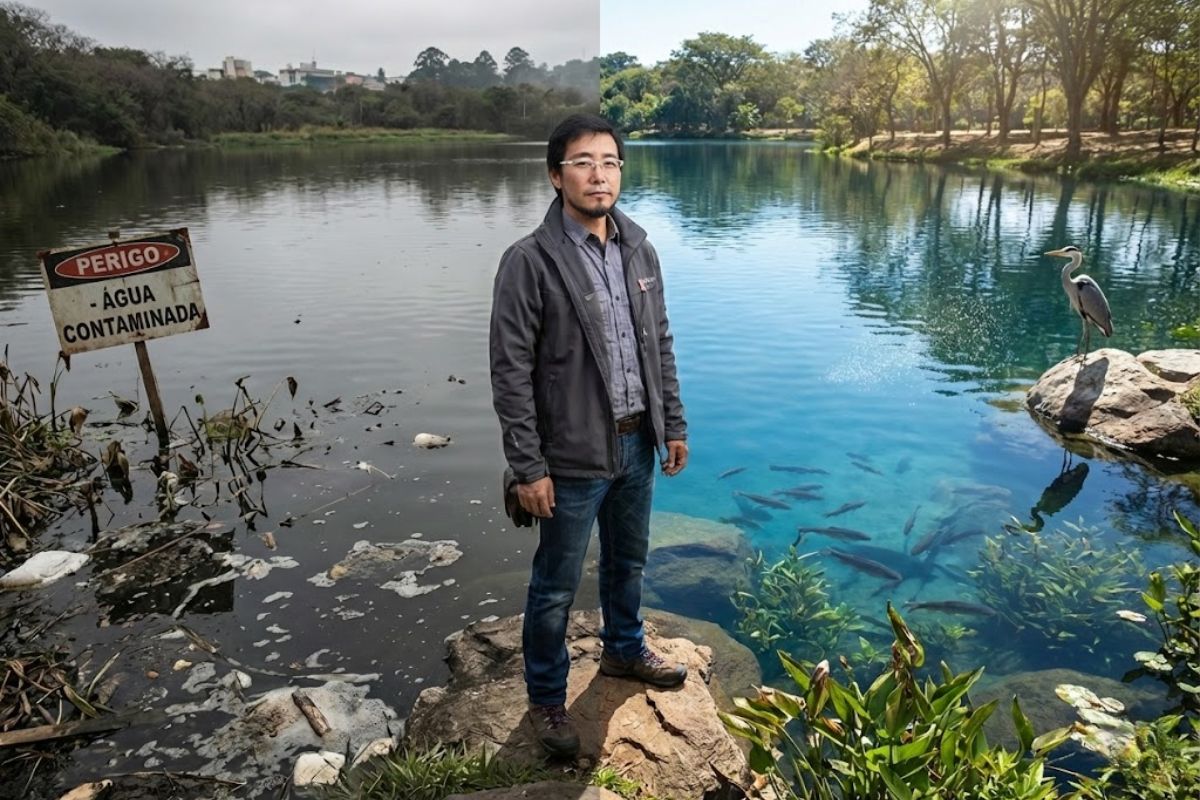
In El Cascajo, In The District of Chancay, North of Lima, a Lake and Its Swamps Became a Sewage Dump and Illegal Landfill, Until Marino Morikawa Applied Nanometric Microbubbles and Clay and Ceramic Biofilters, Accelerating Bioremediation Without Chemicals and Attracting Life Back in Weeks, Using Local Resources
The lake he knew in childhood ceased to be a landscape and became a warning when his father called to say that El Cascajo was in terrible condition. Upon visiting the site, Marino Morikawa found a scene that mixed sewage, aquatic plants dominating the surface, and an illegal landfill around it, with birds trying to feed among what seemed to be irrecoverable.
Instead of resorting to chemicals, he opted for a quieter route that is difficult to see with the naked eye: accelerating processes that already exist in nature. The bet was to combine a system of nanometric microbubbles with biofilters made from accessible materials, trying to transform a degraded environment into a functional lake again, with the return of micro-life, fish, and birds.
When a Lake Becomes Sewage, the Problem Is Not Just the Water

A sewage-contaminated lake does not just change its appearance. What changes, in the chain, is the balance between oxygen, microorganisms, organic matter, and the life that depends on it to breathe, eat, and reproduce.
-
Friends have been building a small “town” for 30 years to grow old together, with compact houses, a common area, nature surrounding it, and a collective life project designed for friendship, coexistence, and simplicity.

-
This small town in Germany created its own currency 24 years ago, today it circulates millions per year, is accepted in over 300 stores, and the German government allowed all of this to happen under one condition.

-
Curitiba is shrinking and is expected to lose 97,000 residents by 2050, while inland cities in Paraná such as Sarandi, Araucária, and Toledo are experiencing accelerated growth that is changing the entire state’s map.

-
Tourists were poisoned on Everest in a million-dollar fraud scheme involving helicopters that diverted over $19 million and shocked international authorities.


In flooded areas, such as the wetlands of El Cascajo, the surface can become overrun with aquatic plants and the water begins to carry a biological and chemical load that hinders any spontaneous recovery in the short term.
It was in this context that Morikawa decided to intervene with a very specific objective: to decontaminate without “forcing” the ecosystem with chemicals. The idea was to give a push so that the biological dynamics could work in favor of the lake again, instead of remaining trapped in a cycle of decomposition and proliferation of contaminants.
What Are Nanobubbles and Why Do They Act Where the Eye Cannot Reach

The heart of the method is a system of nanometric microbubbles: bubbles about 10,000 times smaller than those in a soft drink. The difference in scale is not a cosmetic detail; it is functional. Because they are extremely small, they rise much more slowly and remain in the water for four to eight hours, crossing layers where pollution concentrates and where much of the microscopic life occurs.
On the way to the surface, these microbubbles have an electromagnetic field with positive and negative ions, described as a “magnet” capable of attracting viruses and bacteria. The capture works like a kind of web: microorganisms become immobilized and die; and, if the bubbles reach the surface, they turn to gas and disappear under radiation and ultraviolet rays.
It is a process that tries to tackle the problem at the level where the water “gets sick” first, even before any improvement becomes visible in the lake.
Clay and Ceramic Biofilters: The “Solid” Part of an Invisible Solution
The second piece of the system is the biofilters. In water treatment, a biofilter is a bed of filtering medium where microorganisms settle and form a biofilm.

This biofilm acts as a living community that favors bioremediation, preserving beneficial species of microflora and helping to stabilize the lake’s environment over time.
In the case of El Cascajo, Morikawa designed biological filters with clay to retain inorganic pollutants, such as heavy metals and minerals, which adhere to surfaces and can be broken down by bacteria. He also used ceramic biofilters produced by himself in local pottery courses.

The logic behind this is simple and, at the same time, decisive for any attempt at replication: it makes no sense to depend on an expensive input in a poor area if there is local material.
El Cascajo: What Changed, In How Long, and Why This Draws Attention
The recovery began in 2010, with two inventions created by Morikawa using personal resources. In 15 days, the wetlands underwent a revitalization that had taken six months in the laboratory.
The difference between the lab pace and the field pace is precisely the point that makes this case so debated: when a lake changes quickly, the question shifts from “Did it improve?” to “What exactly changed inside?”.
In the following months, practical application continued to advance. In four months, he decontaminated the entire flooded area and significant returns of fauna were reported: at least 40 species of migratory birds returned to Lake El Cascajo, in addition to 10 species of fish.
In 2013, about 60% of the swamps were already inhabited by migratory birds, especially the Franklin’s gulls, which use the area as a stopover on their route from Canada to Patagonia. For a lake that had turned into a sewage dump, the return of animals serves as a biological thermometer that rarely goes unnoticed.
Why It “Worked” There: Local Conditions, Simple Materials, and an Acceleration Strategy

A detail frequently overlooked in environmental recovery stories is the weight of context. El Cascajo is an ecosystem of approximately 50 hectares in the district of Chancay, north of Lima, and the initial diagnosis included sewage, aquatic plants covering the swamp, and an illegal landfill.

By choosing materials from hardware stores and local ceramics, Morikawa reduces reliance on sophisticated infrastructure, which can be crucial in regions with limited access to technology.
At the same time, the strategy is not to “replace” nature, but to accelerate already existing processes. “Nature does its work. All I do is give a boost to speed up the process,” was the way he found to explain the principle.
Practically speaking, the system attempts to operate on two fronts: reducing the harmful biological load with microbubbles and dealing with some of the inorganic pollutants with biofilters, creating conditions for the lake to once again support healthy micro-life and, afterward, larger organisms.
From the Recovered Swamp to Lake Titicaca: What Changes When the Lake Is Gigantic and Emblematic
After El Cascajo, the focus shifts to a much more challenging target: Lake Titicaca, between Peru and Bolivia, about 4,000 meters above sea level, described as polluted by sewage.
A lake with such geographical, cultural, and ecological weight imposes another type of demand: it is not enough to see sporadic improvements; it is necessary to sustain recovery and address continuous sources of pollution, something that typically involves the city, sanitation, oversight, and habits.
Morikawa is also eyeing the Huacachina lagoon, near the city of Ica, in southern Peru, where the water is said to have stopped infiltrating naturally in the 1980s.
Here, the challenge is no longer just “cleaning” but also includes the physical dynamics of the lake: infiltration, water balance, renewal, and stability. Scaling a method is not just about repeating the technique; it is about adapting the design of filters, calibrating the application of microbubbles, and understanding the particularities of each water body.
What This Case Suggests for Global Efforts Against Water Pollution
The idea of invisible nanobubbles touches on a sensitive point in the fight against pollution: time. When discussing degraded lakes, the common expectation is years, sometimes decades, to see consistent improvement.
The case of El Cascajo draws attention precisely because it challenges this intuition, arguing that certain steps can be accelerated without resorting to chemicals, as long as the biological logic of the system is respected.
But there is a limit that cannot be ignored: a lake cannot remain clean if it continues to receive the same load of sewage and waste.
Nanotechnology can help recover, stabilize, and restore life, but the harsher question remains structural: what happens after the “revitalization” if the source of pollution is not controlled? It is this combination, technology + water governance, that can determine whether the story becomes an inspiring exception or a replicable path.
What makes this Peruvian lake so symbolic is not just the speed of improvement but the choice to confront pollution with something almost invisible, based on natural processes and simple materials.
Between microbubbles that remain in the water for hours and biofilters adapted to the place, the recovery of El Cascajo presents a huge issue: how far can we accelerate the healing of a lake without masking the problem?
If you think of a lake, reservoir, or stretch of water in your region, what is the main source of pollution you see daily: sewage, garbage, metals, lack of circulation?
And, to be completely honest, would you trust more in an “invisible” solution, like nanobubbles, or would you only believe after seeing animals returning and the water genuinely changing?










-

-

4 pessoas reagiram a isso.