





 Portuguese
  English
  Spanish
  5 min of reading
  0 comments


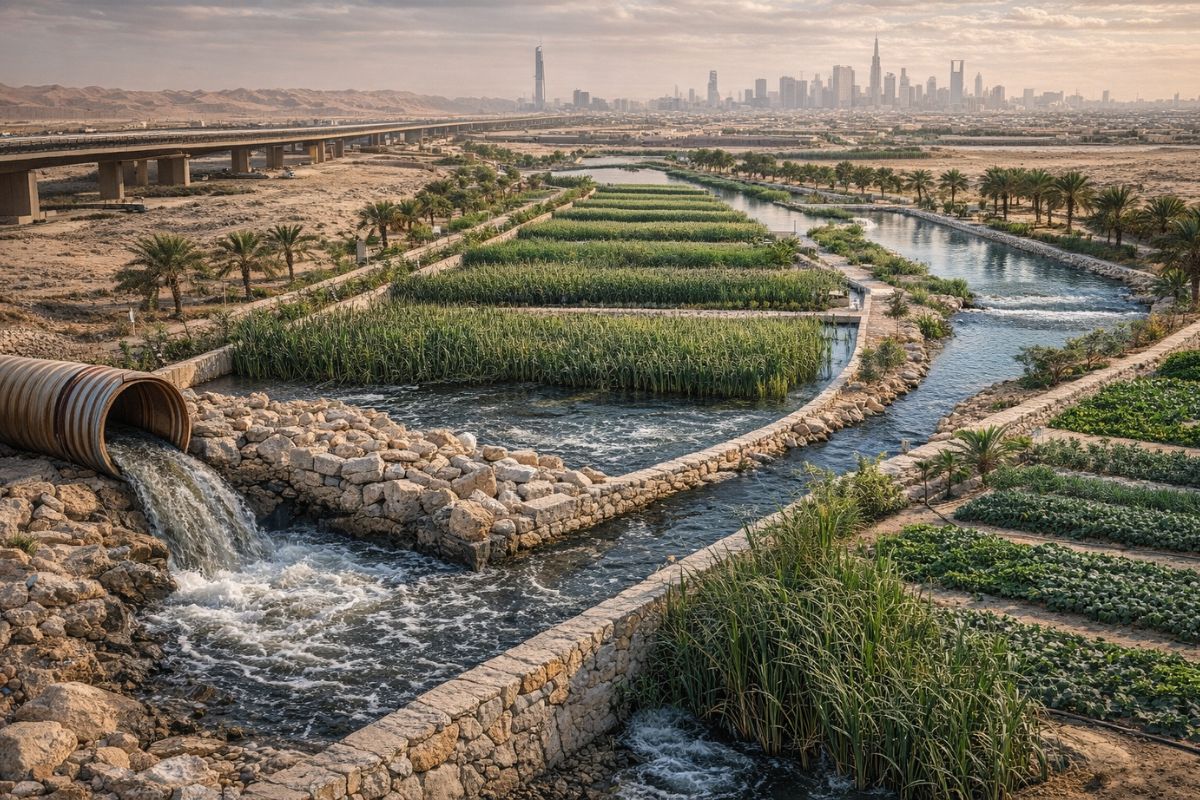
In The Megacity In The Desert Of Riyadh, A Green Corridor In Wadi Hanifa Became A Bioremediation Laboratory: Millions Of Gallons Daily Are Diverted By Gravity To Biocells, Undergo Three Filtration Cycles In 21 Hours, Removing 94% Of Solids And 89% Of Fecal Coliforms, And Return To Irrigation For Local Agriculture.
The megacity in the desert of Riyadh faces a water paradox: every drop has a high cost, but some turns into sewage in just a few hours. It was from this waste that a solution based on ecosystems emerged, where plants and microorganisms do the heavy lifting of purification on an urban scale.
At the center of this operation is the Wadi Hanifa corridor, which has been described as a critical point of health risk due to the mixing of sewage, industrial effluents, and urban runoff. What was once a public health issue has now become a green infrastructure, capable of returning treated water for irrigation while sustaining aquatic life and birds in the midst of the hyper-arid environment.
Wadi Hanifa: From Polluted Drain To Green Corridor Under Urban Pressure

Wadi Hanifa runs through the urban area and has a history of contamination from leaks, septic systems, industrial effluents, and rainwater runoff carrying city waste.
-
Friends have been building a small “town” for 30 years to grow old together, with compact houses, a common area, nature surrounding it, and a collective life project designed for friendship, coexistence, and simplicity.

-
This small town in Germany created its own currency 24 years ago, today it circulates millions per year, is accepted in over 300 stores, and the German government allowed all of this to happen under one condition.

-
Curitiba is shrinking and is expected to lose 97,000 residents by 2050, while inland cities in Paraná such as Sarandi, Araucária, and Toledo are experiencing accelerated growth that is changing the entire state’s map.

-
Tourists were poisoned on Everest in a million-dollar fraud scheme involving helicopters that diverted over $19 million and shocked international authorities.


Families and farmers living along the valley felt the direct impact because the contaminated flow was not confined to the landscape: it connected to the soil, the banks, and agricultural use.
The turning point occurs when the megacity in the desert needs to deal with its own growth. Riyadh is presented as a constantly under construction zone while the surrounding territory is hyper-arid.
With no local water in reliable quantity, sanitation ceases to be just cleaning and becomes a survival strategy, as sewage comes to be viewed as a reusable water source.
The Invisible Gear: Gravity, Three Passes, And 21 Hours Of Retention

The system operates by gravity diversion: millions of gallons per day are channeled to the top of the set and follow through a central channel. From there, the water diagonally flows through the wetlands, called biocells, and enters successive ponds.
Each portion of water passes through the biocells three times before completing the total journey in 21 hours.
The design does not rely on a single “magic tank.” It repeats steps, creates retention, and favors contact between water and living surfaces.
The results visible in the system’s own data are objective: 94% removal of suspended solids and 89% reduction of fecal coliforms. It is not a generic promise, but a measured performance within the logic of ecological treatment.
What Plants Do, And What Stones And Air Do Together
The biocells combine physical, chemical, and biological processes. The first section injects air and elevates dissolved oxygen, which benefits aquatic organisms and hinders the survival of certain unwanted microorganisms.
Next, the water encounters a rocky layer covered by a living biofilm, with algae, plants, and microorganisms that “digest” part of the pollutants.
After this living filter, the flow overflows into a central marshy area, with islets planted with trees and shrubs. There, excess nutrients such as nitrogen and phosphorus, common in household waste, are incorporated into the food chain.
The idea is to push excess nutrients upward, converting pollutant load into biomass, while simultaneously reducing harmful microorganisms along the way.
Riffles, Fish, And Birds: When Sanitation Creates Habitat Instead Of Just Disposal
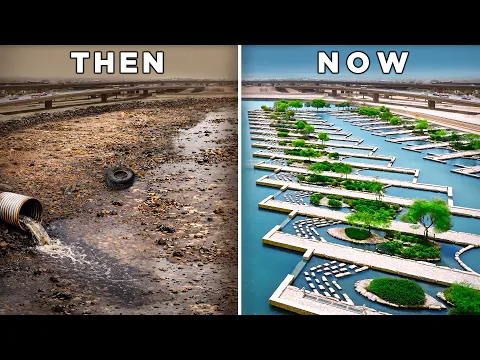

The riffle section, with stones forcing movement and turbulence, increases the contact area and sustains more biofilm, while also maintaining oxygenation.
This keeps the cleaning active and creates habitat. The presence of fish appears as a direct consequence of the environmental improvement, and the fish attract aquatic birds that find abundant food.
This side effect is not trivial in a megacity in the desert. A treatment system that becomes an oasis changes people’s relationship with the valley, as the corridor ceases to be synonymous with bad smell and risk and begins to serve as a recreation area, as well as a wildlife route.
Here, sanitation also involves urbanism and applied ecology.
Local Agriculture, Treated Water, And The Account That Closes In The Field
Treated water does not remain “trapped” at the station. It flows down for agricultural use, irrigating local farms that, according to reports, underwent a period of abandonment when conditions were uninhabitable along the valley.
Through reuse, what leaves the city returns as a resource for planting and maintaining a green cover in the vicinity.
An example mentioned is Kajer Farm, in Wadi, operating with separated uses: gray water directed to trees, with jujube cultivation as the main species to generate by-products and market sales.
The deciding point is that treated sewage becomes an irrigation input, reducing reliance on expensive energy solutions for each new productive hectare.
Desalination, Long Pipelines, And Why Sewage Became A Strategic Asset
The megacity in the desert relies on water imported from afar, including desalination, described as an energy-intensive process, and transported through pipelines nearly 400 km across the desert.
This creates an embedded energy cost in every drop that reaches the taps and then goes to the toilet, sink, and washing.
By reusing wastewater, the city reduces part of the structural waste. The more the population grows, the more wastewater there is, and this becomes fuel for the very biological system, which can expand alongside the demand.
It’s a cycle logic: more people, more effluent, more treated water, more irrigation, more vegetation, more urban cooling, and potential reduction of dust in severe storm events noted in reports.
The Green Goal And The Physical Limit Of The Desert
There is a large-scale greening initiative with a goal of planting 7.5 million trees by 2030. However, planting millions of trees in a territory that receives about 100 millimeters of rain per year and has evaporation more than 25 times higher requires constant water.
The system was designed to produce 45 million gallons per day of treated wastewater, precisely to meet this demand.
This alters the debate on “green” in the desert: it is not just about urban aesthetics, but about water and sanitation infrastructure. Without reuse, the water bill becomes an economic and energy bottleneck. With reuse, sewage ceases to be the end of the line and becomes a stage in a circuit that sustains local agriculture and afforestation.
The megacity in the desert of Riyadh is showing a path where engineering and ecology do not compete but fit together. The diversion of millions of gallons per day to artificial wetlands, with 21 hours of retention and three passes through biocells, transforms a sanitation liability into water for irrigation, food for ecological chains, and support for a green corridor that was once synonymous with risk.
If you lived in a city that depends on expensive and imported water, would you accept irrigating parks and farms with treated wastewater, knowing that tests show reductions in solids and coliforms? In your neighborhood, which problem do you think is most urgent to solve with large-scale ecological solutions: sanitation, extreme heat, or dust storms?










-

-

-

6 pessoas reagiram a isso.