





 Portuguese
  English
  Spanish
  4 min of reading
  0 comments


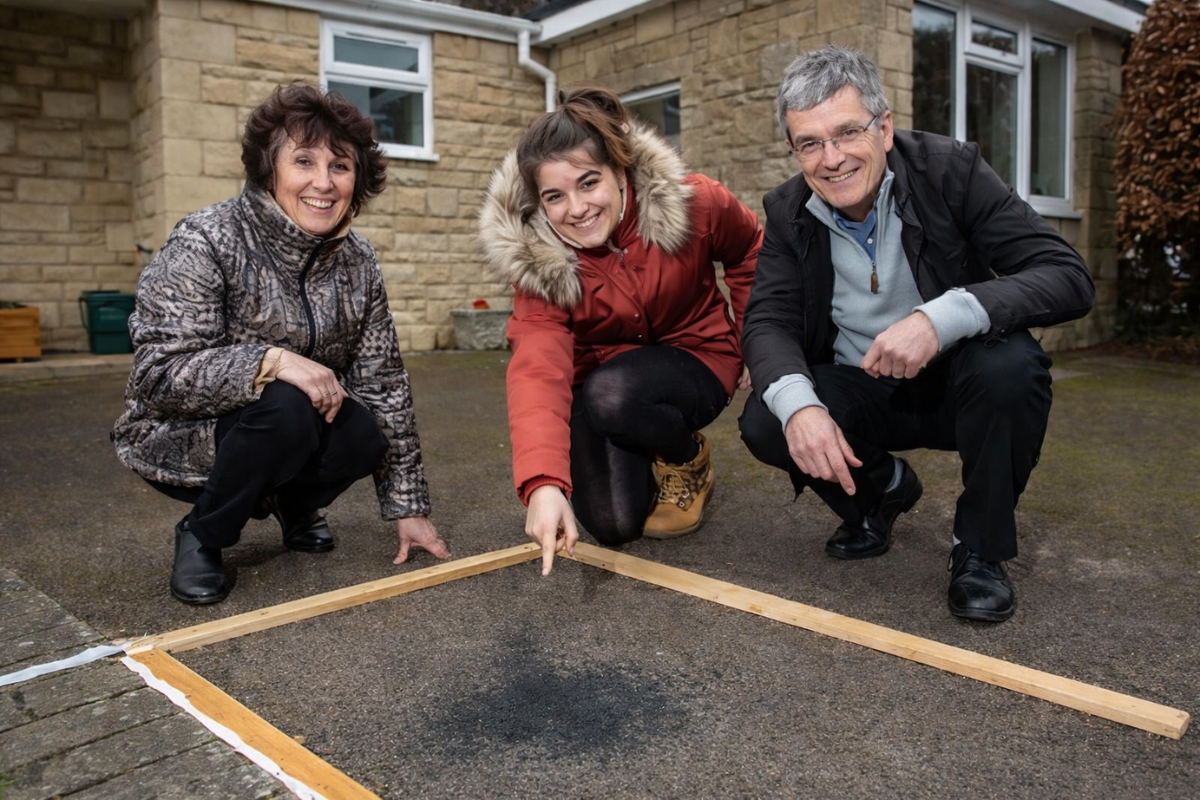
A Newly Arrived Meteorite From Space Hits The Ground Of An English Garage, Leaves Preserved Physical Traces In A Square Meter Of The Floor, Is Displayed In A National Museum, And Becomes A Key Piece To Understand Magnetism, Water, And Chemistry Of The Primitive Solar System
A meteorite fell at the entrance of a family’s garage in the United Kingdom, and no one believed it until they saw the marks.
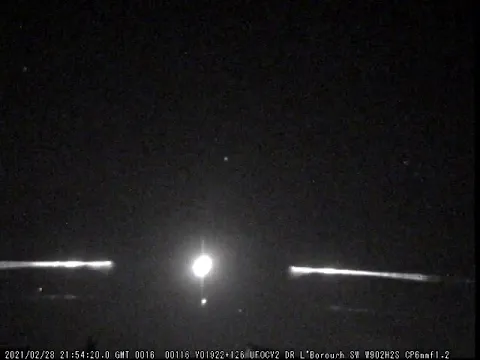
It was 9:54 PM on a calm night in the UK when the sky lit up as if it were daytime. A fireball streaked across the country at high speed, leaving a bright trail that was seen from different cities and recorded by cameras of enthusiasts… and even by residential video doorbells.
What seemed like just a quick spectacle turned into one of the most valuable finds for planetary science in recent years: a fragment of space rock, as old as the Solar System itself, broke apart in the atmosphere and fell in a region of Gloucestershire, in southern England.
-
Friends have been building a small “town” for 30 years to grow old together, with compact houses, a common area, nature surrounding it, and a collective life project designed for friendship, coexistence, and simplicity.

-
This small town in Germany created its own currency 24 years ago, today it circulates millions per year, is accepted in over 300 stores, and the German government allowed all of this to happen under one condition.

-
Curitiba is shrinking and is expected to lose 97,000 residents by 2050, while inland cities in Paraná such as Sarandi, Araucária, and Toledo are experiencing accelerated growth that is changing the entire state’s map.

-
Tourists were poisoned on Everest in a million-dollar fraud scheme involving helicopters that diverted over $19 million and shocked international authorities.


A Thunder In The Night And An Unexpected Discovery
Minutes after the flash, around 10 PM, a member of the Wilcock family heard a noise outside their home. It wasn’t an explosion. They described the sound as something heavy falling to the ground, akin to a large picture frame crashing down from the wall.
At that moment, they had no idea they were the only people in the world to hear the fall of a meteorite newly arrived from space.
Checking the garage entrance, they found something strange: small dark fragments resembling pieces of coal, and a faint mark on the floor. During family group conversations, a suspicion arose: could this be related to the fireball the night before?
Without special equipment, they improvised containers with what they had at home, yogurt pots and plastic bags, and carefully collected the pieces.

The Speed That Made The Meteorite Even More Valuable
The family contacted the Natural History Museum in London, and researchers quickly mobilized to analyze the material. The agility was crucial.
Since the fragment was collected almost immediately, it wasn’t exposed to rain, which helped preserve sensitive compounds, including water-soluble materials that typically get lost when a meteorite is left outside for too long.
The object was classified as a carbonaceous chondrite, a type of meteorite that holds primitive materials from the early Solar System. Although it is not the rarest, it is extremely important for science, especially when well-preserved.
The conservation state allowed researchers to compare the fragment with samples collected directly from asteroids by space missions.

From The Garage Floor To The Museum
The story also took on a curious and human side. Part of the garage floor where the meteorite fell was preserved. Months later, an area of about one square meter was carefully removed to keep the exact point of impact intact, something unusual, as the simplest thing would have been to break everything and replace the floor.
Today, the fragment recovered by the family is on display at the Natural History Museum in London, alongside a larger portion found later in a field by a volunteer associated with the University of Glasgow. Other pieces have also become part of local collections.
For scientists, this represents a rare opportunity to study primordial material from the Solar System in a relatively pure state, with analyses investigating everything from signs of interaction with water to the presence of organic molecules.
For an ordinary family, it was a night they will never forget: the day a cosmic visitor over 4 billion years old literally fell on their doorstep.
(The event occurred in 2021.)










-

-

-

3 pessoas reagiram a isso.