





 Portuguese
  English
  Spanish
  3 min of reading
  0 comments


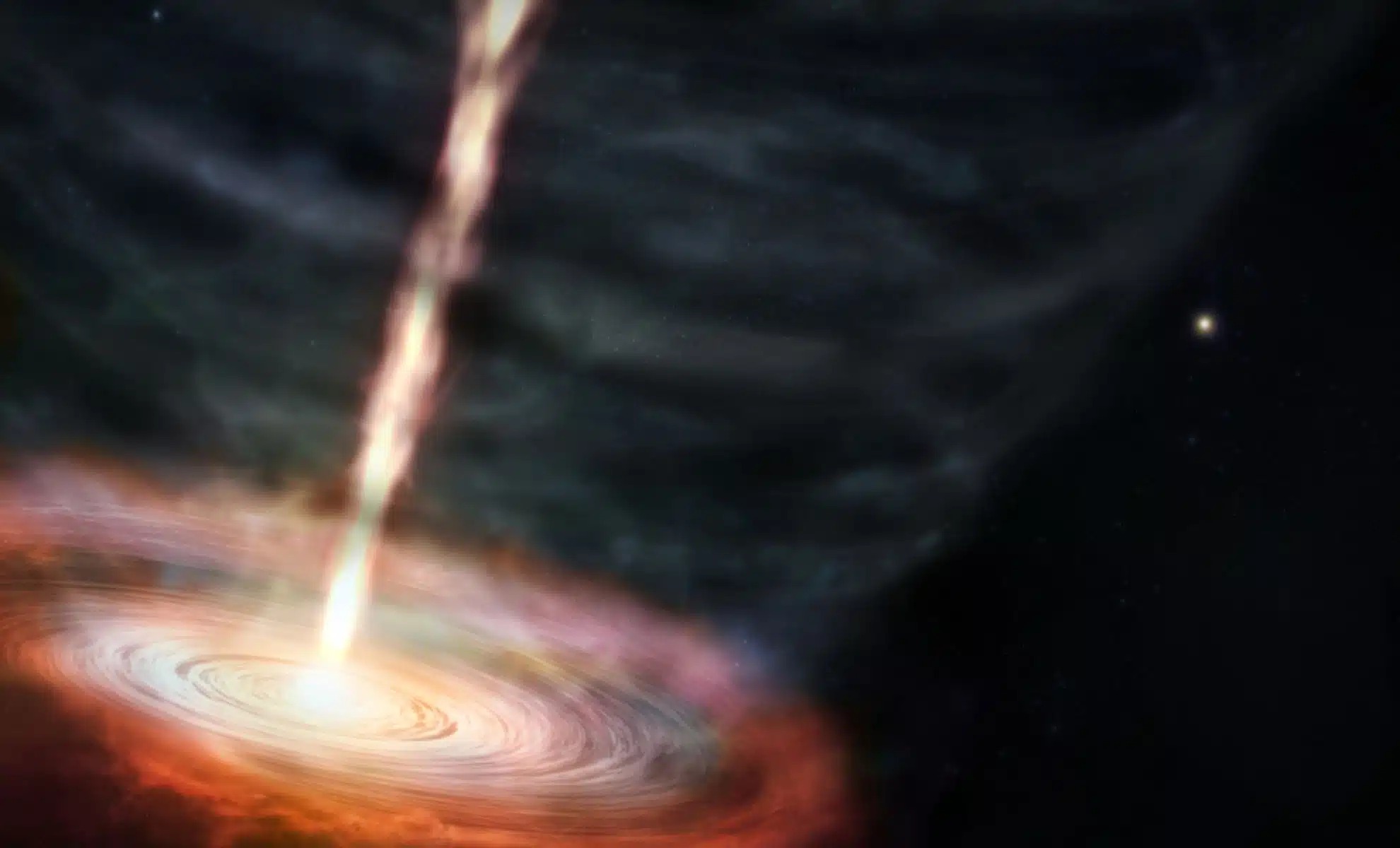
Detection of the Microwave Laser at 1667 Megahertz, Amplified by Gravitational Lens and Recorded by the MeerKAT Array with 64 Antennas, Reveals Gigamaser at Nearly 8 Billion Light-Years and Expands the Investigation of Galactic Collisions in the Young Universe
Astronomers have identified the most powerful and distant microwave laser ever observed, originating from the collision of two galaxies nearly 8 billion light-years from Earth. Detected at 1667 megahertz, the signal was immediately recognized as a record due to its exceptional intensity.
Fortuitous Detection at 1667 Megahertz Reveals Immediate Record
The discovery occurred during observations of the galaxy H1429-0028 with the array of 64 MeerKAT antennas in South Africa. The team was led by Roger Deane from the University of Pretoria.
According to a study published on arXiv, the researchers were searching for galaxies rich in molecular hydrogen, which emit at a specific frequency. The 1667 megahertz channel was checked almost casually.
-
Motorola launched the Signature with a gold seal from DxOMark, tying with the iPhone 17 Pro in camera performance, Snapdragon 8 Gen 5 that surpassed 3 million in benchmarks, and a zoom that impresses even at night.

-
Satellites reveal beneath the Sahara a giant river buried for thousands of kilometers: study shows that the largest hot desert on the planet was once traversed by a river system comparable to the largest on Earth.

-
Scientists have captured something never seen in space: newly born stars are creating gigantic rings of light a thousand times larger than the distance between the Earth and the Sun, and this changes everything we knew about stellar birth.

-
Geologists find traces of a continent that disappeared 155 million years ago after separating from Australia and reveal that it did not sink, but broke into fragments scattered across Southeast Asia.

When pointing the instrument at H1429-0028, the team identified a signal described as enormous and thunderous. According to Deane, it was immediately recognized as a record, marking a fortunate coincidence during data analysis.
H1429-0028 and the Gravitational Lens Effect
The galaxy H1429-0028 had its light distorted and magnified by a foreground galaxy acting as a gravitational lens. This effect made it possible to observe the phenomenon with greater clarity.
Combined images from Hubble and Keck II show the foreground galaxy as a diagonal stripe, while the background galaxy appears to form a distorted ring.
The intensity of the signal classified the phenomenon as the brightest and most distant maser ever observed. The detected microwave laser surpasses previous records in brightness and distance.
How Galaxy Collisions Generate the Microwave Laser
Masers are the microwave equivalents of lasers. While lasers emit coherent visible light, masers produce highly focused radiation at microwave frequencies.
In galaxy collisions, clouds of gas are compressed, triggering intense star formation. The light from newly formed stars passes through clouds of dust, exciting hydroxyl ions composed of hydrogen and oxygen.
When these excited ions are struck by radio waves produced near a supermassive black hole, they release energy in the form of coherent microwave radiation. The result is a highly concentrated beam at a single frequency.
Deane stated that the phenomenon can be classified as a gigamaser, a more powerful category than the megamasers detected in closer galaxies. Its brightness is about 100,000 times greater than that of a star, concentrated in a small portion of the electromagnetic spectrum.
Microwave Laser as a Tool for Studying the Young Universe
As H1429-0028 is nearly 8 billion light-years away, the detected radiation began its journey when the universe was much younger. The microwave laser provides information about processes of merging and galactic evolution over cosmic time.
Matt Jarvis from the University of Oxford highlighted that these signals emerge only under very precise conditions.
According to Jarvis, continuous radio emission and infrared emission from heated dust surrounding forming stars are needed. These specific physical conditions occur when galaxies are merging.
He added that future observations with the Square Kilometre Array, MeerKAT’s more sensitive successor in South Africa, should allow the detection of similar masers at even greater distances.
The current record sets a milestone in observing extreme phenomena associated with galaxy collisions. Identifying the microwave laser expands the capacity to investigate rare environments in the distant universe and understand how these structures have evolved over cosmic time.








-

-

-

-

5 pessoas reagiram a isso.