





 Portuguese
  English
  Spanish
  4 min of reading
  0 comments


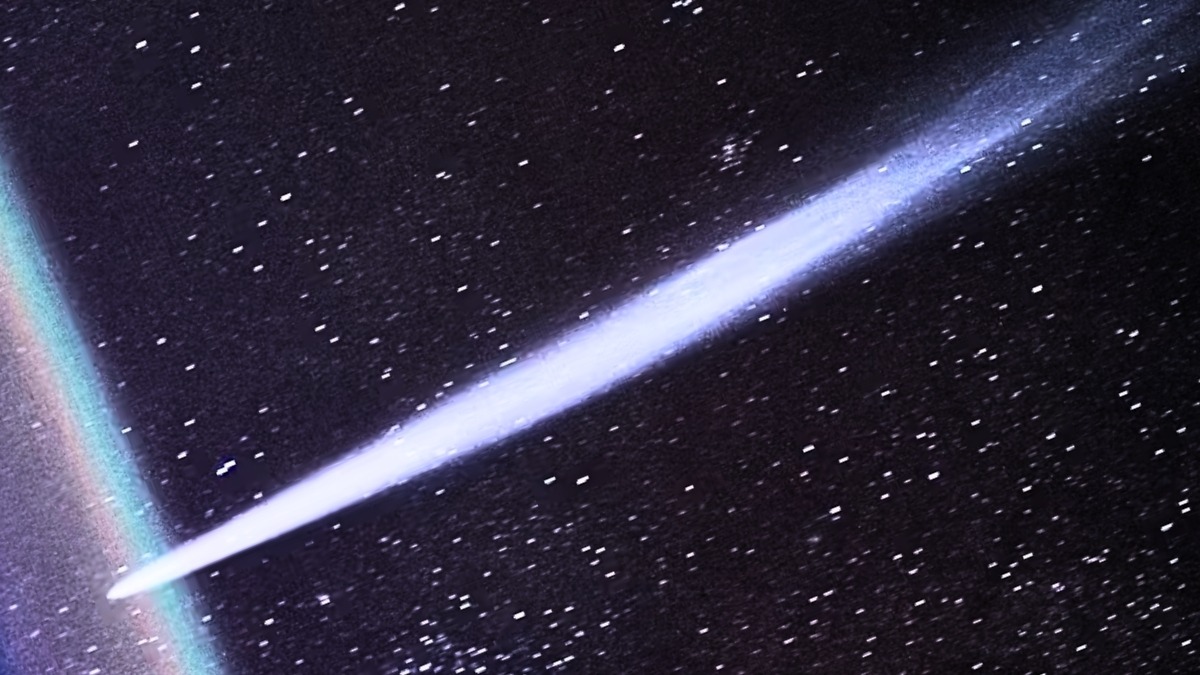
Comet C/2026 A1 (MAPS), Discovered on January 13 in the Atacama Desert, Is Part of the Kreutz Family of Sungrazing Comets, Will Pass 120,000 km from the Sun in Early April and May Reach Brightness Sufficient for Nighttime and Even Daytime Visibility If It Survives Perihelion
A newly discovered comet may soon shine brightly in our skies. Comet C/2026 A1 (MAPS), identified on January 13 in the Atacama Desert, will pass 120,000 km from the Sun in early April and may become visible even in broad daylight.
Comet C/2026 A1 (MAPS) Joins Group of Kreutz Sungrazing Comets and May Feature in a Spectacle in Early April
Comet C/2026 A1 (MAPS) was spotted by a team of four amateur astronomers using a remotely operated telescope in the Atacama Desert. Soon after identification, it became clear that the object belongs to the group of Kreutz sungrazing comets.
This group includes some of the brightest and most spectacular comets ever observed. Comet MAPS moves in an extremely elongated orbit around the Sun and is approaching a pivotal encounter with the star.
-
USP wants to read the DNA of up to 5,000 Brazilian couples before pregnancy to discover if future babies may inherit silent genetic diseases.

-
With cameras attached to their heads, thousands of workers in India are recording themselves cutting fruits, folding clothes, and cooking to train artificial intelligence robots that, in the future, are expected to take over household tasks.

-
A jacket that extracts drinking water from the air seems like something out of a movie, but it has already been tested by scientists and could become an ally in emergencies.
-
Car carrier ship may receive molten salt nuclear reactor after study evaluates shielding, stability, load, safety, and operation without refueling throughout its entire lifespan.





In early April, the comet will pass just 120,000 km from the solar surface. If it survives perihelion, it could become a significant spectacle in the night sky, with the possibility of visibility even during the day.
However, there is a chance the comet may disintegrate before reaching its peak brightness. The expectation directly hinges on its survival during the solar approach.
Fragments of a Megacomet Over 100 km Gave Rise to Sungrazing Comets Observed Over 2,000 Years
Over the last 2,000 years, various spectacular comets have seemingly appeared out of nowhere, shining brightly near the Sun. Some have reached brightness sufficient to be seen in broad daylight.
Historically, the brightest are known as Great Comets. The Great Comet of 1965, C/1965 S1 Ikeya-Seki, was the brightest of the 20th century. Discovered a month before its closest approach to the Sun, it reached brightness equivalent to that of a full Moon.
The Great Comet of 1882, C/1882 R1, was even more intense. At its peak, it became one hundred times brighter than the full Moon and remained visible for several months.
Studies indicate that these comets belong to the Kreutz family of sungrazing comets and share a common origin. Between the 3rd or 4th century BC, a comet nucleus over 100 km came dangerously close to the Sun.
After this approach, far from the star, the large comet split into two main fragments and released multiple smaller pieces. In the 3rd century AD, these fragments returned in their long solar orbit.
Accounts from AD 363 suggest the simultaneous presence of several naked-eye comets during the day. Later, in the 11th century, two large fragments became the Great Comets of 1106 and 1138.
These fragments also fragmented again. The products of these successive divisions have been observed as a continuous series of comets over the last two centuries.
Recent Observations and Record Distance Reinforce Expectations Surrounding Comet MAPS
Currently, the Kreutz family of sungrazing comets includes many smaller fragments that disintegrate as they approach the Sun, as well as larger fragments capable of generating significant events.
The NASA Solar and Heliospheric Observatory, SOHO, has detected thousands of fragments from the Kreutz group over the years. Many are small icebergs just a few meters or tens of meters in diameter.
The most recent large Kreutz comet was observed in 2011. Discovered by Terry Lovejoy, the object barely survived its solar passage and reached brightness comparable to that of the planet Venus at the end of December that year.
Predictions by astronomer Zdeněk Sekanina indicate the possibility of two large sungrazing objects in the coming decades, with one potentially emerging in the next two years.
Comet C/2026 A1 (MAPS) already holds a record. At the time of its discovery, it was farther from the Sun than any other newly identified sungrazing comet up to that point.
The previous holder of that milestone was Ikeya-Seki, in 1965. Nevertheless, technological advances in the last seven decades make it unlikely that the nucleus of comet MAPS is as large as that of that event.
Still, early detection may indicate that the fragment is relatively large or undergoing significant activity. Recent observations recorded a steady increase in brightness, reinforcing the hypothesis of a larger fragment.
What May Happen at Perihelion and How the Comet May Be Observed
It is still early to determine the comet’s definitive behavior at perihelion. If it survives its closest solar approach, it may provide a relevant event in early or mid-April.
If it remains intact, there is a possibility it may reach brightness sufficient for daytime visibility. Even if it does not reach that level, the SOHO spacecraft should provide detailed images of the passage.
In the days following perihelion, the comet will enter the night sky. Due to its typical Kreutz orbit, it will be more easily observed from the southern hemisphere.
If it survives until perihelion and fragments while crossing the solar region, there could be a sudden and unexpected increase in brightness. A late fragmentation may represent the best scenario for a remarkable spectacle.
For now, it remains to monitor the development of the comet and observe its evolution as it approaches the Sun. The outcome will depend on its resilience to the intense solar approach and its behavior during perihelion, a decisive moment for determining its brightness and visibility.





Be the first to react!