





 Portuguese
  English
  Spanish
  4 min of reading
  0 comments


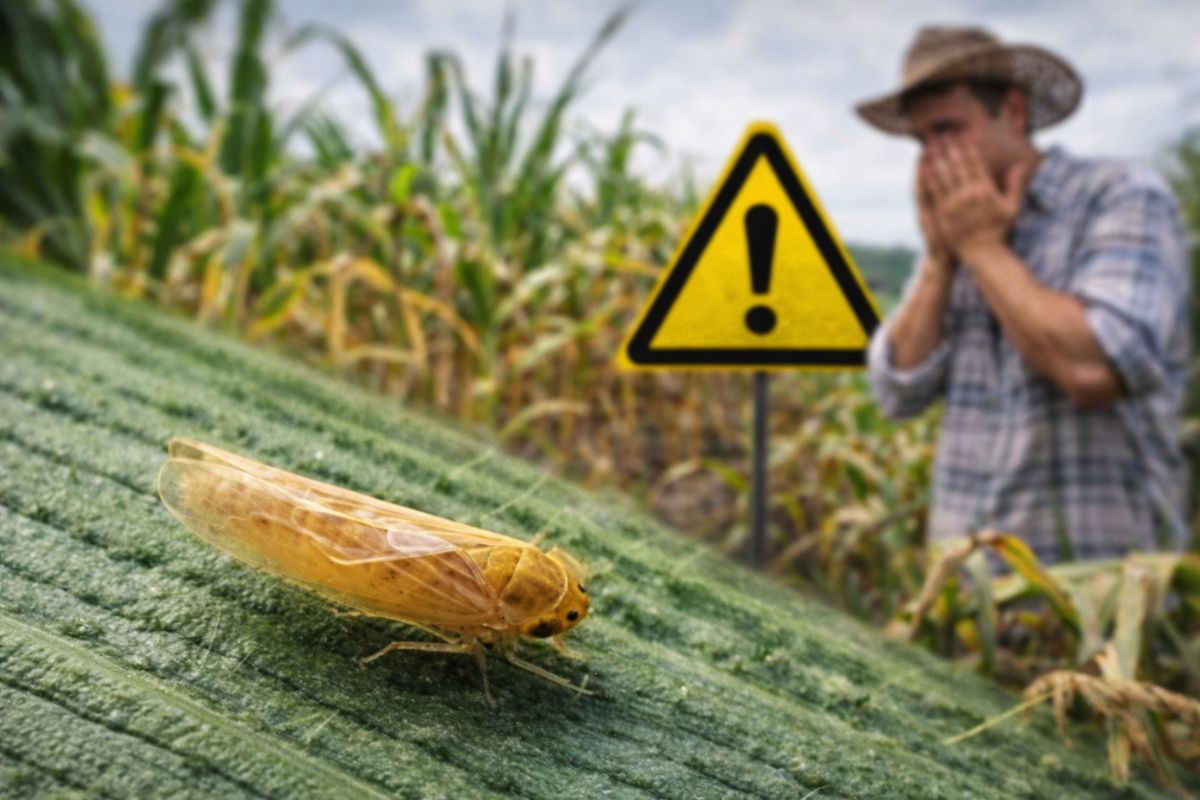
With the Harvest of the First Crop and the Second Planting Underway, the 3 mm Pest Gains Strength in Santa Catarina, Migrates to Young Plants, and Poses Farmers with a Critical Period, with the Risk of Virus-induced Yellowing and Relevant Decline in Corn Productivity in This Current Cycle.
The 3 mm pest has returned to the center of concern in the fields of Santa Catarina at a particularly sensitive moment for corn. With mature areas being harvested and new crops entering early stages, the circulation of the corn leafhopper increases the risk of infection just when the plant is most vulnerable.
The alert is not related to direct risk to humans or animals, but rather to the economic and productive impact on those who plant. The problem lies in the crops, in the potential for yield loss and in the effect that insect pressure can have on the second planting during a decisive window for crop performance.
What Ignites the Alert in Santa Catarina Now
Santa Catarina enters this period with two movements happening simultaneously in the field: the harvest of the first crop and the advancement of new corn areas.
-
The sugar-energy sector advances with agricultural technology, but agricultural productivity still raises concerns.

-
The eggshell that almost everyone throws away is made up of about 95% calcium carbonate and can help enrich the soil when crushed, slowly releasing nutrients and being reused in home gardens and vegetable patches.

-
This farm in the United States does not use sunlight, does not use soil, and produces 500 times more food per square meter than traditional agriculture: the secret lies in 42,000 LEDs, hydroponics, and a system that recycles even the heat from the lamps.

-
The water that almost everyone throws away after cooking potatoes carries nutrients released during the preparation and can be reused to help in the development of plants when used correctly at the base of gardens and pots, at no additional cost and without changing the routine.


This transition creates the ideal scenario for the movement of the corn leafhopper, as insects present in older crops tend to migrate to newly germinated or early developmental plants.
According to Epagri, there is a rise in the population of corn leafhoppers, with an average of about 85 insects per trap.
This indicator alone already raises the level of attention for producers, as it suggests greater pressure in the environment precisely when initial management needs to be more efficient to reduce the risk of productivity losses.
The Size of the Problem Goes Beyond the Insect’s Appearance
The most significant contrast in the field is simple and direct: it is a 3 mm pest, but with a history of billion-dollar impact.
According to CNA, the losses in Brazil between the 2020/21 and 2023/2024 harvests reached about US$ 25.8 billion, with an equivalent reported of 31.8 million tons per year.
This national history helps explain why the advance in Santa Catarina causes unease even before consolidated losses can be measured on each property.
The fear does not arise from the insect’s size, but from what it represents for crops in critical phases, especially when planting occurs close to areas that are already mature and have a greater presence of the vector.
Where Presence Has Been Identified and Why This Phase Is So Sensitive
A survey by Epagri in the second week of February identified the presence of the fine streak virus and the bacteria causing pale and red yellowing in eight municipalities in Santa Catarina: Bom Jesus do Oeste, Irati, Major Vieira, Mafra, Presidente Getúlio, São José do Cerrito, Tijucas, and Tunápolis.
This mapping regionalizes the risk and shows that the alert is not restricted to a single producing center.
Researcher Maria Cristina Canale from Epagri/Cepaf, who is responsible for the Monitora Milho SC program, highlights that the most critical period for infections occurs from the emergence of the plant, at the VE stage, to the early stages like V3 and V4.
In practical terms, this means that the entry of the corn leafhopper during this phase can early compromise productive potential, when the crop is still forming its development base.
Initial Management and Decisions That Can Reduce Losses
The reinforced technical guidance for producers is to carry out the initial planting management with insecticides to prevent the action of the leafhopper on new plantings and reduce the number of insects in the environment.
In a scenario of increasing pressure, response time becomes a productivity factor, as the window of greatest vulnerability for the plant is short and decisive.
In addition to direct control of the leafhopper, there are organizational measures in the field operation that factor into the risk calculation.
Epagri recommends adjusting machinery to avoid grain loss that can lead to volunteer corn, as well as avoiding the planting of new crops in areas very close to already mature plants. These are management decisions that do not eliminate the problem on their own but help reduce the circulation and pressure of the pest in the system.
What Is at Stake in the Second Corn Planting
In the short term, the focus of the farmer in Santa Catarina shifts from just the progress of the harvest to include vigilance over newly planted areas.
When the 3 mm pest advances amid this overlap between crops, the risk is losing productivity without immediate awareness, as the damage begins in the initial phase and shows up later in crop performance.
Therefore, the current alert carries both technical and economic weight at the same time. This is not an isolated episode of insect presence, but rather a context where high population density, migration from mature crops, and sensitive plant phases combine.
It is this combination of factors that worries, and not a single indicator analyzed separately.
In your region, has the corn leafhopper already appeared strongly in this planting season, or is management still managing to contain the pressure? If you plant corn in Santa Catarina, which measure has worked best in the field: initial control, distance between areas, or operational adjustments to avoid volunteer corn?










-

-

2 pessoas reagiram a isso.