





 Portuguese
  English
  Spanish
  5 min of reading
  1 comment


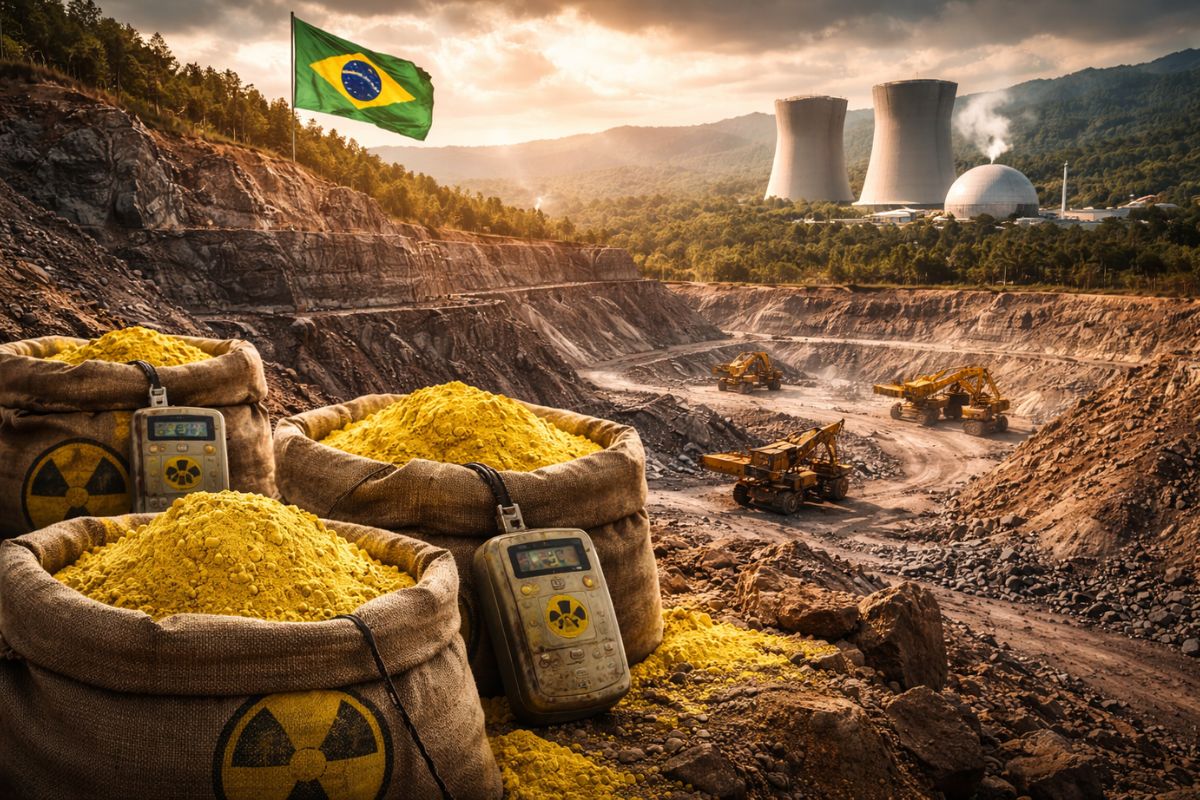


Brazilian Uranium Has Known Reserves, but Remains Stuck Due to Monopoly and Lack of Decree, Even After Law 14.514/2022 Authorizes Partnerships by INB. With Only One Active Mine and Production in 14th Place, the Country Bets on 2026 to Supply Angra 1 and Angra 2, Under Growing Global Pressure
Uranium has reentered Brazil’s strategic conversation for 2026 for a simple and troubling reason: there are indications of large reserves, but production remains modest, limited to a single active mine and a model that depends on a presidential signature to unlock partnerships.
The debate has shifted from merely technical to a contest of timing and institutional design, because the fuel that powers Angra 1 and Angra 2 is tied to monopoly rules, an already approved law, and a decree that has yet to be published.
The Pen That Becomes Rule and Becomes Market
The breaking point is concentrated in a decree: without it, the legal authorization for partnerships remains without a practical format.
-
Motorola launched the Signature with a gold seal from DxOMark, tying with the iPhone 17 Pro in camera performance, Snapdragon 8 Gen 5 that surpassed 3 million in benchmarks, and a zoom that impresses even at night.

-
Satellites reveal beneath the Sahara a giant river buried for thousands of kilometers: study shows that the largest hot desert on the planet was once traversed by a river system comparable to the largest on Earth.

-
Scientists have captured something never seen in space: newly born stars are creating gigantic rings of light a thousand times larger than the distance between the Earth and the Sun, and this changes everything we knew about stellar birth.

-
Geologists find traces of a continent that disappeared 155 million years ago after separating from Australia and reveal that it did not sink, but broke into fragments scattered across Southeast Asia.

It is a situation where permission exists on paper, but the manual that allows for real negotiations is missing, with criteria, responsibilities, and division of results.
Those advocating for acceleration argue that the central problem is not geology, but governance.
The absence of regulation keeps investors at bay and increases the risk of fragile agreements, as any arrangement is exposed to legal insecurity.
Monopoly, INB, and the Bottleneck of the Single Mine
Since the Constitution of 1988, the exploration and trade of nuclear materials have been a monopoly of the Union, a model created under the argument of sovereignty and strategic security.
In practice, this has positioned Indústrias Nucleares do Brasil, INB, as the exclusive axis for uranium in the country.
The concrete result is a difficult operational bottleneck to overcome: with only one active mine, the capacity for expansion is naturally limited.
When the structure depends on a single operator and narrow productive base, the growth pace becomes a political decision before it becomes an industrial project.
Law 14.514/2022 and the Decree That Has Yet to Be Published
The turn began to be outlined with Law No. 14.514/2022, sanctioned at the end of Jair Bolsonaro’s administration, which authorized INB to enter into partnerships with private companies throughout the nuclear fuel chain, from uranium extraction to the manufacturing of fuel used in power plants like Angra 1 and Angra 2.
However, the law has not materialized for an objective reason: the presidential decree that defines the rules for these partnerships is missing, including criteria, responsibilities, and division of results.
Since the beginning of Lula’s administration, versions of the text have been drafted in the Ministry of Mines and Energy, but none have progressed, and internal criticism has taken on a direct phrase:
“As long as this decree is not issued, there is nothing to put on the table for negotiation, and this delay is unjustifiable,” said Carlos Freire, president of INB from 2019 to 2023.
Angra 1 and Angra 2 as a Thermometer for Fuel
When the topic is uranium, Angra 1 and Angra 2 serve as the most practical test of the discussion because they depend on nuclear fuel and, by extension, on supply predictability.
The law mentioned itself addresses the entire chain, precisely to ensure that the debate does not remain confined to the mine but reaches the final product that powers the plants.
This helps explain why the conversation goes beyond mining and enters the territory of energy policy.
It’s not just about extracting more, but about creating a regulatory path that provides predictability from start to finish, from mineral to fuel, without each step turning into an improvised negotiation.
The Push from the World of Big Techs and Concentration
Urgency is also growing because nuclear energy has returned to the center of the global debate as a stable source of electricity with no carbon emissions.
In this context, major technology companies, the big techs, have started to seek this type of energy to power data centers, which helps to increase the demand for uranium.
Today, about 75% of global production is concentrated in a few countries, with Kazakhstan at 39%, Canada at 24%, and Namibia at 12%, according to the World Nuclear Association.
This setup fuels a strategic reading: if Brazil unlocks its production, it can reduce concentration and gain relevance, but this depends on clear rules and consistent execution, not just potential underground.
BNDES Enters the Game and Insecurity Remains a Stumbling Block
Amid the delays, INB itself established a partnership with BNDES at the end of 2025 to structure cooperation models with the private sector.
The bank confirmed consultations with the market to map interested parties, a sign that there is appetite and that the issue has already been placed in planning mode.
At the same time, BNDES acknowledges the limit of this movement: without the decree, any agreement remains vulnerable to legal insecurity.
It’s the kind of scenario where interest appears, but risk prevents commitment, and the political window of 2026 becomes part of the calculation.
What Is at Stake Until 2026
Brazil appears in the contrast that usually draws attention: it ranks around 8th globally in known reserves but occupies only 14th place in production ranking.
The interpretation that emerges from this imbalance is that the bottleneck is not the existence of uranium, but the model that organizes who can produce, with which partners, and under what rules.
If the signature is issued, the country can reposition its role in the global uranium landscape and internally strengthen the supply chain linked to Angra 1 and Angra 2.
If it doesn’t happen, the promise remains as a repeated potential, with modest production and a single mine supporting a topic much too large to remain on hold.
Now it’s worth listening to those outside this table: in your view, should private partnerships in uranium be treated as an economic opportunity, as a sovereignty issue, or as both at the same time? And when you think of Angra 1 and Angra 2, what weighs more: fuel predictability, institutional security, or the pace of political decisions in 2026?








O Brasil reina em 1° lugar, em incompetência e corrupção. O caso + recente: o banco Master. Dizem q o rombo é de + de 100 bilhões. Quando vier à tona, acho q o buraco é ainda maior!!!
Dizem que não se fazem obras estruturantes é p/falta de recursos. O rombo do Master dava p/fazer 6 ferrovias do porte da Transnordestina, que já tá com mais de 20 anos e sequer fizeram a primeira etapa da obra, que é a ligação do Piauí ao porto de Pecem-CE. Para o desenvolvimento do país, não tem dinheiro, mas p%corrupção não falta e é rápido p/desviar e o país nunca sai deste mar de lama!