





 Portuguese
  English
  Spanish
  6 min of reading
  0 comments


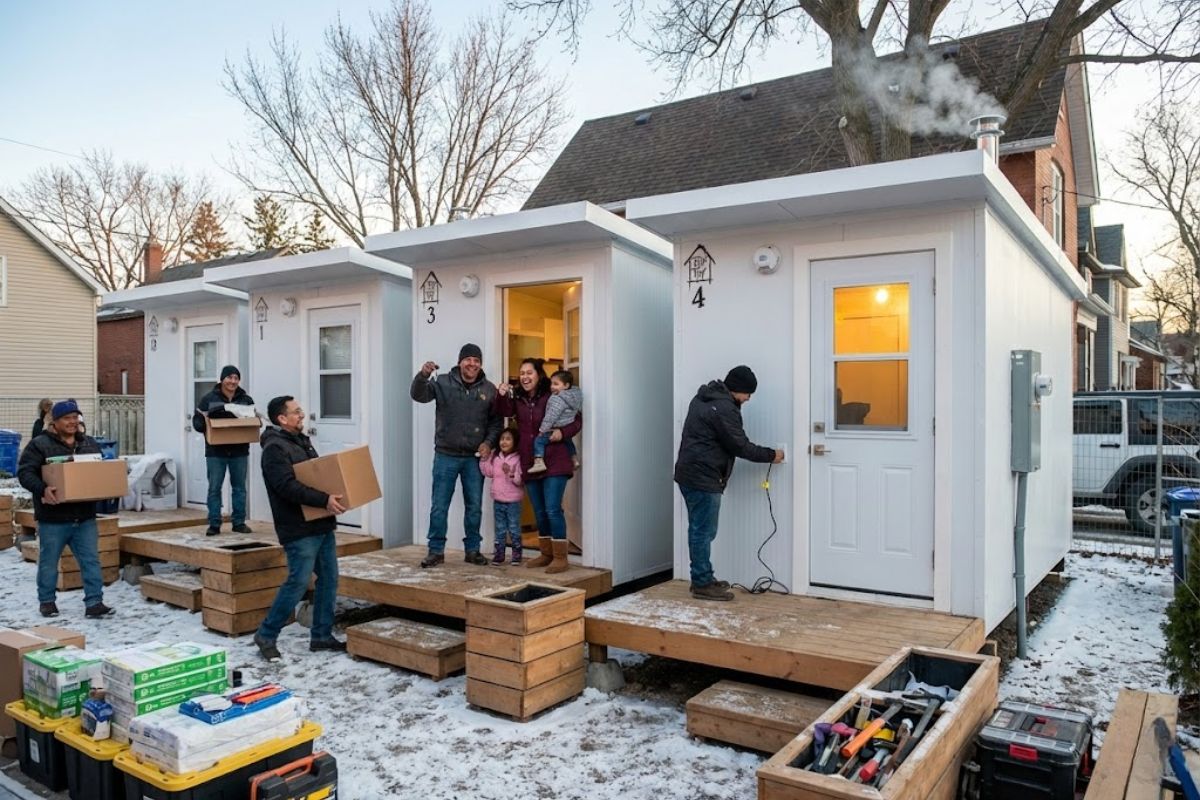
In Leslieville, a row of heated microhomes resumed functioning as temporary housing after leaving St. James Park, now with insulation panels, lighting, electricity, and smoke detectors. Seeds of Hope welcomes four new units in the backyard of the House of Lázaro, offering a bathroom, kitchen, weekly grocery shopping, and support.
Microhomes have once again represented, for some people in Toronto, something that seemed distant: the chance to close a door and sleep with heating, after years of alternating between streets and shelters. In Leslieville, four new units have been installed and began receiving residents with social support and basic structure.
At the same time, the story carries a sensitive point: these microhomes were removed from St. James Park after a cease-and-desist letter and assistance was sent by the city, and the organization behind the project is trying to expand the model without losing focus on the ultimate goal, permanent housing.
A Discreet Address, A Clear Function: Transition With Safety

Cease-and-desist letter and assistance.
The microhomes are now in the backyard of the House of Lázaro, in Leslieville, described as a transitional home managed by the Seeds of Hope Foundation.
-
Friends have been building a small “town” for 30 years to grow old together, with compact houses, a common area, nature surrounding it, and a collective life project designed for friendship, coexistence, and simplicity.

-
This small town in Germany created its own currency 24 years ago, today it circulates millions per year, is accepted in over 300 stores, and the German government allowed all of this to happen under one condition.

-
Curitiba is shrinking and is expected to lose 97,000 residents by 2050, while inland cities in Paraná such as Sarandi, Araucária, and Toledo are experiencing accelerated growth that is changing the entire state’s map.

-
Tourists were poisoned on Everest in a million-dollar fraud scheme involving helicopters that diverted over $19 million and shocked international authorities.


The relocation occurred after units that were in St. James Park were removed in the spring, in a process that involved dialogue to direct residents to permanent housing and gradually remove the homes from the park.
This new arrangement reinforces what the project claims to seek: a transitional tool, not a definitive destination. For those who have lived for years in shelters and on the street, the logic is simple and powerful: a small space, but their own, where a person can regain routine, feel safe, and start to reorganize their life.
What Changed in the Microhomes: Weather Resistance and Protection Items

The older units were described as built to respond to encampments, with running water, gas heating, and electricity.
The new phase begins with a design aimed at better withstanding the elements: insulation panels, lighting, and a more “resistant” structure, along with safety items that appear as practical priorities, such as smoke detectors.
A technical detail cited as part of the set is the inspection seal linked to the ESA electrical certification. In practice, this ties to a recurring concern in improvised shelters: reducing electrical risks and providing predictability in the use of heating and lighting.
This is not a luxury, it’s risk mitigation in a scenario where the cold can be as threatening as urban insecurity.
The Microhome Does Not Solve Itself: What Exists “Outside” Of It

Even with locks and basic items, life in these microhomes is designed to rely on a larger structure.

Those living in the units have direct access to the House of Lázaro, with an assigned unit that includes a bathroom, kitchen, and weekly grocery shopping. This detail changes daily life because it shifts essential needs to a space with support and rules, reducing improvisation.
A resident, Paul Corbett Greer Juel, summarizes the effect with an emotional and objective phrase: he said that the shelter saved his life, highlighting the presence of the heater and the feeling of relief associated with the early arrival of Christmas.
It was also reported that a 65-year-old woman moved into the row of houses after years of sleeping on the streets and in shelters, describing the place as safe and welcoming, and as a base for seeking employment and “getting back on track.” The focus here is not just a roof; it’s a minimum stability to start over.
The City at the Center of the Impasse: Removal from the Park and the Authorization Issue
The project carries a history of friction with public authorities. In St. James Park, there was a moment when five little houses were lined up in the northeast corner until the city sent the founder a cease-and-desist letter and assistance.
Later, according to reports, there was collaboration to guide people to permanent housing and, as each one was accommodated, the homes were removed from the park one by one.
Now, the challenge appears in another form: Seeds of Hope claims that it rents the property where the microhomes were placed and that it had the owner’s support to install them, but it also acknowledges that they do not have permission to be there.
This point is where interpretations tend to split: for some, the humanitarian urgency justifies quick solutions; for others, the absence of authorization signals institutional fragility, especially when thinking about expansion and standardization.
Neighborhood and Perception: When the Solution Exists but Goes Unnoticed
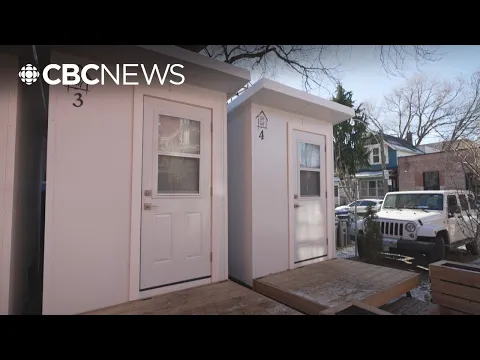

A curious aspect is the reaction from the surroundings. It was reported that neighboring businesses had not even noticed the microhomes, even though they are visible from the street.
This may suggest two things simultaneously: the installation is discreet enough not to alter the visual routine of the neighborhood, and the housing crisis could be happening “next door,” without becoming public conversation.
A nearby resident said she saw the houses being brought in but did not initially know what they were. She also pointed out that it would be important to inform the neighborhood and that, if people knew better what it was about, they might be able to help.
Community transparency becomes part of the project, as local acceptance can be decisive when the proposal is to expand units and maintain stable support over time.
Where This Model Can Go: Expand Without Losing the Goal of Permanent Housing
Tiny Tiny Homes still hopes to work with the city to take more people off the street and out of the cold, while residents and the founder hope the municipal government will be more understanding “this time.”
At the same time, the narrative itself recognizes that the intended definitive solution is not the microhome itself, but the transition to permanent housing, using the structure as a bridge.
Along the way, the project also indicates evolution: the founder is building a larger model, with a sink and enough space for a couple or a small family.
This direction raises practical questions that usually accompany such initiatives: how many units fit without becoming a new type of encampment, who is prioritized when there are few vacancies, and how to ensure that microhomes remain a transition, and not a forced destination due to a lack of permanent alternatives.
Heated microhomes, with electricity, smoke detectors, and access to social support, may seem too small for the size of the problem.
Even so, in the lives of those who have spent years between streets and shelters, four doors can mean the difference between surviving the cold and managing to reorganize their paths, while the city tries to balance urgency, rules, and scale.
If microhomes were installed in your neighborhood to shelter people in the winter, what would make you feel comfortable or concerned, and why? Do you think the neighborhood should be notified beforehand, or should the priority be to get the units operational immediately? And in your view, what is the minimum level of support that transforms a microhome into a real bridge to permanent housing?










-

3 pessoas reagiram a isso.