





 Portuguese
  English
  Spanish
  5 min of reading
  0 comments


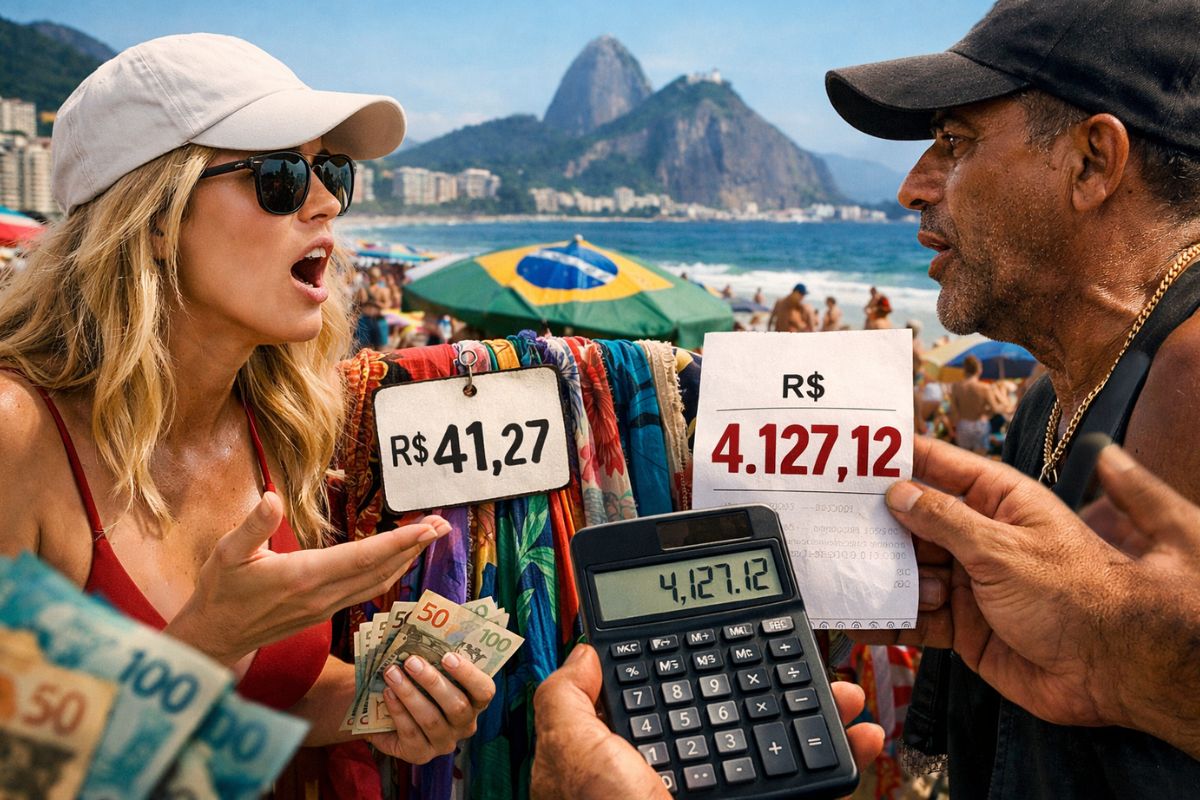
The American Tourist Amber Berumen, a Digital Nomad on Vacation in Brazil for Almost Two Months, Said on Instagram That a Seller in Rio Tried to Charge R$ 4,127.12 for a Sarong Priced at R$ 41.27; She Claims to Have Seen Extra Digits on the Card Reader and the Video Has Already Surpassed 275 Thousand Views.
The tourist Amber Berumen from the United States reports that she has been on vacation in Brazil for almost two months and has been sharing both good and bad experiences on Instagram while staying in Rio de Janeiro, where she spends part of her trip.
In January, the tourist went viral after denouncing the so-called “foreigner tax” after trying to buy a sarong and, according to her, seeing a price much higher than agreed being entered into the card reader; the charge was not completed because the card had a limit, and the video already has over 275 thousand views.
What the Tourist Claims Happened When Buying the Sarong

In her report, the tourist says that the item had a price of R$ 41.27, but the seller allegedly tried to charge R$ 4,127.12 at the time of payment. The difference, described by her as part of a “foreigner tax,” drew attention not just for the amount, but for how it would have appeared at the time of swiping the card.
-
The government requests the Federal Revenue Service for a new system to automate the income tax declaration, reducing errors, time, and bureaucracy for millions of Brazilians.

-
Pix in installments, international Pix, and contactless payment without internet: the Central Bank revealed the new features coming to the tool that is already used by almost every adult in Brazil.

-
Mercado Livre has just started selling medications with delivery in up to three hours to your door, and this move could completely change the way Brazilians buy medicines on a daily basis.

-
In Dubai, rising tensions from the war in the Middle East are causing super-rich individuals to leave the Gulf and direct their fortunes to a new financial refuge in Asia.


The tourist also claims that she noticed the seller “typing extra numbers” into the machine, which, for her, suggested an attempt to deceive.
The main point of her outcry was not paying more, but the suspicion of manipulation of the price at the time of charging, something that is usually hard to identify when everything happens quickly, in a busy environment, and with pressure to complete the purchase.
“Foreigner Tax” and the Line Between High Price and Unfair Advantage

According to the tourist herself, the term “foreigner tax” describes the practice of charging significantly higher prices to foreigners at tourist spots.
In high-traffic areas, this perception often emerges in casual conversations because tourists, in general, arrive with less price reference and with more urgency to make purchases and experience activities.
At the same time, the situation described by the tourist sets a clear limit in the debate: a different price can even be seen as “the game of commerce” by some, but a charge that jumps from dozens to thousands of reais shifts the focus to the possibility of abuse, especially if the consumer feels there was no transparency.
This is why the case has gained traction: it is not just about “expensive” or “cheap,” but rather how the price was presented and authorized.
The Card Reader as a Technical Detail That Becomes the Hero
The tourist says she saw extra numbers being entered, and this touches on a sensitive point: the card reader is often the stage where the purchase becomes more vulnerable to confusion, whether due to error, haste, or bad faith.
In any sale, the amount displayed on the screen, the confirmation before concluding, and the final receipt are the elements that define what was actually authorized.
In the described case, the outcome was determined by a practical detail: the card had a limit and the transaction was not completed.
This turned an experience that could have led to a loss into a public alert, as it allowed the tourist to interrupt the payment before a possible definitive confirmation, in addition to exposing the situation to others who might not check the display as attentively.
Reactions in the Comments and Guidance That Appeared After the Video
After the tourist published the video, she reports receiving guidance in the comments on how to avoid similar situations.
This type of reaction usually arises when many people identify with the context, even without having experienced the same episode: quick purchase, crowded beach, persistent seller, and the feeling that the negotiation needs to end “quickly.”
Among the responses, a user identified as a local gave straightforward advice: avoid using cards and prefer cash, preferably in small denominations.
The suggestion reflects a logic of immediate control over the amount paid, as cash makes the price “visible” and reduces the chance of discrepancies at the time of charging.
For the tourist, this guidance functions as an informal tourist survival manual, shared by those who know the rhythm of the place.
What the Episode Exposes About Trust, Consumption, and Living in Tourist Areas
The tourist’s account does not, by itself, prove anyone’s intent, but illustrates how trust can quickly break down when the consumer realizes they have lost control of the purchase.
In tourist areas, where the relationship is brief and impersonal, small signals such as haste, lack of clarity in pricing, and difficulty in verification can fuel conflicts and generalizations.
There is also a collective effect: when a video like this gains traction, it reinforces the idea that the tourist must always be on alert, which affects the experience of those visiting and, indirectly, the image of those who depend on local commerce.
The discussion that remains is less about a product and more about the type of relationship built with the tourist: transparency, respect, and predictability are what make consumption feel fair, even when prices vary.
The story narrated by tourist Amber Berumen concentrates, in a single payment, several questions that many avoid asking out loud: to what extent is it “negotiation,” when does it become exploitation, and what is each side’s responsibility for tourism to function without distrust.
When a value supposedly jumps from R$ 41.27 to R$ 4,127.12, the conversation inevitably leaves the realm of curiosity and enters the territory of safety and ethics.
Have you ever experienced something similar while traveling or at a tourist spot in your own city? Do you usually check the amount on the card reader before confirming, prefer to pay in cash, or think that different prices for tourists are acceptable as long as they are clearly agreed upon? Share what you do in practice to avoid falling into traps and what you consider fair in these situations.









Seja o primeiro a reagir!