





 Portuguese
  English
  Spanish
 5 min of reading
  0 comments


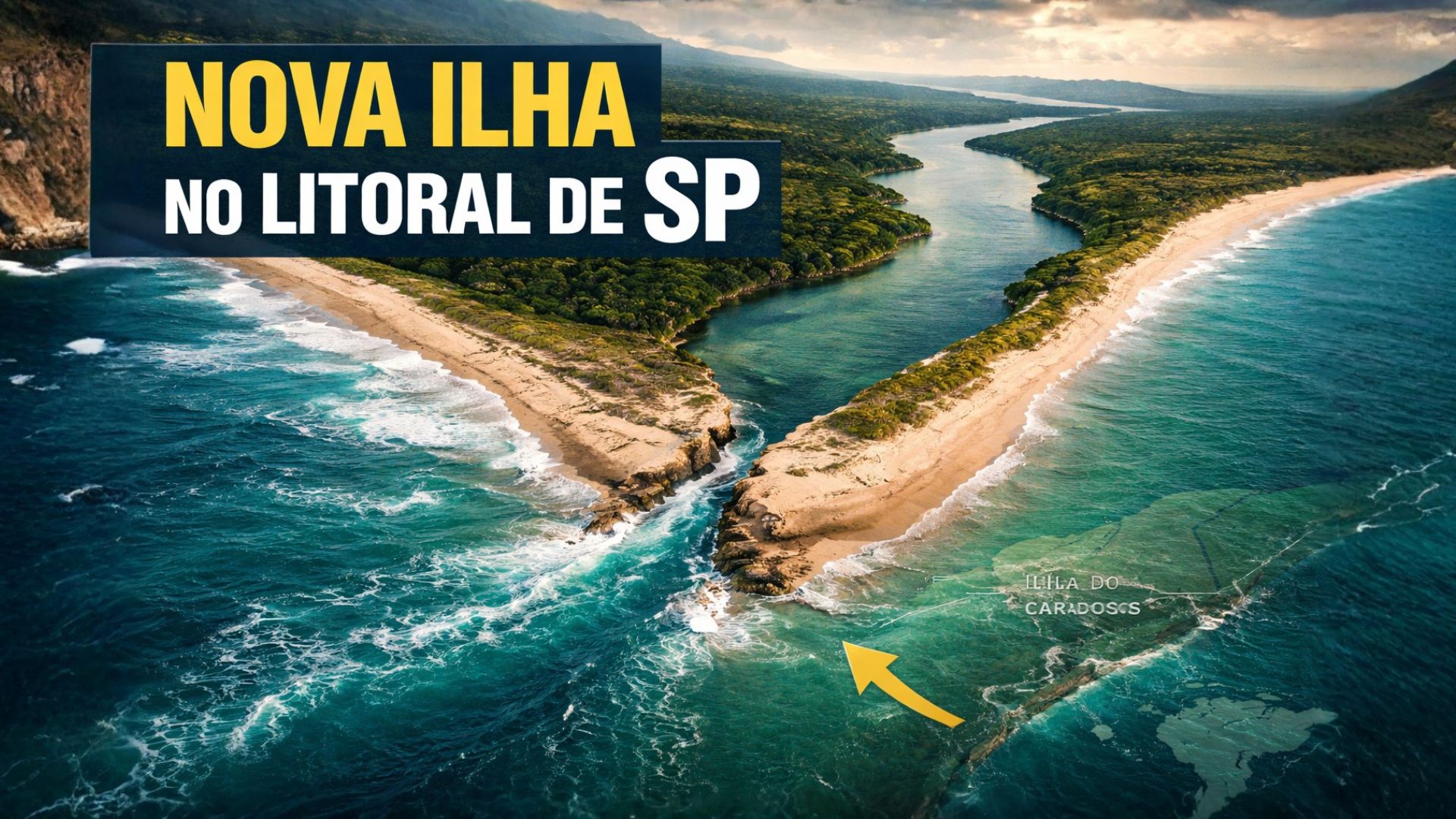
Accelerated Erosion at Melão Strait Could Break Sandbar, Redesign Ararapira Channel, and Isolate Part of Cardoso Island in the Coming Years, According to Ongoing Scientific Monitoring in the Lagamar Region.
The accelerated erosion at the Melão Strait, in Cananéia, on the southern coast of São Paulo, is expected to break the sandbar that separates the ocean from the estuary in the coming years, potentially isolating a stretch of about six kilometers of Cardoso Island.
The narrowing of the restinga has already reduced the land strip to approximately 20 meters at its most fragile point, while the dynamics of the currents opened a channel about 170 meters wide and three meters deep, altering local circulation.
Erosion at Ararapira Channel and Environmental Risk in Lagamar
The Melão Strait is located in the Ararapira Channel, an estuary that marks the natural boundary between São Paulo and Paraná and separates Cardoso Island from Superagui Island, in an area recognized for its high environmental sensitivity and the presence of mangroves.
-
Friends have been building a small “town” for 30 years to grow old together, with compact houses, a common area, nature surrounding it, and a collective life project designed for friendship, coexistence, and simplicity.

-
This small town in Germany created its own currency 24 years ago, today it circulates millions per year, is accepted in over 300 stores, and the German government allowed all of this to happen under one condition.

-
Curitiba is shrinking and is expected to lose 97,000 residents by 2050, while inland cities in Paraná such as Sarandi, Araucária, and Toledo are experiencing accelerated growth that is changing the entire state’s map.

-
Tourists were poisoned on Everest in a million-dollar fraud scheme involving helicopters that diverted over $19 million and shocked international authorities.


In this type of environment, river and ocean waters mix under constant tidal influence, and small changes in the shape of the banks can reorganize currents, redistribute sediments, and produce chain effects on navigation and the composition of coastal habitats.
Why Is the Sandbar Shrinking at Melão Strait
The wear occurs because the current acts unevenly on both banks, like in a meandering river, undermining the sandy base of the restinga, causing gradual retreat and shifting sediments over time, with continuous loss of material in the area.
The most vulnerable area, according to monitoring by researchers who have followed the region for decades, is precisely where the natural barrier has narrowed most sharply in recent years, becoming the most likely point for a new opening to the ocean.

Geologist Rodolfo José Angulo, a professor at the Federal University of Paraná and coordinator of the Coastal Studies Laboratory, has been monitoring the area since 2000 and assesses that, “given the characteristics of the location, a new connection with the sea is inevitable.”
How a New Island Could Emerge along the Coast of SP
The anticipated change does not involve the emergence of land in open sea, but rather the isolation of an already existing stretch south of Melão Strait, which could become surrounded by water if the sandy cordon breaks in the coming years.
The scientific estimate points to a likely window between 2032 and 2034, when erosive pressure and flow reorganization may open a new bar, redesigning the boundary between ocean and channel in the region.
This process already shows concrete signs on the ground, as the channel formed at the strait has begun to disrupt land movements in certain areas and has reinforced the dependence on water routes, directly impacting the daily lives of nearby residents.
Impacts on Navigation, Mangroves, and Artisanal Fishing
The opening of a new bar tends to reorganize the circulation of waters in the Ararapira Channel, as the ocean would start to connect directly to the estuary at Melão Strait, leaving the southern stretch of Cardoso Island in a state of isolation.
With the redistribution of flow, the currently more active bar may gradually lose strength, and siltation may advance in some segments, which would change depths, traditional navigation routes, and local perceptions of where the channel is safe.
Additionally, the alteration in the balance between fresh and saltwater affects the dynamics of the mangroves, which depend on this balance to maintain nutrient cycles and the reproduction of species, potentially impacting biodiversity and artisanal fishing.
Still, specialists monitoring the area often remind us that coastal systems tend to seek a new balance arrangement, although this “adjustment” can impose losses on human communities and sensitive environments during the transition period.
2018 Break and Acceleration of Erosion
In 2018, a break in the area of Enseada da Baleia opened a new connection with the ocean after a strong swell, and the change in the coastline altered the behavior of currents, reflecting on the distribution of energy along the channel.

From this reorganization, points further north began to feel the force of wear more intensely, according to those monitoring the estuary, which helps explain why Melão Strait has gained prominence in recent discussions.
Riprap and Debate on Human Intervention
Among the alternatives debated is riprap, a technique that uses large rock blocks to reduce the impact of waves and attempt to contain sea advance in specific sectors, but its application in estuarine areas tends to generate controversy.
Angulo states that rigid structures can alter the dynamics of the channel and accelerate erosion in neighboring areas, transferring the problem to other segments, which is why he advocates that any intervention be restricted to situations of direct risk to residences.
Justice Demands Plan and Government Monitors Area
The Public Prosecutor’s Office filed a motion against the state and demands actions in light of the erosive advance, and the court set a 45-day deadline for the presentation of measures, in a decision recorded in February 2026 and linked to the requirement for a contingency plan.
In response, the São Paulo government informed that it is monitoring erosion with drones, remote sensing, and periodic inspections, in addition to reporting that a preliminary technical project is under analysis and that discussions are ongoing with residents about a long-term adaptation plan.
The Environment Secretary also stated that the change in the coastline is a natural phenomenon that can be intensified by extreme events and by rising sea levels, while nearby Caiçara communities assess how their routines may be affected.
Four families live about one kilometer from the most sensitive point, according to official information, and Vila Mendonça is cited as the community closest to the strait, in a scenario that combines physical risk, territorial reorganization, and uncertainties about circulation.
If the break occurs within the projected window and the southern stretch becomes isolated by water, how will daily navigation, access to services, and the permanence of traditional communities in a territory that may change permanently be affected?









-

-

-

-

-

-

61 pessoas reagiram a isso.