





 Portuguese
  English
  Spanish
  5 min of reading
  0 comments


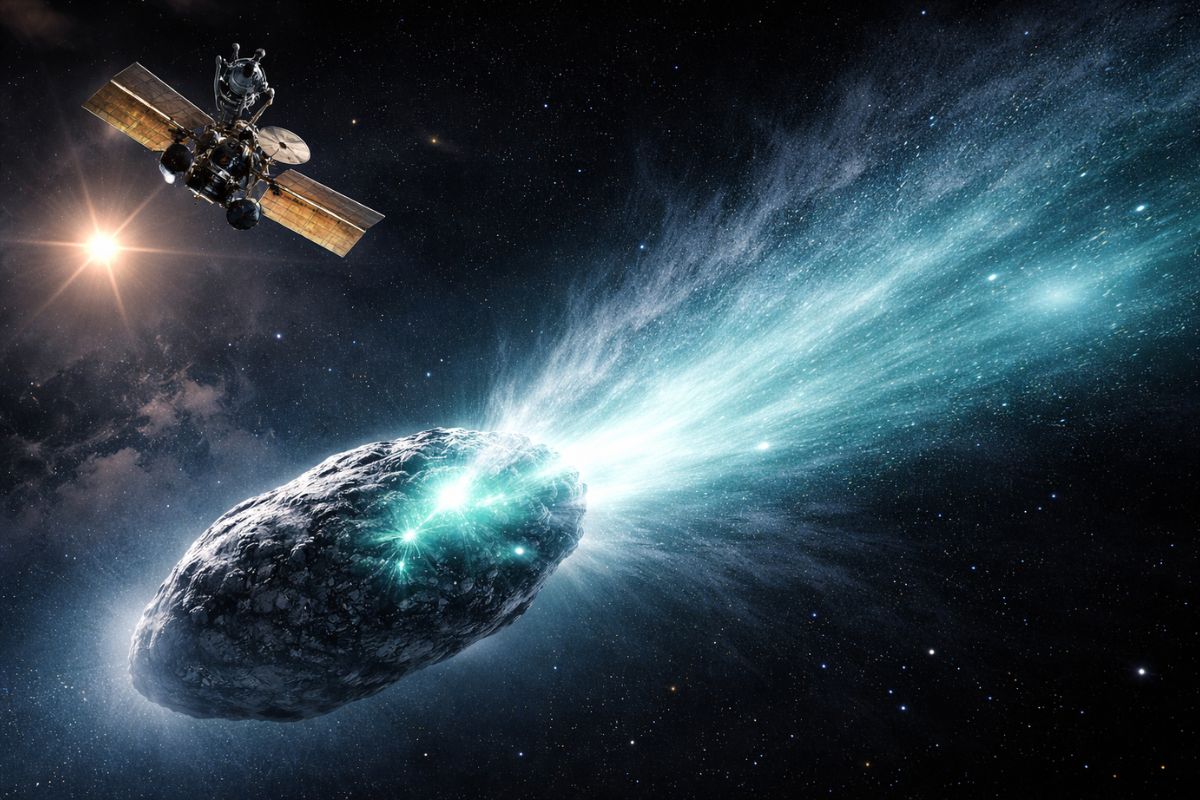
The Interstellar Comet 3I/ATLAS Crossed the Solar System in 2025 and, After Perihelion at the End of October, Entered Full Eruption, Releasing Methanol, Cyanide, Methane, and Water Ice; in December It Passed 270 Million Km from Earth, Observed by SPHEREx and Is Approaching Jupiter in March
The interstellar comet 3I/ATLAS became an observation target when a NASA space observatory identified organic molecules in the material it expelled as it approached the Sun and passed near Earth’s orbit. The record includes methanol, cyanide, and methane, compounds associated with so-called pre-biological chemistry, although this does not imply life.
The passage through the Solar System also put the object in a very rare category, that of a visitor from another stellar system, described as only the third interstellar object ever detected crossing our neighborhood. And the calendar still reserves a point of technical tension: on March 16, 2026, the closest approach to Jupiter could affect the comet’s behavior.
What SPHEREx Was Able to Capture in the Brief Interval of December

SPHEREx, a telescope launched in March 2025, observed the interstellar comet 3I/ATLAS between December 8 and 15, when it had already passed perihelion at the end of October and continued to display what was described as intense activity.
-
Motorola launched the Signature with a gold seal from DxOMark, tying with the iPhone 17 Pro in camera performance, Snapdragon 8 Gen 5 that surpassed 3 million in benchmarks, and a zoom that impresses even at night.

-
Satellites reveal beneath the Sahara a giant river buried for thousands of kilometers: study shows that the largest hot desert on the planet was once traversed by a river system comparable to the largest on Earth.

-
Scientists have captured something never seen in space: newly born stars are creating gigantic rings of light a thousand times larger than the distance between the Earth and the Sun, and this changes everything we knew about stellar birth.

-
Geologists find traces of a continent that disappeared 155 million years ago after separating from Australia and reveal that it did not sink, but broke into fragments scattered across Southeast Asia.

It’s a small time frame of days, but it defines the type of evidence available, because what appears in the data comes from what the comet was releasing at that moment.
The results were released as part of a study published in the journal Research Notes of the American Astronomical Society, still without peer review.
For a common reader, this does not invalidate the finding but necessitates treating the reading as preliminary: it is science in a phase of rapid communication, in a case where the observation time of the interstellar comet does not return.
The Eruption After Perihelion and the List of Compounds That Emerged from the Nucleus
As it approached the Sun, the heat caused the sublimation of ice on the surface of the interstellar comet, releasing jets of gas and forming the coma, the cloud surrounding the nucleus.
It is within this envelope of expelled material that the chemical signatures described by the researchers enter, notably methanol, cyanide, methane, rocky dust, and carbon-rich material.
Carey Lisse, from the Johns Hopkins Applied Physics Laboratory and principal author of the study, described 3I/ATLAS as “in full eruption” after passing the Sun, even releasing large amounts of water ice.
The reference to water ice fits what is expected from a typical comet, where water makes up about one-third of the mass, but the journalistic point here is different: the interstellar comet was active enough to release observable material even after perihelion.
The Distance from Earth and What It Means to Pass 270 Million Kilometers
In December, the interstellar comet passed about 270 million kilometers from Earth.
It is an enormous distance on a human scale, but small enough, on an astronomical scale, to allow direct observation by instruments like SPHEREx, as long as the object’s activity produces detectable signals in the gas and dust around the nucleus.
It also helps put the term “close” in the right perspective. There was no indication of risk to Earth in the set of information released, and the scientific interest arises from the chance to analyze materials that have been preserved at low temperatures for a long time.
The curiosity here is chemical and dynamic, not an impact alert.
Why Speed and Estimated Age Fuel Fascination
3I/ATLAS was discovered in July 2025 and was traveling at about 221,000 km per hour within Jupiter’s orbit.
Scientists cited in the study associate this trajectory with the long history of a body that may have crossed space for billions of years, accelerated by gravitational interactions with other stars, before entering our neighborhood.
This detail matters because the label of interstellar comet is not just an adjective. It indicates that the composition and behavior may reflect formation conditions outside the Solar System, which explains the attention on molecules like methanol and cyanide.
When an interstellar comet releases its gases, it exposes a sample from another place, even if in pieces of information, such as spectra and indirect signals.
The Encounter with Jupiter on March 16, 2026 and the Risk of a New Turn
The closest approach to Jupiter is scheduled for March 16, 2026, and the planet’s gravity could increase gas release or expose material from the interior of the interstellar comet.
In other words, the gas giant could function as a torque wrench: it does not create matter from nothing, but it can alter how much of the interior stays accessible, depending on the gravitational stress and the rotation of the nucleus.
There is also a narrative effect because Jupiter carries the fame of being the “architect” of orbits in the Solar System. When an interstellar comet passes under its influence, interest increases in trajectory changes, bursts of activity, and how the coma reacts.
If Jupiter boosts activity, the signature of methanol, cyanide, and methane could become more evident in new observations, but this is still expectation, not a confirmed fact.
Europa and Ganymede Enter the Radar, but NASA Hits the Brakes
The presence of organic molecules has led part of the public debate into a slippery area, that of “life beyond Earth.”
NASA itself has emphasized that organic molecules are not synonymous with life, because these compounds can arise from natural chemical processes unrelated to organisms, and this needs to be clear whenever discussing interstellar comets.
Even so, some researchers have raised a purely theoretical hypothesis: organic particles released could, in theory, cross trajectories that intercept moons like Europa or Ganymede, considered promising in the search for life due to subsurface oceans beneath icy crusts.
The caution is not to sell certainty where there is only geometric possibility. Europa and Ganymede appear as background to the debate, not as a confirmed destination of material from the interstellar comet.
What we have so far is an interstellar comet observed in a short window by SPHEREx, with signals of methanol, cyanide, methane, and water ice after perihelion, in addition to passing 270 million kilometers from Earth.
The next technical chapter, on March 16, 2026, depends on the encounter with Jupiter and how gravity will affect the object’s activity.
When you think of interstellar comets, what impresses you the most: the chemistry it releases, the fact that it is only the third detected visitor, or the idea that Jupiter will alter the course in March 2026? If you could choose one observation, would you point it at the nucleus, the coma, or the effect of the encounter with Jupiter?








-

Uma pessoa reagiu a isso.