





 Portuguese
  English
  Spanish
 5 min of reading
  0 comments


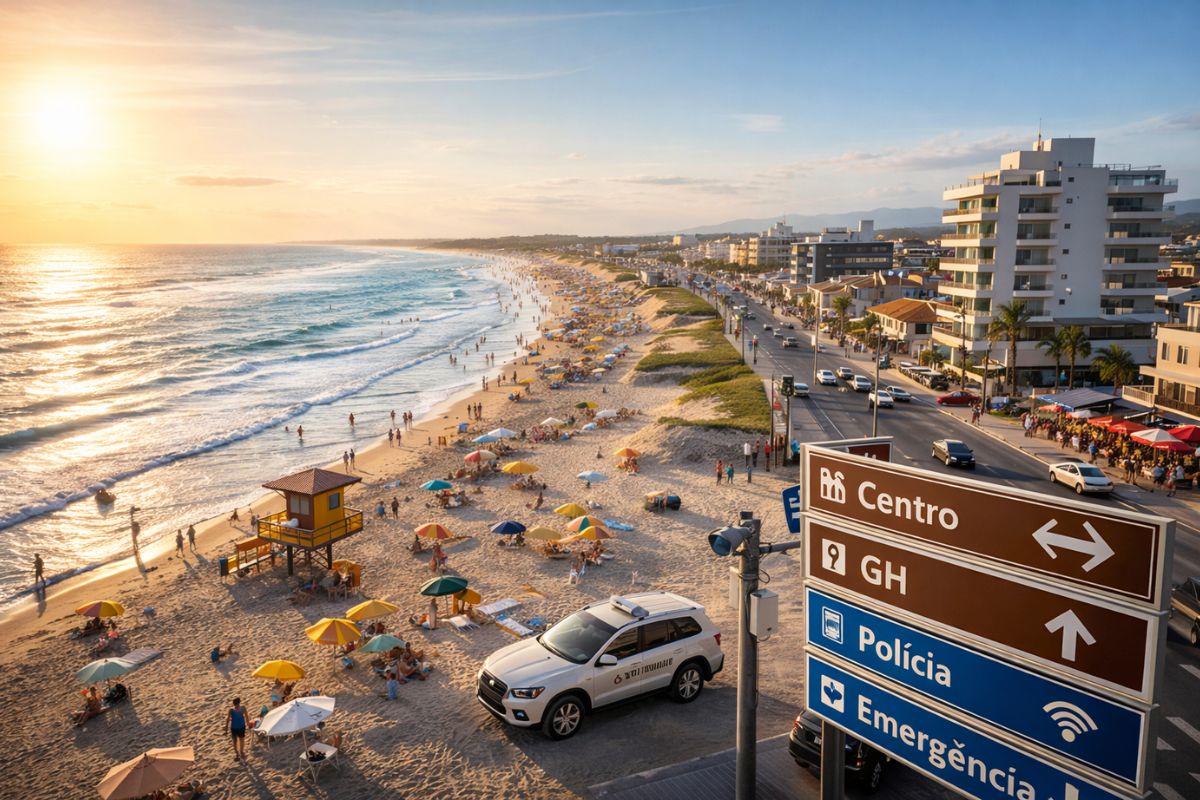
The Beach City in Southern Santa Catarina, Araranguá, Left Category C That It Held Between 2022 and 2024 and, After the Reformulation of 2025, Entered the First Group of the Tourism Map in 2026, with Ecotourism on Morro dos Conventos and Pressure for Management and Demand Services
The beach city in Southern Santa Catarina gained a new label in 2026 when Araranguá became part of the first group of the Tourism Map, a leap that repositions the municipality on the internal map of the sector and increases the weight of each local decision regarding ecotourism, infrastructure, and services. What seemed like mere bureaucracy has turned into a national showcase.
The recognition came after a change in criteria in 2025 and an evaluation that includes tourism management and planning, cultural and natural resources, lodging, events, transportation, internet connectivity, public safety, health, and tourist demand. In Araranguá, the official reading is that the combination of public power and private initiative accelerated this classification.
What the Tourism Map Is About and What Changes When Araranguá Enters the First Group

The Tourism Map is the tool used to group municipalities according to criteria of structure and performance related to tourism, and Araranguá appears in 2026 as a tourist municipality after being classified as category C between 2022 and 2024.
-
Friends have been building a small “town” for 30 years to grow old together, with compact houses, a common area, nature surrounding it, and a collective life project designed for friendship, coexistence, and simplicity.

-
This small town in Germany created its own currency 24 years ago, today it circulates millions per year, is accepted in over 300 stores, and the German government allowed all of this to happen under one condition.

-
Curitiba is shrinking and is expected to lose 97,000 residents by 2050, while inland cities in Paraná such as Sarandi, Araucária, and Toledo are experiencing accelerated growth that is changing the entire state’s map.

-
Tourists were poisoned on Everest in a million-dollar fraud scheme involving helicopters that diverted over $19 million and shocked international authorities.


In practice, this step changes the way the beach city in Southern Santa Catarina is perceived when it comes to planning priorities and the capacity to receive visitors.
The shift is also symbolic: Araranguá is no longer described as intermediate and now forms part of the first group of the Tourism Map, in a context where the beach city in Southern Santa Catarina tries to balance growth and preservation.
The higher the showcase, the more visible what still needs to be done becomes.
The Criteria That Weighed in the Evaluation and the Challenge of Sustaining the Seal in 2026
The Ministry of Tourism itself lists the points observed: management and planning, cultural and natural resources, lodging and event services, transportation infrastructure, economic structure, tourism specialization, internet connectivity, public safety, health, and tourist demand.
For Araranguá, this means that the advancement does not depend on a single attraction, but rather on a set of deliverables that connect, from road access to the quality of service.
There is a political and operational component in this mechanism.
An employee of the Araranguá Sport and Tourism Secretariat, Antenor Da Silva, attributed the result to the partnership between public administration and private initiative, stating that the role of the public sector is to provide infrastructure support for entrepreneurs to invest.
The reading is straightforward: without roads, signals, security, and services, ecotourism becomes mere talk; with the basics in place, ecotourism begins to generate demand that feeds back into the system.
Ecotourism as Strategy and as Pressure: Morro dos Conventos and Rio Araranguá at the Center
When it comes to ecotourism in the region, Morro dos Conventos and Rio Araranguá concentrate local imagination and demand, combining a beach setting with terrain and waters described as crystal clear.
Here, Araranguá tries to translate landscape into experience, with kayaking, schooner, speedboat, and jet ski tours, as well as trails on Morro dos Conventos guided by specialized guides.
This model, however, demands consistency. The same narrative of ecotourism that attracts visitors increases the responsibility to preserve what sustains the demand.
According to local reports, a concern of the administration is to maintain the natural beauty so that tourism is practiced sustainably, and this applies both to Morro dos Conventos and the surroundings of Rio Araranguá.
In ecotourism, any degradation first shows up in the visitor’s experience and then in the city’s finances.
International Demand, Memory of the 1990s, and the Return of Argentinians and Uruguayans
In the last two years, Araranguá has recorded an increase in international tourists, primarily Argentinians and Uruguayans, a movement that the municipality associates with a return to a common pattern from the 1990s.
Antenor Da Silva states that there was a decline over the years and that now, visitors have returned to seek the beauty of Morro dos Conventos as they did in the past.
This flow has a practical effect on what the Tourism Map measures.
More people circulating puts pressure on lodging, events, connectivity, and basic services, which is why the beach city in Southern Santa Catarina enters 2026 with a challenge of continuity: to sustain infrastructure and public safety during peak periods without compromising the health and experience of those arriving and those who live there.
Recognition does not end the work; it usually inaugurates new demands.
Educational Tourism, UFSC, and the Bet on Events That Keep the City Active Outside the High Season
Araranguá also attempts to broaden its attraction logic beyond immediate leisure by treating education as a draw.
The municipality is described as the only one in the southern region of the state to offer a medical course at UFSC, a factor that brings students and keeps the city bustling more consistently, with reflections in services and long-term occupancy.
The administration also mentions intentions to invest in workshops and lectures, in partnership with Senac, Sebrae, and IFSC.
For the Tourism Map, this type of agenda can resonate with the events item and the idea of distributed demand, and for ecotourism, it works as a complement: the city gains a reason to be visited when the weather does not favor the beach, while Morro dos Conventos remains as Araranguá’s natural showcase.
What Lies Behind the Seal: Management, Infrastructure, and the Cost That Comes to Everyone
The story of Araranguá on the Tourism Map in 2026 is not just about natural beauty.
It is also about management routines, about connecting planning to works, and about offering minimum services that sustain ecotourism without turning the landscape into a fragile backdrop.
It is at this point that the beach city in Southern Santa Catarina is measured with a stricter yardstick, because the label of tourist municipality is not maintained merely through rhetoric.
At the same time, the municipality gains a window of opportunity.
If the city can combine preservation of Morro dos Conventos, service qualification, and a schedule of events and education, it reduces its dependence on a single seasonal peak.
And this, in the end, is what the Tourism Map tries to capture: the capacity to receive, maintain, and grow consistently.
Araranguá arrives at 2026 with the maximum stamp of the Tourism Map and with ecotourism supported by Morro dos Conventos, but recognition only makes sense if the beach city in Southern Santa Catarina can practically sustain connectivity, security, and health without losing what it offers.
The question that remains is simple and uncomfortable: is it possible to grow without losing character?
Have you visited Araranguá or Morro dos Conventos and felt that access, security, and services match the landscape, or does the city still seem to rely on its potential?










-

-

-

7 pessoas reagiram a isso.