





 Portuguese
  English
  Spanish
  4 min of reading
  0 comments


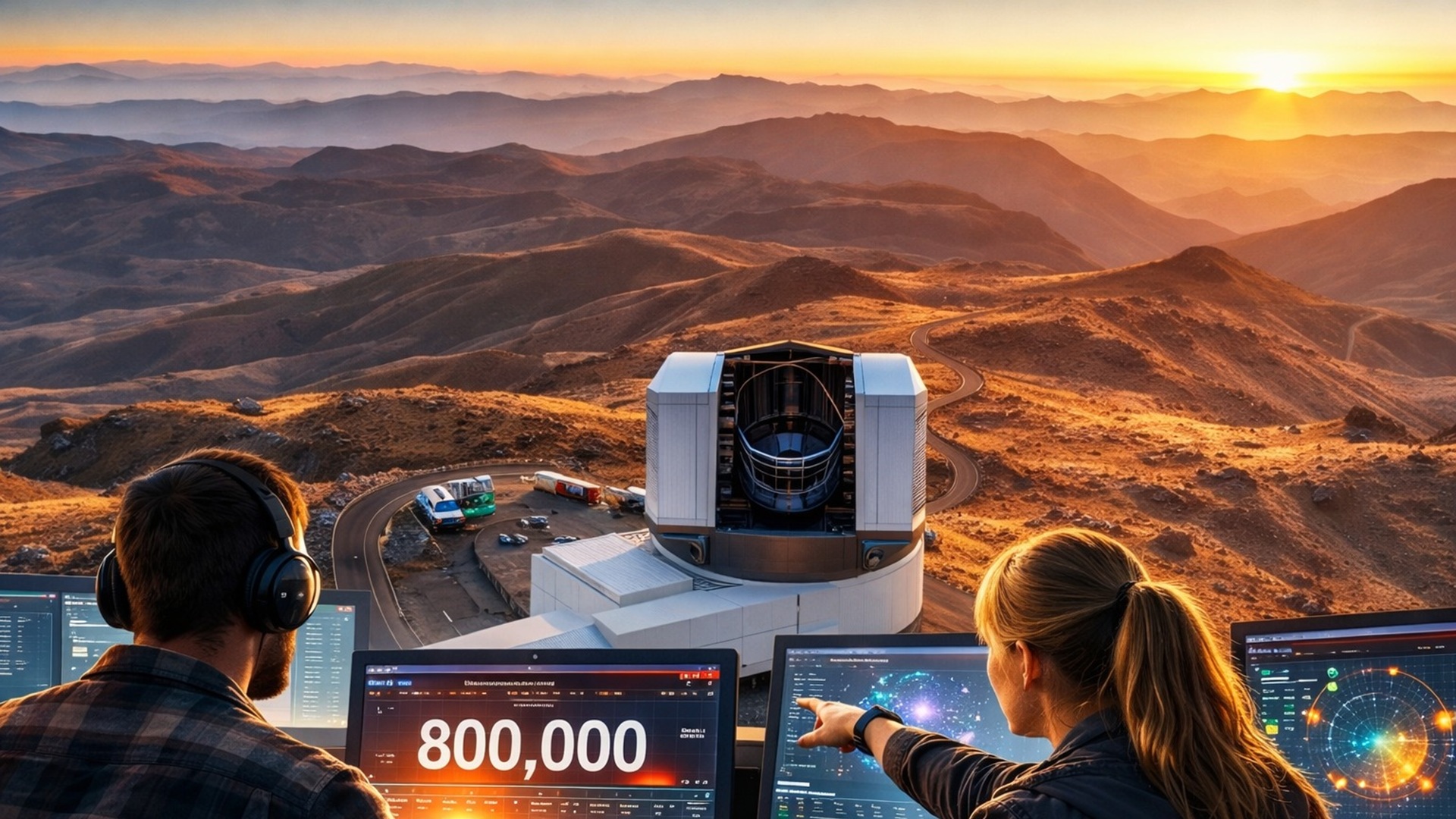
Automated System of the Vera C. Rubin Observatory Began Global Notification Sending After Registering Changes in the Night Sky, Distributing 800 Thousand Alerts to Astronomers in a Few Minutes and Inaugurating a New Phase of Continuous Monitoring of the Universe with an Estimated Capacity of Up to 7 Million Notifications per Night
Astronomers around the world received 800 thousand notifications after the Vera C. Rubin Observatory began continuous monitoring of the night sky on Tuesday night, marking the first official sending of the new automated astronomical alert system on a global scale.
System Monitors the Night Sky and Sends Alerts in a Few Minutes to Astronomers
The Vera C. Rubin Observatory spent the night observing regions of the dark cosmos and identifying changes recorded in the night sky.
The new system automatically sent notifications to the computers of astronomers connected to the international observation program.
-
Motorola launched the Signature with a gold seal from DxOMark, tying with the iPhone 17 Pro in camera performance, Snapdragon 8 Gen 5 that surpassed 3 million in benchmarks, and a zoom that impresses even at night.

-
Satellites reveal beneath the Sahara a giant river buried for thousands of kilometers: study shows that the largest hot desert on the planet was once traversed by a river system comparable to the largest on Earth.

-
Scientists have captured something never seen in space: newly born stars are creating gigantic rings of light a thousand times larger than the distance between the Earth and the Sun, and this changes everything we knew about stellar birth.

-
Geologists find traces of a continent that disappeared 155 million years ago after separating from Australia and reveal that it did not sink, but broke into fragments scattered across Southeast Asia.

The alerts were generated by the Alert Production Pipeline, software developed by the University of Washington.
The system is designed to produce up to 7 million alerts per night, documenting celestial events detected during observations made by the Rubin telescope.
According to Hsin-Fang Chiang, head of data processing operations at the US Data Facility, the speed and volume of notifications represent an unprecedented scale for astronomers’ work.
In recent months, hundreds of thousands of alerts had been produced in tests. With the official activation, every analyzed image begins to generate notifications within minutes of recording.
Observatory Structure Allows Continuous Analysis of the Night Sky
After nearly two decades of development, the Rubin Observatory operates with the largest digital camera ever built for astronomy. The equipment features an ultra-sensitive 8.4-meter primary mirror, designed to capture extremely subtle variations in the night sky.
The alert system informs astronomers about events deemed relevant within two minutes of their discovery. This interval allows for additional observations to be requested for more detailed analyses of the detected phenomena.
According to Luca Rizzi, program director of research infrastructure at the National Science Foundation, the observatory connects scientists to a continuous flow of information about cosmic events occurring in real time.
Among the phenomena detected in the first batch of notifications are supernovae, variable stars, active galactic nuclei, and newly discovered asteroids in the solar system.
Each alert indicates changes observed in a specific area of the night sky since the last pass of the telescope, including new light sources, variations in star brightness, or moving objects.
Processing 10 Terabytes per Night Required a Decade of Technological Development
The Alert Production Pipeline was developed over ten years by teams of researchers and software engineers. The goal was to enable the daily processing of approximately 10 terabytes of astronomical images.
Eric Bellm, professor of astronomy at the University of Washington and leader of the team responsible for the system, stated that real-time discovery required advances in image processing algorithms, databases, and data orchestration.
The massive volume of information generated during each observation session demands automated processing capable of quickly identifying changes relevant to astronomers.
This model allows large data streams to be transformed into usable notifications almost immediately after the images are captured.
Ten-Year Survey Will Expand Observation of the Night Sky by Astronomers
The launch of the system precedes the start of the Legacy Survey of Space and Time, expected to begin later this year. Over the next ten years, the telescope will produce wide-field images of the southern sky every few nights.
As new images are captured at unprecedented depths, alerts will continuously keep astronomers informed about changes observed in the universe.
The Rubin Observatory is located on top of a mountain in the Chilean Andes. On June 23, 2025, the first images obtained by the telescope’s 3,200-megapixel camera were released to the public.
During the testing phase, the equipment recorded millions of galaxies and stars distributed across the Milky Way, as well as identifying 2,104 previously unobserved asteroids.
According to presented estimates, in just the first year of the LSST survey, Rubin is expected to observe more objects than all other optical observatories combined, significantly increasing the volume of notifications received by astronomers monitoring the night sky.








-

-

-

-

-

-

201 pessoas reagiram a isso.