





 Portuguese
  English
  Spanish
  9 min of reading
  0 comments


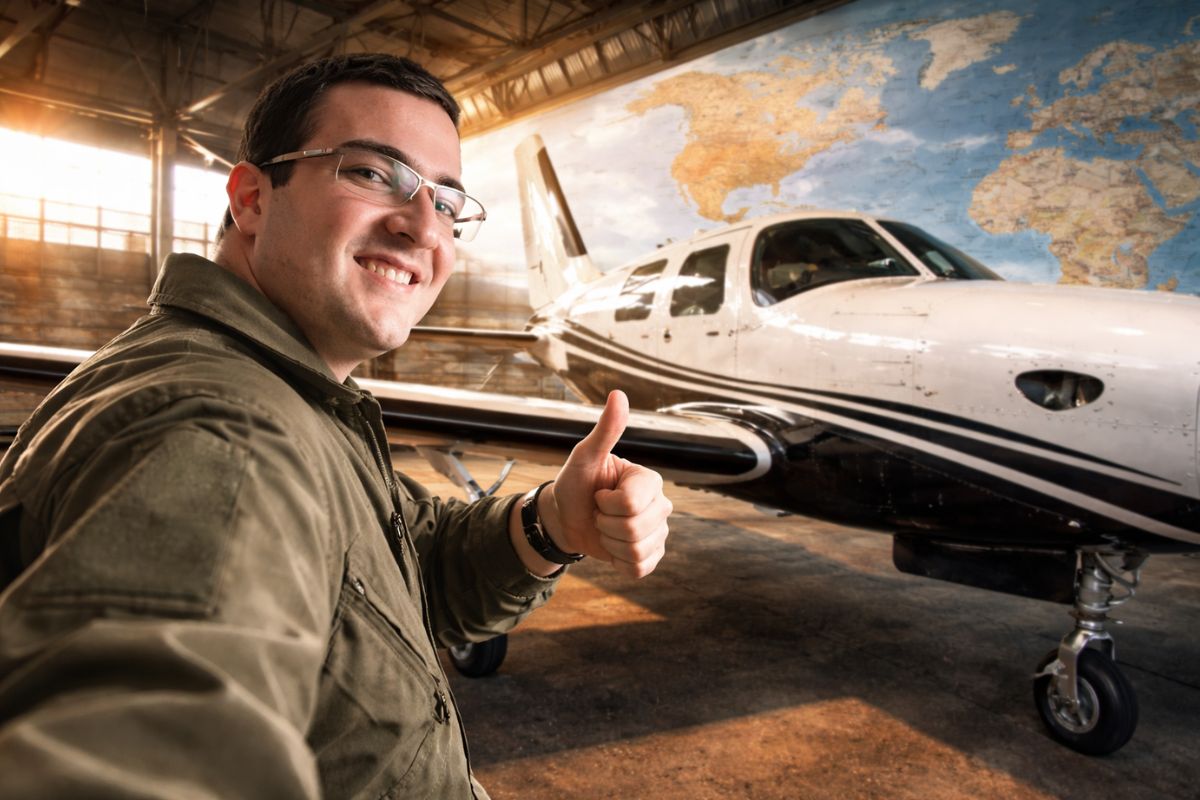
Walter Toledo’s Round-the-World Journey Began With Careful Planning, a Piper Malibu Matrix With Limited Range, 126 Flight Hours, and 36 Fuel Stops, Passing Through 11 Countries in 51 Days and Concluding With Recognition From Guinness as the Youngest Pilot to Circumnavigate the Globe.
Walter Toledo’s round-the-world journey was not built on an ideal airplane or a comfortable route. At the age of 20, the Brazilian took command of a single-engine Piper Malibu Matrix, registration PR-EBA, and turned an idea considered insane into a feat recognized by Guinness at the end of 2012, after analyzing GPS images, flight records, passport stamps, and audiovisual material from the expedition.
What makes the crossing more significant is not only the pilot’s age or the cumulative distance but the succession of technical, meteorological, and diplomatic challenges faced along the way. There were 11 countries, 126 flight hours, and 51 days of mission, with segments over the North Atlantic, a critical passage through Russia, excess oil consumption, installation of an extra tank within the aircraft, and even the approach of a hurricane before the conclusion.
The Plan Was Bold and Depended on an Airplane With Clear Limits

Walter Toledo recalls that the idea of going around the world flying seemed, at first, a project difficult to be taken seriously.
-
Friends have been building a small “town” for 30 years to grow old together, with compact houses, a common area, nature surrounding it, and a collective life project designed for friendship, coexistence, and simplicity.

-
This small town in Germany created its own currency 24 years ago, today it circulates millions per year, is accepted in over 300 stores, and the German government allowed all of this to happen under one condition.

-
Curitiba is shrinking and is expected to lose 97,000 residents by 2050, while inland cities in Paraná such as Sarandi, Araucária, and Toledo are experiencing accelerated growth that is changing the entire state’s map.

-
Tourists were poisoned on Everest in a million-dollar fraud scheme involving helicopters that diverted over $19 million and shocked international authorities.


Nevertheless, determination prevailed, and the objective became clear: to bring to Brazil the record previously held by Jamaican Barrington Irving, recognized in 2007 as the youngest aviator to circumnavigate the globe at age 23.
The Brazilian mission was therefore born with a precise target and high symbolic pressure.
Planning began early and revolved around a predetermined choice: the family company’s Piper Malibu Matrix, Equipav. Walter acknowledges that, for a mission of this magnitude, a turboprop would be more suitable than a piston aircraft.
But reality imposed a different path. Securing a better aircraft on loan would be even more challenging, and the project would have to adjust to what was available.
The definition of the route became the center of the work. The Matrix had about six hours of range and, in normal cruise mode, reached 1,050 nautical miles at the safety limit.
The choice was to fly always eastward, taking advantage of the prevailing tailwinds. This decision, he said, proved to be correct, as it significantly reduced the segments with headwinds and helped preserve performance and fuel.
There were also altitude restrictions and engine health concerns. The aircraft’s ceiling was 25,000 feet, sufficient to escape some areas of bad weather, but flying above 15,000 feet for extended periods, according to the mechanics consulted by Walter, damaged the engine.
The round-the-world journey was designed not as a loose adventure but as an operation meticulously fitted within the limits of a single-engine aircraft.
The Route Crossed the North Atlantic and pushed the Project to Technical Limits

The initial plan involved departing Brazil from Boa Vista, passing through Grenada, Puerto Rico, Miami, and then formally starting the crossing of all the meridians of the Earth, using the avgas fuel pump as a reference.
Then, the route would ascend along the east coast of the United States, proceed to Québec, Goose Bay, and then face one of the most sensitive parts of the expedition: the North Atlantic.
Goose Bay was already seen as a critical point because the weather changed rapidly and the winds were constant. In Narsarsuaq, Greenland, Walter reports that the airport could go from visual conditions to instrument conditions in just 30 minutes.
There was also an additional complicating factor: at these latitudes, the Matrix’s GPS would go down for long periods, forcing the pilot to revert to classical training with flight computers, charts, compass, and stopwatch. It was during these times that modernity gave way to well-learned basics.
From Greenland, the route would enter Europe through Wick, Scotland, descend to Shoreham for a 50-hour inspection, proceed to Germany, Moscow, and then cross seven points in Russia before heading across the Bering Strait towards Anchorage, Alaska.
Then came Canada again, Salt Lake City for a 100-hour inspection, Miami to complete the crossing of the meridians, and finally, the return through the Caribbean route to Brazil.
The route was important not only for distance. It required meticulous documentation, fuel logistics, international authorization, and consistent performance from an aircraft that would fly over ice, sea, mountains, Russian territory, and areas of severe weather.
The round-the-world journey was not a geographical stroll; it was a sequence of stages where each mistake could jeopardize the next.
Low Oil Almost Ended the Expedition Long Before the Record

The first major technical scare appeared during the advance along the North American east coast. Severe storms prevented Walter from reaching the intended destination and forced him to divert to Wilmington.
He reports that even two F-15 fighter jets from the United States Air Force could not cross the wall of clouds he encountered on the way. The description is striking: over 50,000 feet high and more than a thousand kilometers long. If the fighters turned back, the small PR-EBA had no reason to insist.
Upon landing in Québec, the problem he feared most arose. The oil level was very low. A Canadian mechanic opened the hood and found a wall of fire and soaked hoses.
He cleaned, tightened loose clamps, and ran the engine for ten minutes. Visually, it seemed resolved. Walter continued to Goose Bay. On the next landing, everything was dirty again.
The situation was particularly grave because from there on began the crossing over the frozen sea, with few or no real alternatives. A new adjustment was made, paying attention to a somewhat strangled hose. After a short flight with no apparent leaks, the expedition continued.
The problem, however, persisted throughout the North Atlantic crossing, with excessive oil consumption averaging a quarter per hour.
As the flights lasted between four and five hours and the aircraft took off with a maximum load of 12 quarts, there was no immediate collapse.
Walter landed, topped off oil, and continued. This lasted until maintenance in Europe, where the defect began to be investigated more deeply. In Frankfurt, the mechanics identified the need to replace cylinder number 2, but failed to realize that cylinder 4 also required replacement.
The round-the-world journey continued with a poorly resolved problem, and this almost killed it in Siberia.
Russia Blocked the Plan and Forced an Improvised Solution Inside the Airplane
If the engine complicated the technical part, Russia transformed the diplomatic aspect into pure tension. On the day of departure, the team received a call from the company contracted to supply avgas at Russian airports, canceling the entire operation.
Even so, by decision of the mission control center, Walter proceeded to England, while a team member flew to Moscow to understand how the system worked and try to secure the crossing.
At that moment, there was no viable alternative route due to visas, documents, and authorizations.
After much negotiation and even help from the Brazilian Embassy in Moscow, the Russians only permitted fuel stops at four airports: Omsk, Krasnoyarsk, Yakutsk, and Anadyr. The problem was that this reduced network required more range.
That was when the need arose to install a transfer tank inside the airplane, with a capacity of 450 liters, adding approximately six extra hours of range.
Walter returned to Wick, Scotland, where a local contact, Andrew, helped with the installation. The system operated with hoses connecting the internal tank to a pump that sent fuel to the left wing of the Matrix.
This operation required constant balancing and careful use of the selector, consuming first the left wing during takeoff, switching to the right during leveling, and simultaneously refueling the left wing with the contents of the internal tank.
With this, the Russian route became possible, but not smooth. The segment from Helsinki to Omsk was the longest, taking nine hours. In communication, everything went relatively well with limited help from the language, but deviations and direct headings were prohibited.
Walter describes the outcome as “rat paths” drawn in the Russian sky. The round-the-world journey remained alive because the team improvised more range to fit within a much smaller authorization than planned.
Siberia Almost Closed the Mission and the Hurricane Waited at the End
It was on the flight to Yakutsk, lasting seven hours, that the oil problem escalated again. With one hour to go before landing, the pressure dropped drastically.
Walter requested priority, made a direct and high approach, prepared to glide to the runway if the engine shut down. He landed with the gauge nearly in the red and the belly of the aircraft leaking oil. With no nearby alternative, Yakutsk was the only possible choice.
The Russian Piper base responded quickly, opened cylinders 4 and 6, and, as they could not replace them, they only substituted the rings to allow the plane to reach the United States. Not even a simple test flight was easy to authorize.
After a whole day of negotiations, Walter managed to take off for a quick flight nearby, landed without visible leaks, and continued at four in the morning to Anadyr and, from there, to the Bering Strait.
In Alaska, already in Anchorage, and then towards Seattle, the excessive oil consumption reappeared. In the United States, the situation was less dramatic because there was “an airport every square meter,” as he summarizes.
So he began to land every two hours to top off oil until reaching Salt Lake City, where he underwent extensive maintenance and replaced cylinders 4 and 6. Only then was the problem effectively addressed.
But the final stretch still held severe weather. The arrival in Miami coincided with the anticipation of Hurricane Isaac. Walter reports that he flew at 500 feet over the Everglades for half an hour to maintain sufficient visual conditions for landing. He touched down with no wind, but the plane was tied down with chains and ropes.
Two days later, already relieved by the secured record, he began the return trip through the Caribbean route and re-entered Brazil via Boa Vista. The round-the-world journey ended not with a clean and calm arrival, but after crossing oil, Russia, ice, and a hurricane without losing the mission’s focus.
The Record Was Brazilian and Came Surrounded by Material Proof
When the mission concluded, the achievement already had its own size: 11 countries traversed, 126 flight hours, 51 days of expedition, and 36 fuel stops, with a total consumption of 8,540 liters of fuel. But formal acknowledgment depended on robust validation.
Guinness evaluated GPS images, flight records, passport stamps, and audiovisual material produced by photographer Eduardo Fleury, who accompanied the journey.
At the end of 2012, the institution recognized Walter Toledo as the youngest pilot to circumnavigate the globe aboard a single-engine aircraft.
The record did not come due to a beautiful narrative or patriotic repercussion. It came because there was enough documentary trail to support what seemed too improbable for a 20-year-old pilot in a Piper Malibu Matrix.
There is also a symbolic component assumed by Walter himself. In Campinas, upon returning, he made two low passes to showcase the banner on the tail of the plane and mark that this record had been carried by a young Brazilian aviator around the planet. Subsequently, the experience was also transformed into a book, For God, For the Homeland, consolidating the crossing as memory and testimony.
In the end, what distinguishes this case is the combination of youth, method, and persistence. Walter Toledo’s round-the-world journey was not empty heroism nor luxury aerial tourism. It was a real operation, surrounded by calculation, scares, and corrections, until it became a record.
If you were in Walter Toledo’s place, at which point in the expedition would the pressure weigh the most: during the crossing of Greenland without reliable GPS, on the long flight within Russia with an improvised extra tank, or during the final approach with Hurricane Isaac looming over Miami? And, looking back at this feat today, what impresses you the most, the age, the single engine, or the ability to keep the mission alive even when the aircraft seemed to demand otherwise?










-

Uma pessoa reagiu a isso.