





 Portuguese
  English
  Spanish
  3 min of reading
  0 comments


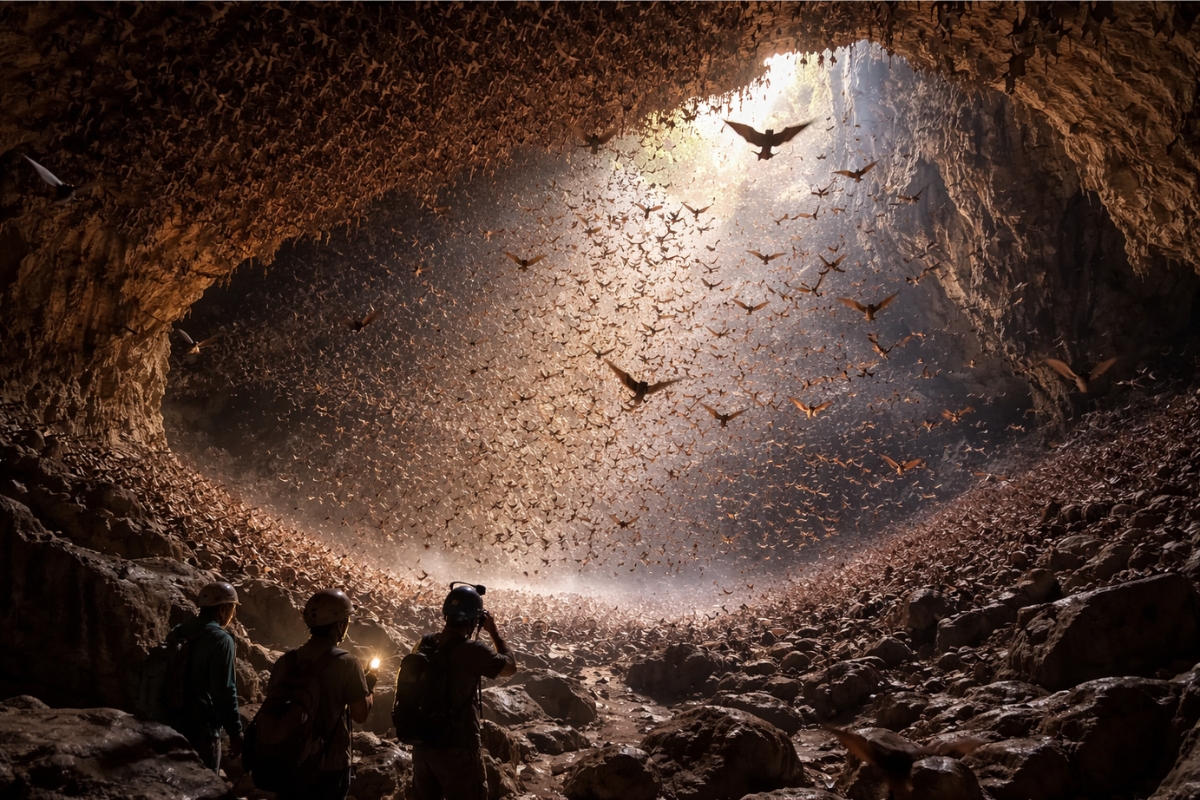
In Tocantins and Goiás, Researchers from ICMBio in Partnership with Bat Conservation International Identified Caves with Over 157 Thousand Bats to Map Giant Colonies and Protect Threatened Species, Triggering Conservation Alerts and Drawing Attention from the Scientific Community.
Imagine entering a completely dark cave and knowing that over 150 thousand bats live there. The scene may seem frightening to many. For researchers, however, it represents one of the most relevant discoveries ever made in the Brazilian Cerrado.
The first bat caves of the biome were identified in the states of Tocantins and Goiás. These are caves that concentrate large colonies, reaching hundreds of thousands of individuals.
The finding expands knowledge about Brazil’s speleological heritage and reveals that there are still underexplored areas with enormous ecological importance.
-
Friends have been building a small “town” for 30 years to grow old together, with compact houses, a common area, nature surrounding it, and a collective life project designed for friendship, coexistence, and simplicity.

-
This small town in Germany created its own currency 24 years ago, today it circulates millions per year, is accepted in over 300 stores, and the German government allowed all of this to happen under one condition.

-
Curitiba is shrinking and is expected to lose 97,000 residents by 2050, while inland cities in Paraná such as Sarandi, Araucária, and Toledo are experiencing accelerated growth that is changing the entire state’s map.

-
Tourists were poisoned on Everest in a million-dollar fraud scheme involving helicopters that diverted over $19 million and shocked international authorities.

What Are Bat Caves and Why Has This Discovery Become Noteworthy in the Cerrado
Bat caves are caves that house giant colonies of bats. In some cases, they gather tens or even hundreds of thousands of animals in a single shelter.
Until now, this type of formation had not been officially recorded in the Cerrado at this scale. The discovery was conducted by the National Cave Research and Conservation Center, ICMBio Cecav, in partnership with Bat Conservation International.
The detail that attracted the most attention was the size of the populations found and the presence of endangered species.
Tocantins Concentrates Colonies of Up to 157 Thousand Bats in a Single Cave

In Tocantins, two caves have been classified as bat caves: Boa Esperança and Casa de Pedra.
In the cave Boa Esperança, researchers identified about 10 thousand bats. Among the recorded species are Phyllostomus hastatus, Anoura geoffroyi, and Pteronotus rubiginosus.
The Casa de Pedra cave was even more impressive. The site hosts over 157 thousand bats, one of the largest colonies ever recorded in Brazil. Species such as Pteronotus rubiginosus and Anoura geoffroyi were found there, in addition to individuals of Natalus macrourus, a species considered endangered in the country.
The scale of the colony placed the site among the most relevant for conservation.
Gruta do Jacaré in Goiás Also Gathers Over 20 Thousand Bats and Endangered Species
In Goiás, Gruta do Jacaré also revealed impressive numbers. The cave houses over 20 thousand bats, including endangered species.
Among them is Natalus macrourus, identified within the cave. The presence of this species reinforces the environmental value of the area.
According to specialists involved in the research, both Gruta do Jacaré and Casa de Pedra can also be classified as hot caves.
Hot Caves Are Rare in Brazil and Have Extreme Conditions
Hot caves are caves with small entrances, low air circulation, and extremely high bat density.
These environments maintain constant temperatures throughout the year, ranging between 28 and 40 degrees Celsius. Relative humidity exceeds 90 percent.
There are fewer than 20 caves with these characteristics throughout Brazilian territory. This makes these ecosystems extremely rare and fragile.
Any alteration can jeopardize thousands of individuals.
Why Protecting Bats Impacts Even Agriculture
About 45 percent of bat species recorded in Brazil use caves as shelters.
Protecting these natural structures is essential to ensure the survival of the colonies. The impact goes beyond biodiversity.
According to researchers from the National Action Plan for the Conservation of Brazil’s Speleological Heritage, the bats from these caves consume hundreds of tons of insects each year.
This helps reduce the use of agricultural pesticides and generates savings for farmers. The effect is direct on the quality of life for populations living near the caves.
The discovery shows that the Cerrado still holds impressive surprises and reinforces the importance of protecting subterranean environments that support thousands of lives and impact the entire ecological chain.
Did you imagine that the Cerrado hid caves with over 150 thousand bats? Share your thoughts in the comments.










-

Uma pessoa reagiu a isso.