





 Portuguese
  English
  Spanish
  5 min of reading
  0 comments


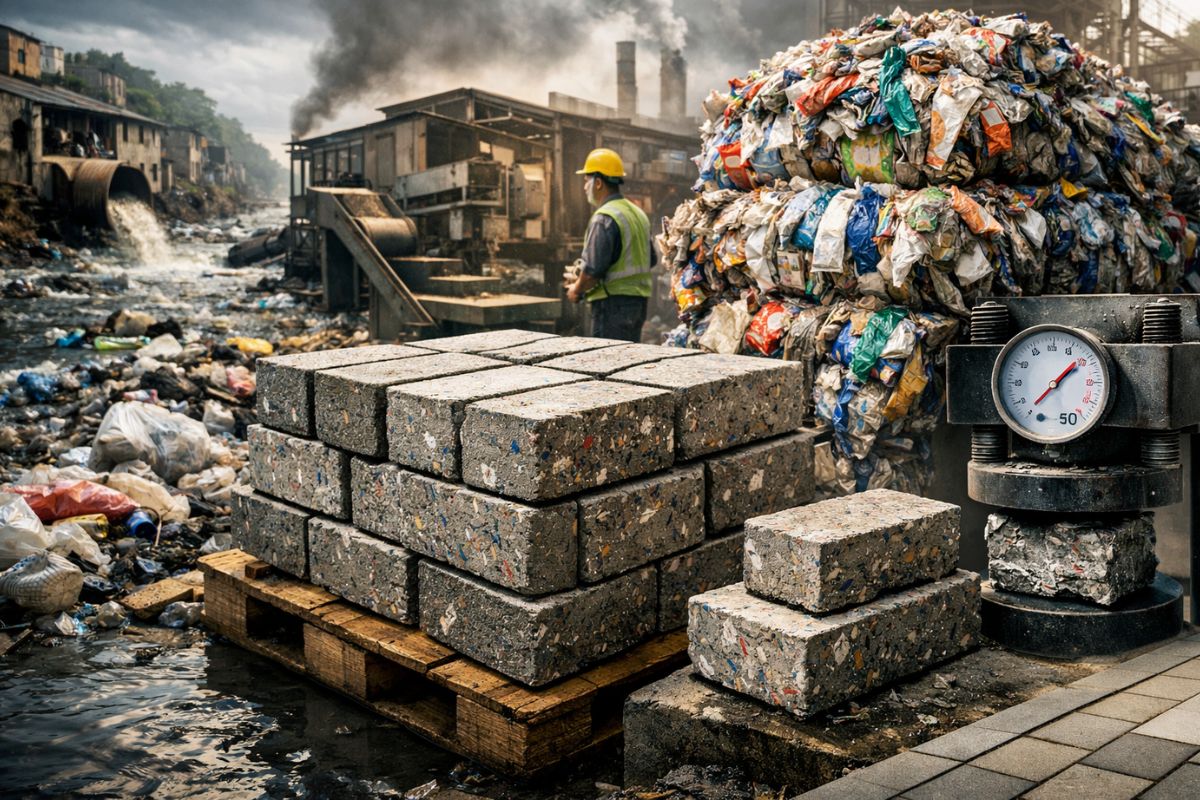
Founded in 2019 by Sabrina and Nubi Tatan, Rebricks collects pouches and multilayer packaging that usually end up in landfills or incinerators, grinds everything into flakes, and molds paving bricks with 20% waste, withstanding 250 kg/cm² in parks, tracks, and parking lots without losing shape, adhesion, and proven safety.
In Jakarta, bricks have ceased to be merely construction products and have become a practical response to a growing problem: the daily circulation of disposable packaging that, due to being “too complex,” ends up accumulated in landfills, incinerators, or scattered across rivers and beaches.
Rebricks was born precisely at this friction between consumption and disposal. Established in 2019 by two friends, Sabrina and Nubi Tatan, the factory aimed to do something specific: take packaging considered “impossible to recycle” and transform it into paving bricks that behave like conventional bricks in everyday use.
Jakarta As A Starting And Arrival Point
The operation takes place in Indonesia’s capital, Jakarta, where the presence of plastic waste is visible in urban routines: street food, quick purchases, hygiene items, all packaged in small portions, with lots of wrappers and little chance of returning to the production cycle.
-
Motorola launched the Signature with a gold seal from DxOMark, tying with the iPhone 17 Pro in camera performance, Snapdragon 8 Gen 5 that surpassed 3 million in benchmarks, and a zoom that impresses even at night.

-
Satellites reveal beneath the Sahara a giant river buried for thousands of kilometers: study shows that the largest hot desert on the planet was once traversed by a river system comparable to the largest on Earth.

-
Scientists have captured something never seen in space: newly born stars are creating gigantic rings of light a thousand times larger than the distance between the Earth and the Sun, and this changes everything we knew about stellar birth.

-
Geologists find traces of a continent that disappeared 155 million years ago after separating from Australia and reveal that it did not sink, but broke into fragments scattered across Southeast Asia.
It was there that the founders started quite directly, visiting local stalls and businesses to collect disposables like instant coffee pouches, dry noodle packaging, assorted packages, and bags. The collection was not a logistical detail; it was the heart of the idea, because the goal was not to compete with “easy” recycling but to tackle the waste that usually remains.
What Makes These Packages So Difficult To Recycle

Rebricks focuses on multilayer plastic, the material used to package everything from coffee and snacks to detergent, single-use shampoo, and liquid soap. These empty packages are not made from a single type of material: they combine layers of different plastics and often aluminum foil.
In practice, this creates an industrial impasse. Separating such thin and different layers requires processes that almost never pay off, so the most common route becomes disposal: landfill, incineration, or leakage into the environment. Here, “impossible to recycle” is not just an expression; it’s a shortcut the system takes when separating costs more than discarding.
From Empty Bag To Flake: How Waste Becomes Bricks

Before reaching bricks, there is a stage that determines the consistency of the final product: plastic needs to be reduced and uniformed.
At Rebricks, this plastic waste is first decomposed into tiny flakes, which makes it easier to mix irregular waste with more predictable construction materials.
Then, these flakes enter the mixture with cement and sand, and the blend is molded into blocks. Visually, they may look like conventional bricks, but the interior reveals their origin: the brick is “dotted” with plastic flakes. The central point is that this presence is not decorative; it is a planned fraction of the composite.
How Much Plastic Enters, How Much Strength Exits: What The Numbers Indicate
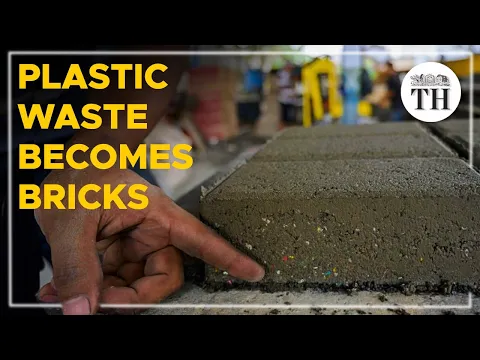

The produced blocks carry a very objective data point: 20% of the content is plastic waste. This proportion does not eliminate the need for cement and sand but changes the destination of a material that would otherwise proceed to permanent disposal.
The reported strength also connects to a local reference: the bricks can withstand 250 kg per square centimeter, a value described as the Indonesian standard for paving bricks.
This helps to understand why the cited application is the urban “floor” for parking lots, pavements, parks, and even running tracks, where what matters is bearing load, friction, time, and heat. The technical promise is not lightness; it is permanence.
Scale, Routine, And What Is Still Being Tested
So far, the company has produced more than 100,000 bricks, a number pointing to something beyond a prototype. There is also a daily dimension in the incoming material flow: thanks to a viral campaign on social media, packaging from donors across the country has started to arrive, and the waste continuously enters the factory.
On “any given day,” the operation is described as capable of preventing almost 88,000 pieces of plastic packaging from polluting the environment.
This type of data is usually the most difficult to visualize because it doesn’t appear as a single mountain of trash: it spreads, gets lost in drains, returns by the river’s edge, and reappears in the sea. When the account converts to “pieces per day,” the problem ceases to be abstract.
Beyond The Floor: Hollow Bricks And New Functions In Construction
After consolidating the paving bricks, Rebricks began to explore another possibility: turning waste into hollow bricks, used as construction elements in interior walls and coverings.
This stage is relevant because it changes the type of technical requirement. Flooring requires strength and durability under load and friction; interior walls and coverings require dimensional stability, fit, finish, and predictability in laying.
The same logic of “taking from disposal” remains, but the challenge is to meet different uses without losing performance.
The story of Rebricks is easy to summarize but difficult to execute: two friends in Jakarta insisted long enough to test around 100 methods, remake prototypes, and arrive at a process that shifts the “impossible waste” into an urban-use piece.
And, along this journey, bricks become a way to measure what the city consumes and what it chooses not to see.
If this idea reached your area, would you feel comfortable walking on pavements made from coffee, noodle, and hygiene product packaging?
And, looking at your city, what “no exit” waste do you think should be prioritized: pouches, bags, snack packaging, or another type that you see accumulating every day?








-

-

-

-

-

18 pessoas reagiram a isso.