





 Portuguese
  English
  Spanish
  4 min of reading
  0 comments


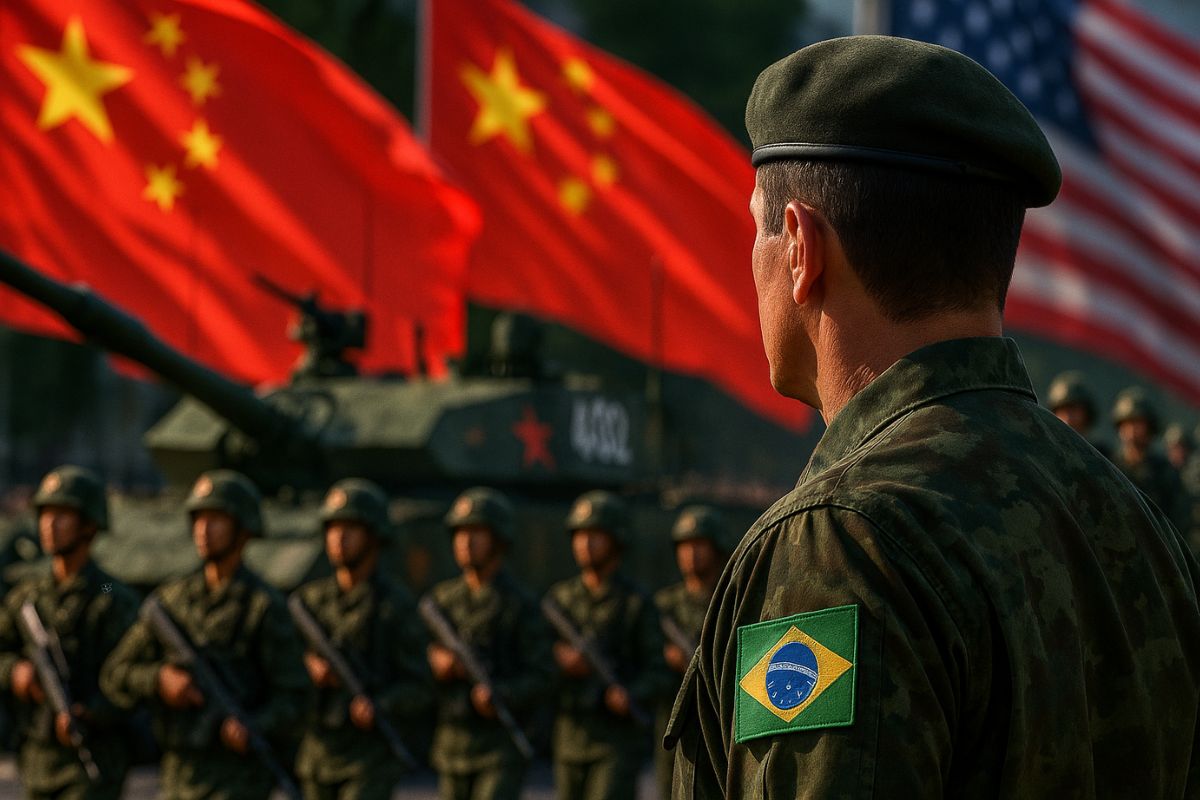
According to Lawyer Davi Aragão, after the September 3, 2025 parade in Beijing, Brazil signaled its openness to acquiring Chinese weapons, risking sanctions and international isolation.
Brazil has maintained a strong military partnership with the United States for more than seven decades, marked by cooperation in military technology, joint exercises, and access to cutting-edge equipment. However, Celso Amorim’s participation in the largest military parade in China’s history on September 3, 2025, raised a warning: the Brazilian government is assessing the possibility of tightening military relations with Beijing and adopting Chinese weapons in place of American ones.
According to lawyer Davi Aragão, this shift could have direct consequences for the country’s defense and foreign policy. The change of suppliers is not just technical, but geopolitical — and it can be costly in terms of sovereignty, reliability, and international standing.
The Historic Partnership with the USA
Since the agreements signed in 1952, Brazil has had U.S. military cooperation.
-
The government requests the Federal Revenue Service for a new system to automate the income tax declaration, reducing errors, time, and bureaucracy for millions of Brazilians.

-
Pix in installments, international Pix, and contactless payment without internet: the Central Bank revealed the new features coming to the tool that is already used by almost every adult in Brazil.

-
Mercado Livre has just started selling medications with delivery in up to three hours to your door, and this move could completely change the way Brazilians buy medicines on a daily basis.

-
In Dubai, rising tensions from the war in the Middle East are causing super-rich individuals to leave the Gulf and direct their fortunes to a new financial refuge in Asia.


This relationship was strengthened in 2019, when the country received extra-NATO ally status, facilitating access to advanced technologies.
Thanks to this partnership, Brazilian troops participated in joint training such as UNITAS and JRTC, as well as having integrated equipment like the Embraer A-29 Super Tucano aircraft, used by the U.S. Air Force in international missions.
Between 2020 and 2024, the United States accounted for 43% of global arms exports, supplying over 100 countries, mostly Western democracies.
The Rise of Chinese Weapons
China currently holds the fourth position in the global arms export ranking, with 5.9% of the market, supplying 44 countries, including Pakistan, Bangladesh, Algeria, and Nigeria.
Their products include the Chengdu J-20 fighter jet, the VT-4 tank, and low-cost attack drones.
According to Davi Aragão, the appeal lies in the more affordable price and quick delivery. However, there are serious criticisms regarding reliability and technological security.
Reports from Jordan and Iraq show frequent failures in Chinese drones, some of which were resold after disappointing use.
Cybersecurity Risks and Dependence
One of the most critical points is the risk of technological backdoors embedded in Chinese military equipment.
As the civilian and military sectors in China are integrated, there are suspicions of vulnerabilities that could allow for remote control or deactivation from a distance.
Similar cases have already been detected in sensors, port cranes, and solar inverters, leading Western countries to ban companies like Huawei and ZTE.
In the worst-case scenario, systems acquired by Brazil could be neutralized during military operations, directly compromising national defense and sovereignty.
The Growing Friction with Washington
The approach to China occurs at a time of open conflict between Brazil and the United States.
In July 2025, President Donald Trump imposed tariffs of 50% on Brazilian imports, sanctioned officials such as Alexandre de Moraes, and froze assets.
At the same time, he opened a case against Brazil at the WTO for alleged digital trade violations.
While entrepreneurs defended the country in hearings in Washington, Celso Amorim was in Beijing, alongside Xi Jinping and Vladimir Putin, reinforcing the image of diplomatic realignment.
Strategic Consequences


A rupture with the U.S. could result in the loss of access to critical technologies, such as the GE F414 engine of the Gripen fighter, essential for the Brazilian Air Force.
The country could be excluded from joint military exercises and face economic sanctions, in a scenario similar to Turkey, punished for purchasing Russian S-400 missiles and banned from the F-35 program.
Geopolitically, Brazil runs the risk of being seen as part of the authoritarian axis led by China, Russia, Iran, and North Korea, which would reduce its influence in forums such as the G20 and UN and could lead to a flight of international investments.
As highlighted by Davi Aragão, the potential exchange of 70 years of partnership with the U.S. for Chinese weapons is not just a matter of market, but of sovereignty and global repositioning.
The decision could redefine Brazil’s role on the international chessboard, bringing it closer to authoritarian regimes and distancing it from historical allies.
In your opinion, is it worth it for Brazil to risk sanctions and isolation to adopt cheaper Chinese weapons? Or is maintaining the partnership with the U.S. still crucial for national security? Please leave your opinion in the comments — we want to hear from those following this scenario in practice.









-

3 pessoas reagiram a isso.