





 Portuguese
  English
  Spanish
  4 min of reading
  14 comments


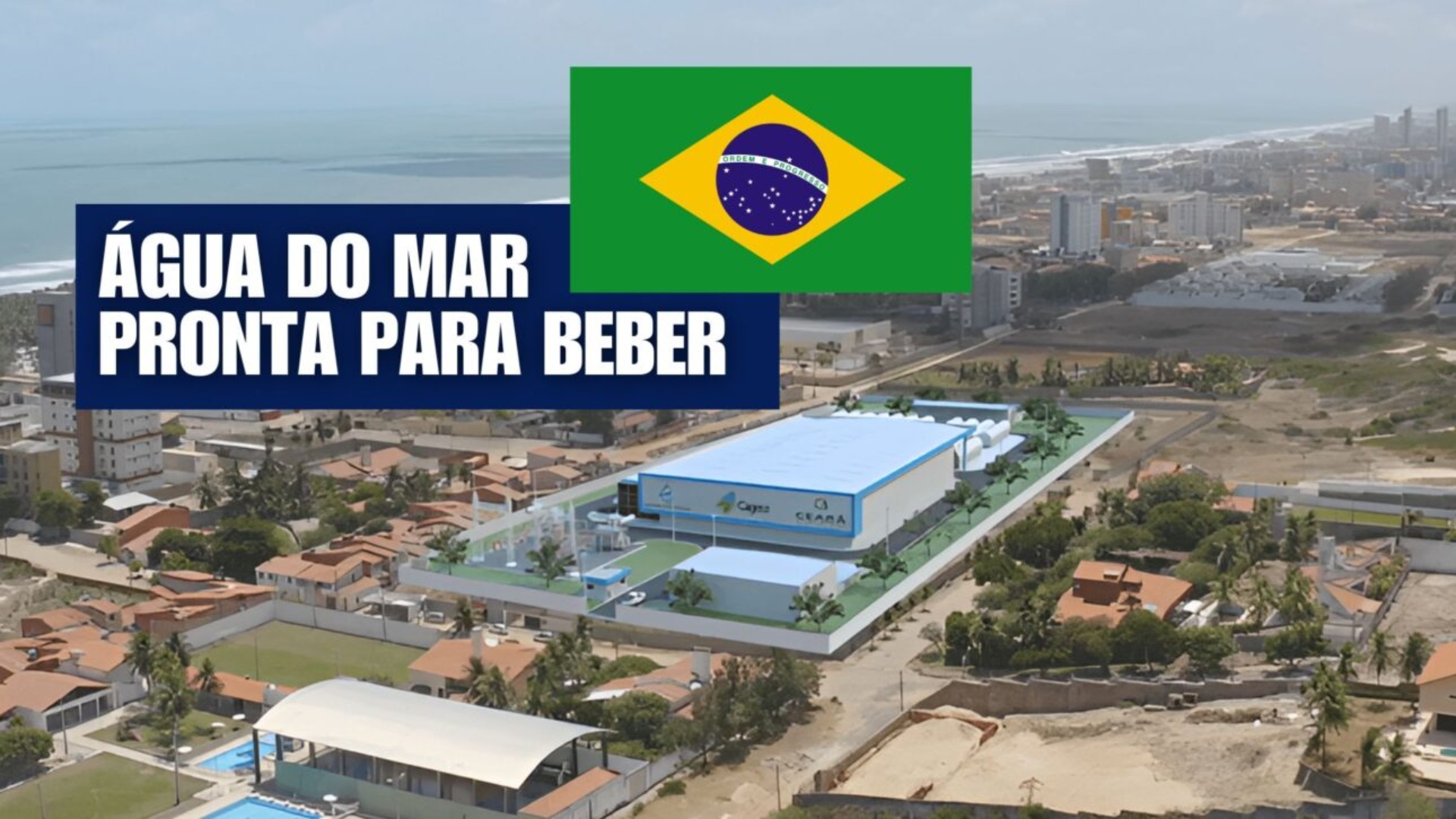


Fortaleza Advances in the Largest Desalination Plant in Brazil with a Capacity of 1 m³ of Water per Second at Praia do Futuro
The Water and Sewage Company of Ceará (Cagece) is advancing in the implementation of the largest desalination plant in Brazil, located at Praia do Futuro, in Fortaleza.
The Dessal Ceará project, developed in a public-private partnership with the consortium Águas de Fortaleza, formed by the companies Marquise, PB Construções, and Abengoa Água, received an Installation License issued by the State Superintendence of the Environment (Semace) in September 2025.
This authorization allows the start of construction, expected to take place in 2025, with full operation estimated for 2027 or 2028, depending on the construction schedule.
-
Friends have been building a small “town” for 30 years to grow old together, with compact houses, a common area, nature surrounding it, and a collective life project designed for friendship, coexistence, and simplicity.

-
This small town in Germany created its own currency 24 years ago, today it circulates millions per year, is accepted in over 300 stores, and the German government allowed all of this to happen under one condition.

-
Curitiba is shrinking and is expected to lose 97,000 residents by 2050, while inland cities in Paraná such as Sarandi, Araucária, and Toledo are experiencing accelerated growth that is changing the entire state’s map.

-
Tourists were poisoned on Everest in a million-dollar fraud scheme involving helicopters that diverted over $19 million and shocked international authorities.


Impressive Capacity of the Reverse Osmosis Plant
The plant operates with the capacity to produce 1 cubic meter of drinking water per second, equivalent to 86.4 million liters per day.
This volume directly serves about 720 thousand people in the Metropolitan Region of Fortaleza, representing an increase of approximately 12% in the supply of treated water for the capital of Ceará.
The central technology adopted is reverse osmosis, a method that separates salt from seawater through semipermeable membranes under high pressure, a process used in about 80% of desalination plants operating worldwide.
Detailed Steps of the Desalination Process

The process begins with the intake of seawater at submerged points far from the coast, using pipes that avoid direct impacts on marine fauna.
The captured water goes through pre-treatment stages, including filtering through screens, sand beds, and the addition of coagulants and disinfectants to remove sediments, particles, and organisms.
Then, pumps raise the pressure to about 60 bar, forcing the water through the membranes, where the separation occurs: the permeate is the purified water, while the concentrated brine, with higher salt content, receives controlled dilution before returning to the ocean, minimizing changes in local salinity.
Post-Treatment Ensures Drinking Water Quality
After reverse osmosis, the desalinated water, extremely pure, goes through post-treatment with remineralization, adding calcium, magnesium, and other minerals to meet drinking water standards and improve taste.
pH corrections and final chlorination ensure microbiological safety until distribution.

Automated systems monitor parameters such as turbidity and dissolved solids in real time.
Response to Water Vulnerability in the Northeast
The Dessal Ceará project emerges as a response to the water vulnerability of the Brazilian Northeast, a region marked by prolonged droughts and dependence on reservoirs subject to climatic variations.
Fortaleza, which imports most of its water from distant springs, gains from this plant an inexhaustible alternative source, the ocean, reducing pressure on reservoirs and allowing better allocation of rainwater to the interior of the state.
The initiative diversifies the water matrix, aligning with resilience strategies adopted in countries with extensive coastlines and freshwater scarcity.
Investments and Public-Private Partnership Model
The public-private partnership foresees investments of about R$ 3.1 billion over 30 years, with the concessionaire responsible for construction, operation, and maintenance.

Cagece purchases the water produced according to demand, paying only for the volume actually delivered.
The site of the plant, at Praia do Futuro, underwent adjustments after discussions about impacts on underwater infrastructures, resulting in relocation to an area that preserves telecommunication cables and meets environmental conditions, such as protection for fauna and management of construction waste.
Strict Environmental Conditions from Semace
Semace imposed 65 conditions in the installation license, including a basic environmental plan with mitigating measures, monitoring of brine dispersion, and permanent protection of the marine ecosystem.
Technical visits to plants in Israel, a global reference in desalination, assisted in improving the project.
When operational, the plant integrates energy efficiency, with potential for reducing operational costs at scale.


National Impact on Coastal Regions
Other coastal regions of Brazil observe the advances in Ceará, as the country has over 8,500 kilometers of coastline and faces recurring water crises in capitals like Recife and Salvador.
Ceará, a pioneer in small-scale desalination in the interior, is now scaling the technology for urban supply, transforming the sea into a strategic ally against scarcity.
The implementation of Dessal Ceará reinforces water security in a state that has suffered from severe droughts in recent years, with reservoirs frequently below capacity.
The plant adds a layer of independence from rain, benefiting not only Fortaleza but also contributing to the balance in the use of state water resources.
And you, do you think projects like Dessal Ceará should be replicated in other coastal capitals of Brazil to combat future water crises?









Excelente trabalho, em especial na época em que estamos vivendo sob a ameaça de aumento do nível do mar. Sem dúvida nenhuma é uma forma de conter ou combater uma.futira tragédia , como também uma forma de tornar possível que muitos outros tenham acesso a água tratada.
Em minha opinião, já passou da hora do Brasil tomar essa ação.
É necessário que, todos os estados em região litorânea, adotem essa medida.
É uma excelente iniciativa! Dessa forma vejo ser possível contar com a abundância do oceano para socorrer a humanidade com o recurso tão importante que é a água. Outro ponto positivo é o cuidado com os impactos ambientais sendo captação feita com esse cuidado em alto mar longe da costa.