





 Portuguese
  English
  Spanish
  5 min of reading
  2 comments


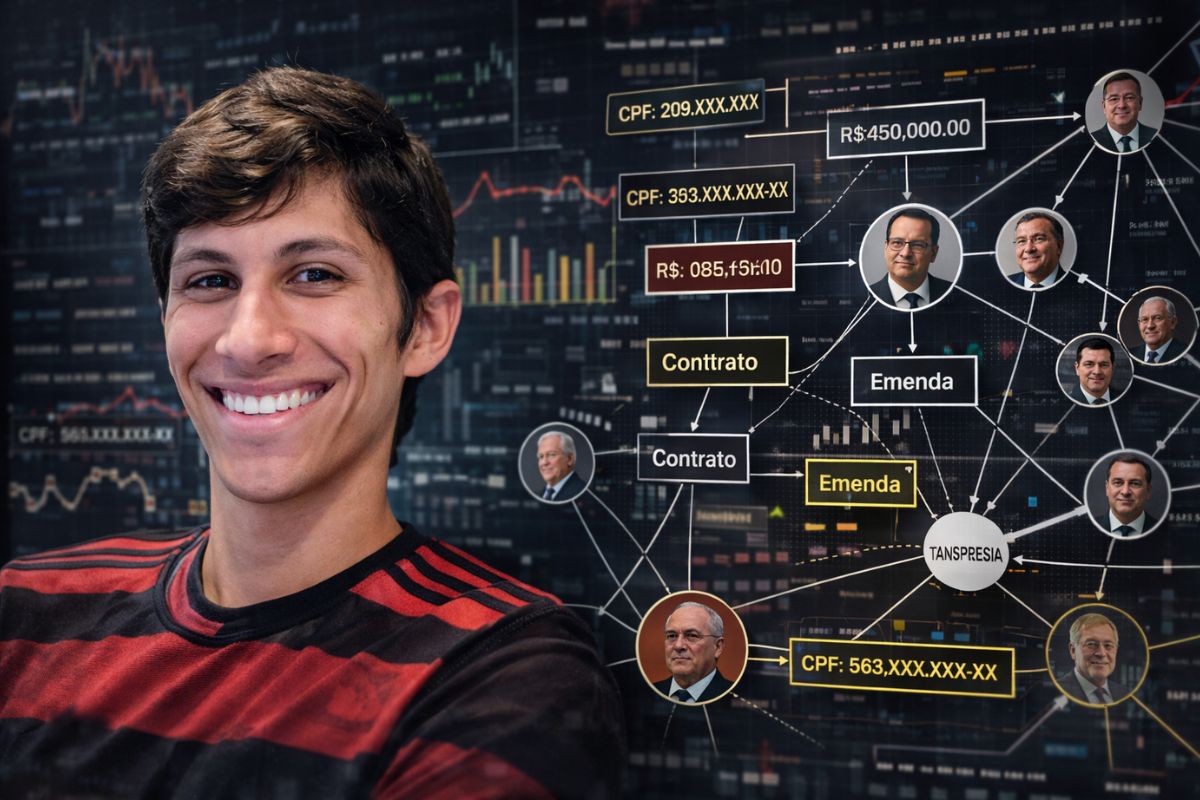


Created by Bruno César, the Brazilian tool integrates the Transparency Portal, TCU, and Federal Revenue to relate CPF, individuals, and companies in graphs, indicating percentage risk scores in transfers, amendments, and contracts; the initial crossings indicate high-risk exposures totaling tens of millions at different governmental levels
A Brazilian programmer started to attract attention by bringing together, in a single system, public databases that are usually scattered and difficult to cross-reference. Based on the CPF of politicians and civil servants, the tool organizes federal transfers, administrative contracts, and business links into visual relationships that help reveal patterns.
The responsible party is Bruno César, who identifies as a member of the br/acc movement, linked to accelerationism. The demonstration occurred on social network X, with a graph-based interface that connects individuals, companies, and resource flows, proposing a risk reading without using accusatory labels.
How the Brazilian Tool Reorganizes Public Data Based on CPF
The central idea of the system is simple to understand and difficult to execute well: take existing public information and make it interact with each other.
-
Motorola launched the Signature with a gold seal from DxOMark, tying with the iPhone 17 Pro in camera performance, Snapdragon 8 Gen 5 that surpassed 3 million in benchmarks, and a zoom that impresses even at night.

-
Satellites reveal beneath the Sahara a giant river buried for thousands of kilometers: study shows that the largest hot desert on the planet was once traversed by a river system comparable to the largest on Earth.

-
Scientists have captured something never seen in space: newly born stars are creating gigantic rings of light a thousand times larger than the distance between the Earth and the Sun, and this changes everything we knew about stellar birth.

-
Geologists find traces of a continent that disappeared 155 million years ago after separating from Australia and reveal that it did not sink, but broke into fragments scattered across Southeast Asia.
Instead of analyzing each database in isolation, the Brazilian tool seeks to see continuity between transfers, contracts, and business ties, with the CPF serving as a starting point to chain relationships.
In solutions of this kind, the critical stage is often consolidation: the same actor may appear with different spellings, incomplete records, and variations in identification across systems.
When integration is automated, the chance of expanding investigative reach increases, but it also heightens the need to validate matches to reduce association errors and hasty interpretations.
Why Graphs Change the Way We View Amendments, Transfers, and Contracts
Graphs are useful because they treat each entity as a “node” and each relationship as an “edge”: person, company, municipality, contract, transfer, everything is part of the same network. Instead of a linear list of payments, the observer starts to see paths of who receives, who contracts, who is linked, how money circulates, and where there is concentration.
It is at this point that the Brazilian tool gains strength to answer “where” and “who” without relying on a ready-made narrative: the demonstration on X showed diagrams that connect individuals and legal entities to resource flows, allowing for the identification of recurring routes.
A pattern that repeats across the network becomes a signal for attention, not because it proves something in itself, but because it indicates where it is worth delving into checks, documents, and context.
What Appeared in the First Crossings and Why It Became a Risk Score

Among the cases indicated by the system are situations where parliamentary amendments allocate resources to municipalities, and later, local contracts end up in the hands of companies associated with relatives of congressmen.
Inconsistencies also emerged suggesting possible “ghost employees” and federal transfers to educational institutions with indications of cadastral irregularity.
This type of finding is sensitive because it mixes financial volume with personal ties, and can generate strong interpretations before thorough verification.
To address the “why” of transforming findings into metrics, Bruno César states that the project adopted a statistical model that estimates exposures and classifies as “high risk,” totaling tens of millions of reais.
Instead of using terms like “corruption” or “suspicion,” the system began to present percentage risk scores, a common approach in compliance practices.
In practice, this changes the framing: the accusation is replaced with a quantified alert, which can guide audits and reports without asserting guilt.
Limits, Legal Cautions, and the Path to Open Source
A Brazilian tool with this purpose quickly encounters two limits: the quality of public data and the risk of misuse of the conclusions.
Even with official databases, cadastral inconsistencies, update delays, and incomplete records can create false positives — connections that “seem” strong visually, but do not hold up when one looks at the documentary details.
For this reason, the developer says they intend to submit the code for legal review before making it open source.
The promise to open the code, if it happens, tends to increase methodological transparency and allow for external audits, but also requires clarity on criteria: which signals increase the score, which decrease it, how the tool handles homonyms, indirect ties, and relationships that are legal yet politically sensitive.
Transparency, LAI, and the Role of Technology in Everyday Oversight
The project dialogues with the advancement of transparency policies in Brazil after the Access to Information Law of 2011 and with a recurring criticism: the databases exist, but remain fragmented across different systems, which reduces the ability to see the big picture.
When the reading depends on multiple disconnected platforms, the investigation cost rises and oversight tends to be limited to specialized teams.
By structuring data in networks, the Brazilian tool seeks to lessen this friction, facilitating the work of investigative journalists, civil society organizations, and oversight agencies, as the developer claims to be a priority.
Nonetheless, the real impact depends on a key point: transforming visualization into responsible procedure, with verification, due process when applicable, and care not to confuse “risk” with “proof”.
The Brazilian tool presented by Bruno César exposes a current tension: public data already allows seeing a lot, but integration is still lacking to turn it into oversight intelligence.
By using CPF and graphs to connect amendments, transfers, contracts, and business ties, the system relies on risk scores to guide investigations and, at the same time, tries to shield itself from direct accusations with compliance-like language.
If you had access to such a risk score, would you trust the triage by percentage more, or would you only believe after seeing documents and local context?
In a case of an amendment that ends in a contract with a company linked to a relative, what would you consider a “legitimate alert” and what would be a “deceptive connection”? And, in your view, what should be the ethical limit for publishing graph relationships involving a public agent before a thorough investigation?








O Ministro Dino, já deve mandar achar este rapaz e protge-lo. A forma é ótima para investigação mais rápida
Oi????
O gordino é mais um dos que vão ser pegos por essa ferramenta!!