





 Portuguese
  English
  Spanish
  5 min of reading
  27 comments


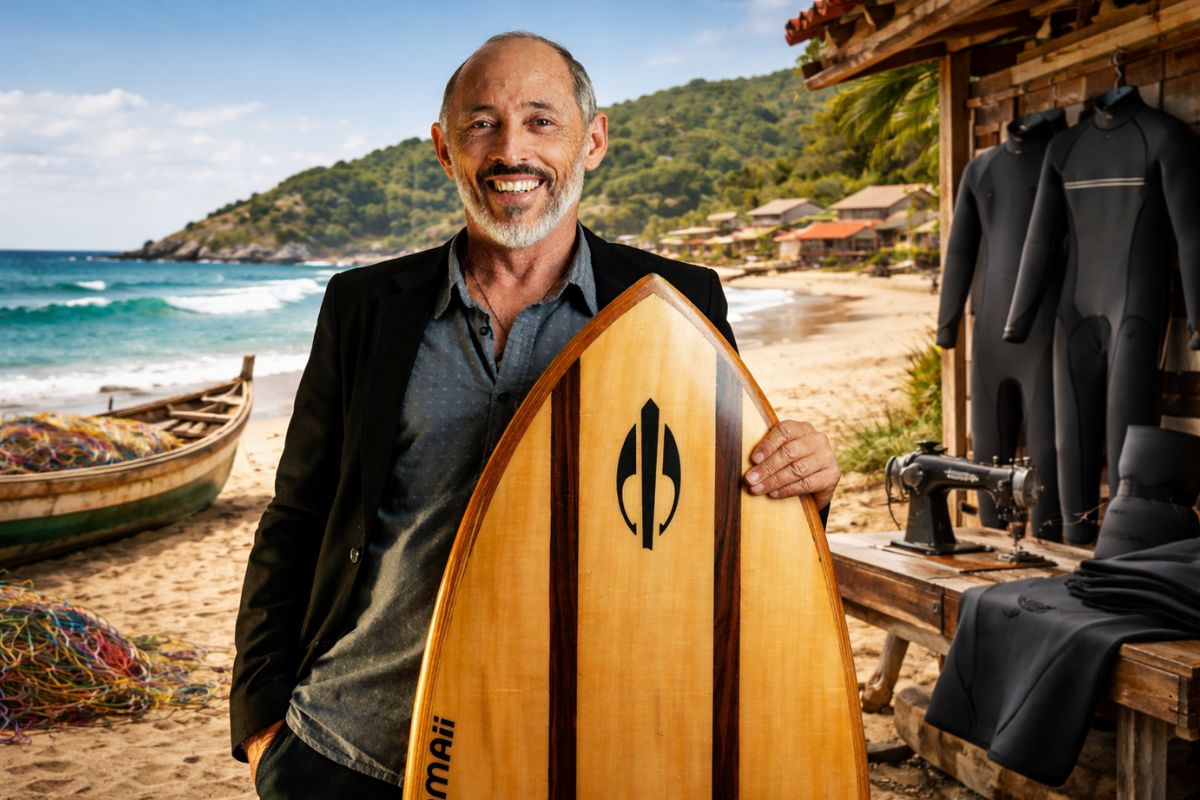


The Brazilian Doctor Marco Aurélio Raymundo, the Morongo, Swapped His Routine in Rio Grande do Sul for a Fishing Village in Garopaba, Where He Wanted to Work at the Health Clinic and Surf, Until He Created a Wetsuit That Opened the Way for Mormaii and Later Reached the Cited Revenue
When the story of reaching the top is told quickly, it often erases the beginning. In the case of Marco Aurélio Raymundo, the Morongo, this beginning is marked by a break: a Brazilian doctor who left Rio Grande do Sul and chose Garopaba to split his time between the health clinic and surfing in almost empty beaches.
What seemed like a personal change ended up being a practical solution. In the cold of winter, he sewed a wetsuit for himself to go into the water, and the improvisation led to orders. Decades later, Mormaii appears associated with a revenue of R$ 350 million in 2021, a figure attributed to InfoMoney in the data gathered here.
From Medicine in Rio Grande do Sul to the Call of Garopaba

The starting point is straightforward: the already graduated Brazilian doctor was working in Rio Grande do Sul in the 1970s and had surfing as a constant interest.
-
Friends have been building a small “town” for 30 years to grow old together, with compact houses, a common area, nature surrounding it, and a collective life project designed for friendship, coexistence, and simplicity.

-
This small town in Germany created its own currency 24 years ago, today it circulates millions per year, is accepted in over 300 stores, and the German government allowed all of this to happen under one condition.

-
Curitiba is shrinking and is expected to lose 97,000 residents by 2050, while inland cities in Paraná such as Sarandi, Araucária, and Toledo are experiencing accelerated growth that is changing the entire state’s map.

-
Tourists were poisoned on Everest in a million-dollar fraud scheme involving helicopters that diverted over $19 million and shocked international authorities.


The move to Garopaba, described as a fishing village, was not presented as a romantic escape, but rather as an attempt to fit his profession and ocean routine into the same address.
According to the narrative attributed to the brand’s official website, the intention was to serve the community at the health clinic while also surfing frequently.
The geography became part of the plan, because Garopaba offered emptier beaches and a local dynamic where a newcomer could still move around without the typical urban machinery of large centers.
Why Winter Pushed the Brazilian Doctor to Neoprene

The technical detail that changes the story is the cold.
The data indicate that in the winter, it was practically impossible to stay in the water due to low temperatures, and that’s when the Brazilian doctor decided to sew a wetsuit for himself.
The gesture has an intimate aspect, but also a reading of home engineering: reducing heat loss to extend time in the sea.
Neoprene, in sports use, usually works as an insulator by creating a layer of water between the body and the material, which warms with body heat and decreases thermal exchange.
It’s not magic, it’s physics applied to discomfort, and this helps to understand why a solution made for one person can become a collective necessity when the same limitation affects everyone who surfs in the cold.
From Word of Mouth to Product: When Surfing Becomes a Market
The data describe a simple diffusion mechanism: the news spread, orders began, and the brand started expanding.
There is an important social element here, because surfing is, by nature, a network of observation. Anyone who enters the water with something different is seen, questioned, copied, and adapted.
The official website of Mormaii is cited stating that the first surf wetsuits in the country allowed any Brazilian athlete to buy one without relying on imported products.
Even without unit numbers or prices, the statement delineates an impact: local neoprene becomes an alternative in a market where importation tends to increase costs and delay access.
When equipment stops being a rarity, the sport changes scale.
Mormaii and the 1980s: Brand, Prestige, and Continuity
The expansion is connected, in the data, to the prestige that surfing gained as a sport in the 1980s. This point matters because a brand cannot sustain itself solely on utility; it needs cultural circulation.
As surfing becomes more visible, the demand for suitable clothing also grows, and neoprene stops being a niche solution to become a standard item.
Here, Garopaba appears as a symbolic and practical origin.
The Brazilian doctor did not create Mormaii in a lab; he created it near the sea, in a context where testing, failing, and adjusting are part of the day.
The brand is born from the friction between body, water, and temperature, and this origin is often remembered precisely because it contrasts with more standardized business narratives.
The Amount of R$ 350 Million and What It Does Not Answer
The most objective data is the revenue of R$ 350 million, attributed to InfoMoney and located in 2021. It gives dimension, but also opens gaps.
Those who look only at this total might imagine a straight line of success when the very history presented suggests a sequence of small bets made before any guarantee existed.
There is also a lack, in the data, of the breakdown of this value: which product lines drive the result, what share comes from neoprene clothing, and how much represents licensing or diversification.
Still, the figure helps to fix an idea: a momentum born from surfing and neoprene managed to become a large enough company to appear in balance sheets and headlines.
What This Trajectory Teaches About Risk, Work, and Choice
The harsh reading of this biography is that it does not romanticize the leap; it exposes the cost.
A Brazilian doctor who moves states and bets on Garopaba trades predictability for a daily life where the ocean dictates and the market is uncertain.
And even when the sewing becomes a product, there is still the stage of producing consistently, delivering, dealing with demand, reputation, and quality.
The more practical reading is that innovation, sometimes, does not arise from the search for novelty but from the refusal to accept a limit. Winter was the limit. Neoprene was the answer. Surfing was the testing ground.
Mormaii was the consequence. It’s a short but demanding chain, where each link depends on the previous one.
The story of the Brazilian doctor Morongo does not boil down to a slogan about abandoning everything, because what appears in the data is a path of work: Rio Grande do Sul, Garopaba, cold, neoprene, orders, expansion, soaring surfing, and, decades later, the figure of R$ 350 million attributed to 2021.
If you had a stable job and a passion that requires time and risk, what decision would make sense in your real life: move to a city like Garopaba, try to create something from scratch, or keep the safe path? And looking at today’s surfing, do you think national neoprene is still a symbol of autonomy or has it just become another fashion item?










Se o indivíduo é **** ele não passa de uma escória endinheirada. Só duas hipóteses explicam um ****: ou é um **** completo, ou é um ser de péssima índole. Não existe meio termo.
Não foi bem assim…Mas o PIOR, é que após alguns anos, este TRASTE virou bolsonaristas, como a maioria dos TRASTE que nasceram no REICH SC
TRASTE é quem vive de bolsa família, etc… trabalho é dignidade!
Ver a opinião rasteira e criminosa de um extremista de esquerda, é sempre um desafio para o nosso humor, quer dizer que o médico inventou algo que se tornou marca nacional e o extremista o crítica?
E tu pelo jeito é um fracassado!
SC é o grande campeão, é o estado q possui a maior concentração de celulas NEO…N.A.Z.I do país em termos de proporção populacional. Cerca de 300. Não á toa o Geno….cida tem 70% de eleitores.
Esquerdopatia tem tratamento. Vai te tratar!!!
A Estória dele todo mundo já Conhece…..