





 Portuguese
  English
  Spanish
  6 min of reading
  3 comments


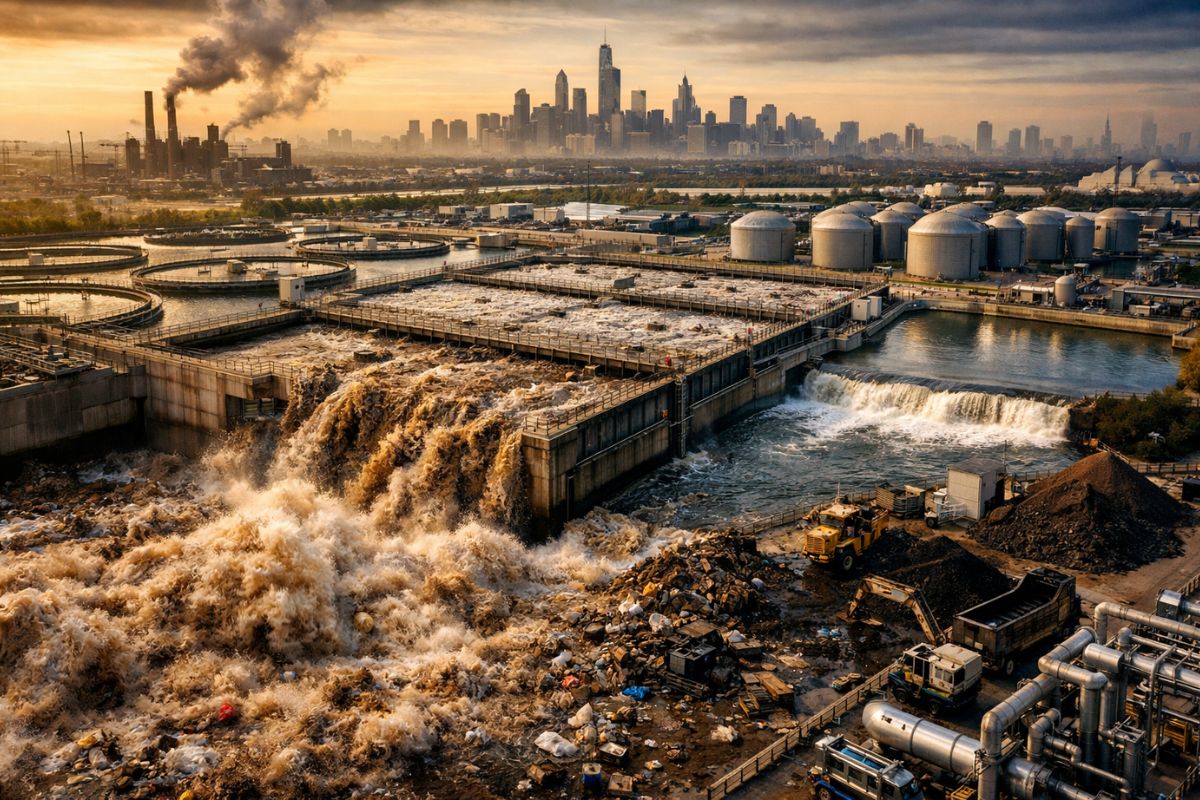


Around Chicago, the Stickney Treatment Plant receives raw sewage from about 2.3 million people and, when the rain pours, it reaches a treatment capacity of 1 million gallons per minute, separating trash, grease, and sludge, and returning to the channels a much cleaner effluent daily.
Chicago is the kind of city that only realizes its “invisible side” when the rain pours and the volume explodes: in a single day, Stickney has dealt with up to 1.4 billion gallons of wastewater, something comparable to more than 2,000 Olympic swimming pools flowing through the same path.
What impresses is not just the scale, but the logic behind it: condensing in hours what nature would take weeks to separate and transform, returning much cleaner water to the channels and converting solids into biosolids, energy, and fertilizer, without disguising what comes in or goes out.
Why Chicago’s Sewage Doesn’t “Disappear” When It Goes Down the Drain

In Chicago, every flush, shower, and sink connected feeds into a system that doesn’t work by magic: everything that “goes away” needs to end up somewhere, and Stickney exists precisely so that this destination is not the river, raw, the way it came in. What the eyes don’t see becomes infrastructure, and infrastructure becomes routine.
-
Friends have been building a small “town” for 30 years to grow old together, with compact houses, a common area, nature surrounding it, and a collective life project designed for friendship, coexistence, and simplicity.

-
This small town in Germany created its own currency 24 years ago, today it circulates millions per year, is accepted in over 300 stores, and the German government allowed all of this to happen under one condition.

-
Curitiba is shrinking and is expected to lose 97,000 residents by 2050, while inland cities in Paraná such as Sarandi, Araucária, and Toledo are experiencing accelerated growth that is changing the entire state’s map.

-
Tourists were poisoned on Everest in a million-dollar fraud scheme involving helicopters that diverted over $19 million and shocked international authorities.


The central point is simple and uncomfortable: raw sewage comes with odor and organic load, but also with objects and waste that shouldn’t be there.
The plant operates on two axes simultaneously, treating the liquid for return to the water system and directing the solid fraction to become biosolids used as fertilizer, closing a cycle that, in Chicago, only makes sense because it is monitored and repeated every day.
The Coarse Screens and the Sorting That Begins with the Habit of Those Who Live in Chicago

The first impact of Chicago’s sewage with the plant is physical and direct: the coarse screens, with openings capable of retaining larger objects, filter trash and plastics before they become part of the rest of the process. This is where the reality of what is thrown in the toilet appears unfiltered, the way no one likes to admit.
One item, in particular, appears frequently and becomes an operational problem: so-called “flushable” wipes.
The practical point is that they do not degrade in the system, do not break down inside the plant, and tend to stick to irregular surfaces, forming blocks that need to be removed.
What the sorting captures moves along conveyors to dumpsters and, in the end, goes to landfills, an uncomfortable reminder that, in Chicago, not everything that enters the plumbing should have entered.
Aerated Sand Tanks: When Grease Rises and Sludge Sinks, Chicago Gains Time

After sorting, the flow is pumped to structures above ground level, reaching the aerated sand tanks, where the velocity decreases and the separation becomes clearer.
Lighter materials, such as grease, oils, and fats, form a surface layer, while heavier waste settles at the bottom as sludge.
This moment is crucial because it prepares what comes next: rotary blade equipment removes the “scum” layer from the top and scrapes the sludge from the bottom, directing the solids to digestion and centrifugation stages.
In days of elevated flow, when Chicago dumps extreme volumes into the system, this stage helps maintain process stability, preventing the “excess” from disorganizing the entire sequence.
Microorganisms and Oxygen: The Part Where Chicago Uses Biology to Reduce Pollutants
In the transition to secondary treatment, the plant enters what resembles an urban-scale laboratory: tanks with carefully maintained microorganisms receive pumped air, creating an environment where bacteria “consume” pollutants and unwanted substances. Chicago is not “cleaning” the water with perfume, but rather with metabolism.
This oxygen has a central function: helping in the neutralization of compounds like ammonia, converting it into less toxic forms of nitrogen, such as nitrate and nitrite.
The difference is ecological and practical because ammonia is toxic to small and large fish living in waterways, and the transformation reduces the risk to aquatic life when the treated water returns to the system of channels.
The Final Settling Tank and the Boundary Between “Looks Clean” and “Is Safe” in Chicago
The circular final settling tanks are the last stop in the separation process: there, solids and liquids separate once again, with the removal of what still remains of solid material and the release of the treated effluent.
The liquid that passes through the spillway goes to the sanitary and navigation channel, returning to the system as treated effluent.
There’s a detail that prevents easy interpretations: the treated water may look beautiful and clean, but it is not potable. The goal is not to produce drinking water, but to return to the channels water that is much cleaner than what entered.
For this, there are quality standards to meet, defined by the Illinois Environmental Protection Agency, and samples are analyzed daily in the laboratory to ensure that the release does not harm the environment or pose a risk to the public.
From Sludge to Fertilizer and Energy: When Chicago Transforms Solids into Biosolids and Biogas

While the liquid makes its way back, the sludge follows a parallel, longer, and industrial route: centrifugation and digestion.
In the centrifuges, the sludge is mixed with a polymer and spins at high speeds to further separate solids and liquids. Then, the digesters perform anaerobic digestion, heating and breaking down organic matter through microbial action, producing biogas.
In this process, the methane generated is reused for part of the energy consumption of the facility itself.
Afterward, the material goes through centrifuges again until it becomes a “cake” of biosolids: on a normal day, Stickney can produce over 1,000 wet tons of this material.

Part of the logistics is rail-based, with cars that can receive around 70 wet tons per shift, totaling around 1,000 to 2,000 wet tons over a normal day, heading for additional treatment and drying before becoming fertilizer used in agricultural areas, as well as in golf courses, parks, and recreational spaces.
What Chicago’s Scale Reveals About Rain, Routine, and Collective Responsibility
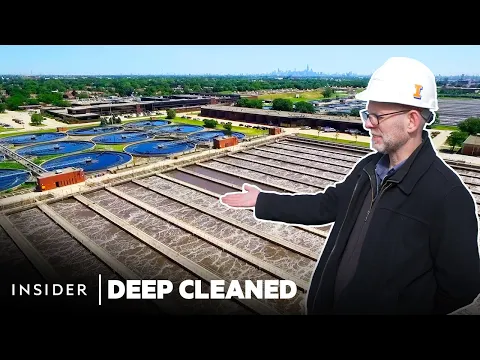

When the rain changes the rhythm, Chicago shows why such a large plant exists: in intense operation, the system can receive about 1 million gallons per minute, and what would be a collapse becomes a race of engineering, chemistry, and biology to keep the effluent within standards and protect the aquatic environment.
The volume does not forgive improvisation, which is why the plant does so much “in-house,” with its own laboratory and constant monitoring.
The plant also exposes an uncomfortable truth: efficiency depends, in part, on collective behavior.
Toilets were not made for trash, and clogged street drains become shortcuts for everything on the surface to end up in the same destination as sewage, arriving at Stickney along with rainwater.
Chicago can treat absurdly more than an average plant in the state, but still bears the burden of what the city decides to push into the system.
Chicago treats an inevitable problem with a process that mixes brute force and fine detail: screens that catch what shouldn’t be there, tanks that separate grease and sludge, microorganisms that reduce pollutants, and laboratory routines that ensure standards before returning the water to the channels.
At the same time, it transforms solids into biosolids and reuses methane for energy, showing that even waste can become a resource when there is scale, control, and operational discipline.
Now I want to hear from you in a very direct way: in your city, do you have any idea where does the water from the toilet and rain go after it disappears down the drain?
And have you ever seen someone treat a toilet like a trash can with “flushable” wipes, oil, and leftovers, even knowing that this can cause blockage and costs down the line?










Buenas noches desde Cajamarca (distrito de Cajamarca) – Perú, aquí a la fecha no existe ningún proceso de tratar las aguas servidas y de lluvia, las aguas residuales van crudas al río más cercano y así irriga parte de la zona agrícola de la ciudad y otro distrito aledaño. Hay proyecto de una PTAR, pero hasta la fecha no hay nada concreto. Tanto las autoridades y la población desconoce el grave daño que significa no tratar estas aguas.. gracias a la información que comparten vemos que cual posible es manejar de manera sostenible este elemento tan importante como es el agua. Gracias. Saludos
Es admirable todo el trabajo que hacen en mi ciudad hay una planta de tratamiento pero esta muy lejos de ser ese lujo de planta
Em casa, não jogamos nada de deferente do que é o objetivo do vaso sanitário. A cidade tem tratamento de esgoto, mas, muitos jogam esgoto em valas. O mar está poluído.