





 Portuguese
  English
  Spanish
  3 min of reading
  3 comments


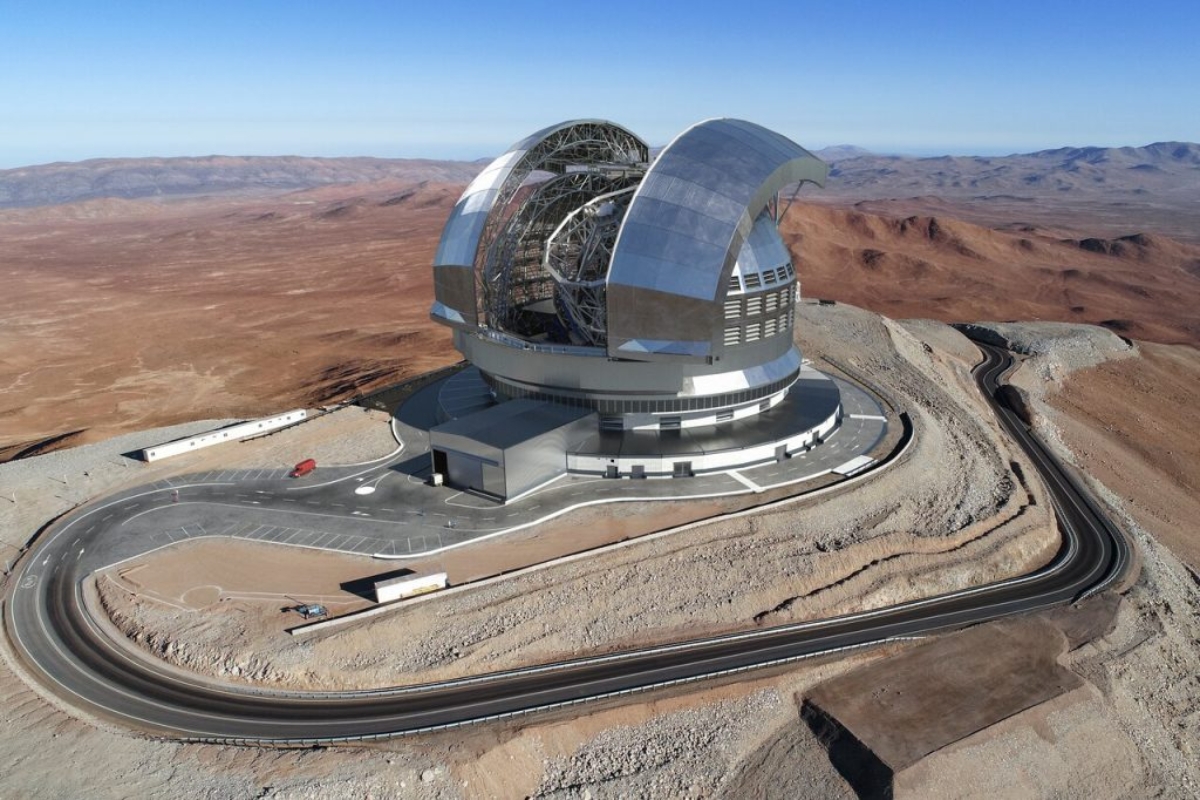


In The Atacama Desert, The European Southern Observatory Is Building The Extremely Large Telescope With A 39.3-Meter Primary Mirror And An Investment Of €1.45 Billion To Investigate Exoplanets And The First Galaxies, Creating Global Excitement In Astronomy.
Dozens of boxes with mirrors scattered over a remote hill in northern Chile draw attention amidst the arid landscape of the desert. On-site, workers are advancing in the construction of one of the most ambitious scientific structures on the planet.
The Extremely Large Telescope, known as the ELT, is already about 60 percent complete. Once finished, it promises to change what humanity knows about the universe.
The first scientific observations are expected to take place by the end of 2028. The impact could be immediate in almost all areas of astronomy.
-
Motorola launched the Signature with a gold seal from DxOMark, tying with the iPhone 17 Pro in camera performance, Snapdragon 8 Gen 5 that surpassed 3 million in benchmarks, and a zoom that impresses even at night.

-
Satellites reveal beneath the Sahara a giant river buried for thousands of kilometers: study shows that the largest hot desert on the planet was once traversed by a river system comparable to the largest on Earth.

-
Scientists have captured something never seen in space: newly born stars are creating gigantic rings of light a thousand times larger than the distance between the Earth and the Sun, and this changes everything we knew about stellar birth.

-
Geologists find traces of a continent that disappeared 155 million years ago after separating from Australia and reveal that it did not sink, but broke into fragments scattered across Southeast Asia.

Billion-Dollar Project Puts Chile At The Center Of Global Astronomy
The telescope is a project of the European Southern Observatory, an intergovernmental research organization focused on astronomy.
The investment is €1.45 billion, equivalent to approximately R$8.87 billion. The figure is impressive and reinforces the scale of the initiative.
According to representatives of the institution, the new observatory is expected to impact practically all fronts of universe study, from the formation of the first galaxies to detailed analysis of stars in other regions of the cosmos.

39.3-Meter Giant Mirror Will Be The Heart Of The Telescope
The detail that draws the most attention is the size of the main mirror.
With a diameter of about 39.3 meters, the mirror will be approximately 1.5 times larger than the Brandenburg Gate in Berlin. It will be made up of 798 individual segments.
These pieces, currently stored in boxes at the construction site, will be assembled to form the largest infrared optical structure in the world, a position that should be maintained for decades.
In addition to the main mirror, the system will feature multiple additional mirrors, each with different levels of complexity, making the project a huge engineering challenge.
Strategic Location At 3,050 Meters Above Sea Level Favors Observations
The ELT is being built at Cerro Armazones, about 3,050 meters above sea level and approximately 1,000 kilometers north of Santiago, the Chilean capital.
The region is part of the Atacama Desert, considered one of the best places in the world for astronomical observation due to its extremely dry climate and low atmospheric interference.
This combination of high altitude and clear sky allows for capturing extremely faint signals from distant regions of the universe.
Search For Life Beyond Earth And Travel To The Universe’s Past

Among the main objectives of the Extremely Large Telescope is the search for signs of life on exoplanets, which are planets located outside our solar system.
Scientists intend to analyze the atmospheres of these distant worlds to identify possible biological signs.
In addition, the telescope will allow for stepping back billions of years in time, observing the first stars and galaxies formed after the beginning of the universe.
The expectation is to deepen the understanding of how cosmic structures emerged and evolved throughout cosmic history.
Technical Challenge Involves Highly Complex System
The construction of the ELT does not involve just a large mirror.
It’s a highly complex system, with multiple mirrors and components that need to operate with extreme precision.
According to the technical team in charge, the assembly, integration, and verification require strict coordination and cutting-edge technology to ensure that the telescope functions perfectly when it begins operation.
With 60 percent of the project completed and scientific activities expected to start by the end of 2028, the Extremely Large Telescope is establishing itself as one of the most ambitious projects in modern astronomy, promising to unprecedentedly expand humanity’s view of the universe and the possible existence of life beyond Earth.
Do you believe that the ELT will be able to find concrete signs of life beyond our planet? Share your opinion in the comments.








Lo interesante sería que existiera un acceso para el común de los chilenos, a la información que el telescopio obtenga. Que exista información a través de revistas, folletos etc.
Ojalá y así sea , una imagen con ese tipo de pruebas , nos ubicaría en esa posición tan egocentricamente regional con la que se cuenta en el minúsculo corpusculo en el que nos encontramos , vivimos y regodeamos creyendonos únicos . Una perspectiva lejana de muestras de vida por pequeñita qu está fuese nos cimbraria y replantearia nuestra verdadera dimensión : frágil y a la vez relevante …
Les comento que no solo van a conseguir microbios sino civilizaciones avanzadas de la cual vamos a aprender mucho gracias