





 Portuguese
  English
  Spanish
  5 min of reading
  0 comments


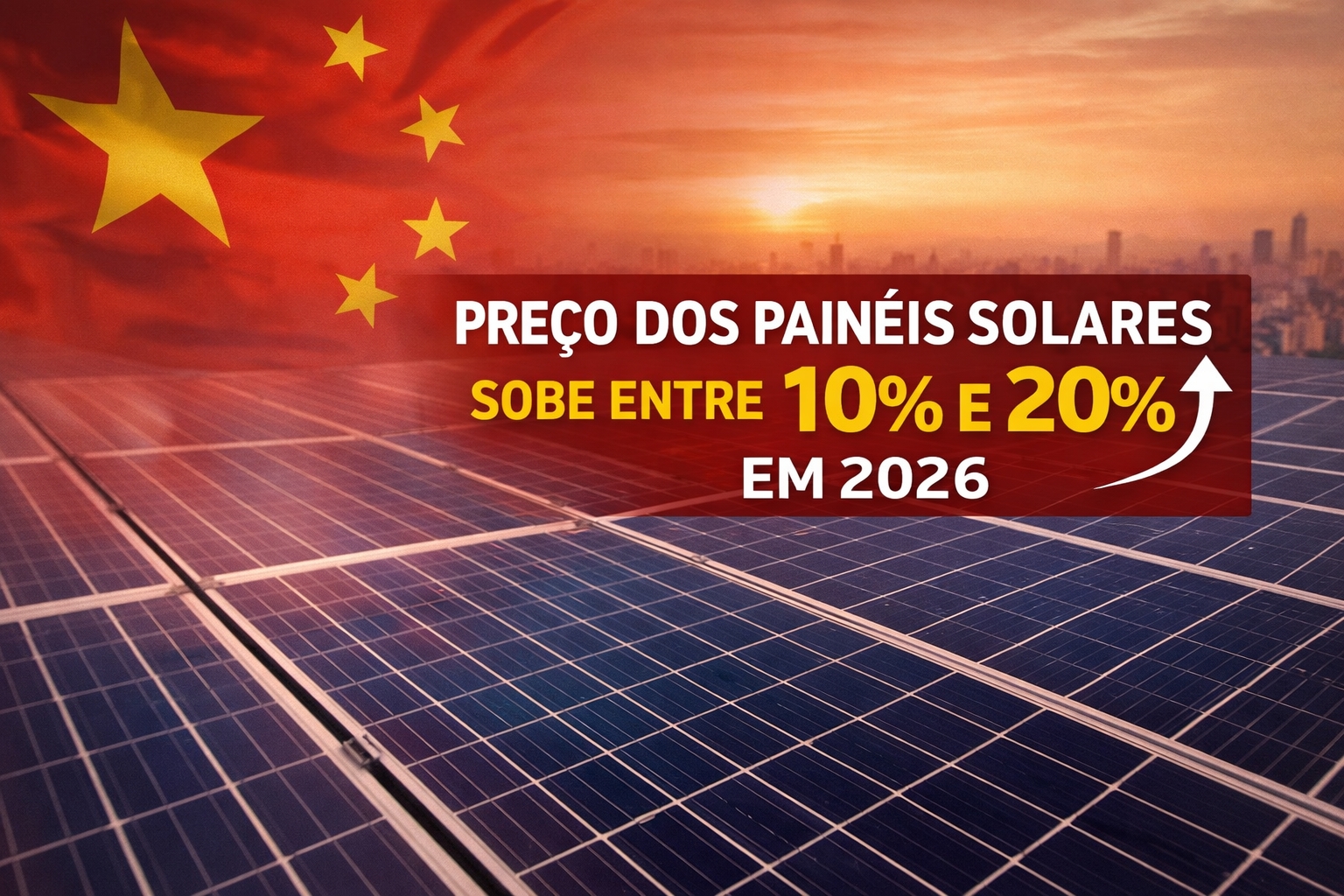
The Removal Of VAT Reimbursement On Photovoltaic Exports From April 1st And The Gradual Ending Of The Benefit For Batteries Until 2027 Should Push Costs For Manufacturers, Importers, And Consumers Worldwide.
If 2024 and 2025 were years when many got used to seeing solar panel prices resembling a permanent sale, 2026 might turn the page. China, which dominates the global photovoltaic supply chain, decided to change something that seems bureaucratic, but hits directly in the pocket: the VAT reimbursement on exports.
In practice, what was previously a fiscal relief funded by the State becomes an embedded cost in the final export price. The expected outcome by market analysts: higher panels worldwide, with an estimated increase between 10% and 20%, depending on the product and the moment of purchase.
And there’s a detail that makes everything more “now or never” for those buying in large volumes: some analysts are already working with the hypothesis that exports may accelerate before the change, precisely to take advantage of the period prior to the new rules.
-
Mercado Livre has just started selling medications with delivery in up to three hours to your door, and this move could completely change the way Brazilians buy medicines on a daily basis.

-
In Dubai, rising tensions from the war in the Middle East are causing super-rich individuals to leave the Gulf and direct their fortunes to a new financial refuge in Asia.

-
“No one will make us change the Pix,” says Lula after the US report.

-
Lula responds directly to Trump and says that Pix is from Brazil and will not change under pressure from anyone, after a report from the United States pointed out the Brazilian payment system as an American trade barrier.


What Changes In China’s Taxation And Why Does It Make Modules And Batteries More Expensive
The change is direct for photovoltaic energy: China will eliminate the VAT reimbursement on exports starting April 1st. This is likely to raise the product’s exit price, as the benefit no longer exists to be deducted.
For battery storage, the path is more gradual. The VAT reimbursement, according to a scenario described by industry analysts, drops from 9% to 6% between April and December 2026 and disappears completely on January 1, 2027. Translating without beating around the bush: batteries also enter the route of increasing costs, but in two phases.
The official discourse from the Chinese government indicates four objectives for this adjustment. Reduce excess production capacity, contain considered excessive price competition, stimulate innovation, and avoid trade friction. This is a dual message. Internally, it signals supply control and an attempt to pull the sector into a dispute less based on price. Externally, it indicates a response to growing trade tensions in various markets.
In the midst of all this, the most straightforward reading is simple: if costs rise at the origin of the planet’s largest supplier, the bill flows through the entire chain. Manufacturer adjusts. Distributor recalculates. Importer passes on. Integrator changes the proposal. And the final consumer feels it, even if with a delay.
The End Of Cheap Panels And The Domino Effect In The International Market

Here enters the point that grabs attention. It’s not just a tax changing. It’s the real risk of ending a cycle of very low prices that has become a reference for the sector.
According to Energias Renovables, the elimination of the reimbursement could, in itself, push the price of modules up around 10%, and when this is combined with the rising costs of raw materials, the jump could reach 15% or 20% in specific components.
And there’s more pressure emerging at the same time. Polysilicon, a central raw material for cell production, has seen increases reported as close to 30% in some recent periods. The justification cited by sector participants involves coordinated production cuts to reduce the prior excess supply. In numbers circulating in the market, the spot price per kilogram has risen from the range of four euros to over five euros, with references indicating something close to 6.39 euros in mid-January 2026.
When polysilicon rises, it pulls the rest along. And it’s not just him. There are reports of increases in wafers, cells, glass, and especially silver, which is used in parts of the manufacturing process. The market gets stuck with that combination that no one likes: less favorable tax and more expensive inputs at the same time.
The most likely outcome is a rapid transition. Modules rise first. Batteries begin to rise as well. The complete system takes a little longer to reflect, because installers and distributors are still trying to burn stock purchased at old prices. But that stock doesn’t last forever. When it runs out, the new price becomes the rule.
What This May Mean For Brazil And For Those Buying Solar Systems
For Brazilian readers, the most useful part is understanding where the impact hits. Brazil is a relevant importer of photovoltaic components. When international prices rise, the chain here feels it in three places.
First, in the price of the kit, modules, inverters, cables, and structure. Second, in the delivery time, because a rush for early purchases can mess up logistics. Third, in the return calculation, because when the initial investment rises, the payback time tends to stretch, even if the electricity bill remains high.
This does not mean that solar energy stops making sense. It means that the window of very low prices may be closing. And when a market grows accustomed to cheap modules, any increase of 10% to 20% becomes a topic of conversation, budgeting, and postponed decisions.
A potential side effect that may appear is the return of strategies that had lost strength, such as greater search for alternative manufacturers outside China, attempts to diversify supply, and increased volume negotiations. However, none of these moves is instantaneous. China remains the center of the board.
China Remains Giant And The Numbers Explain Why The World Pays Attention
The reason this news becomes global is not just tax. It’s scale. China is the largest producer of solar panels and also the country that installs the most photovoltaics.
In 2024, the country installed around 277 gigawatts, a record that alone surpasses the combined annual capacity of many markets. By mid-2025, the total solar capacity in China would exceed 1,100 gigawatts. When a country of this size changes tax rules, there is no “only local.” Everything becomes global.
On the industrial side, shipment rankings show a dominant group of manufacturers with well-known names in the market, such as Jinko, Longi, JA Solar, and Trina leading the way, maintaining leadership for several years. This concentrated top reinforces an important point: the chain is not fragmented. When the cost changes, it changes for many people at the same time.
In the end, the message is clear. The price of panels will not rise for “one reason.” It may rise for a combination. Less tax incentive, higher input costs, and an official strategy to curb the price war. For those following solar energy, 2026 could be exactly the year when the market stops talking about cheap modules and starts talking about real costs.








-

-

-

4 pessoas reagiram a isso.