





 Portuguese
  English
  Spanish
  6 min of reading
  1 comment


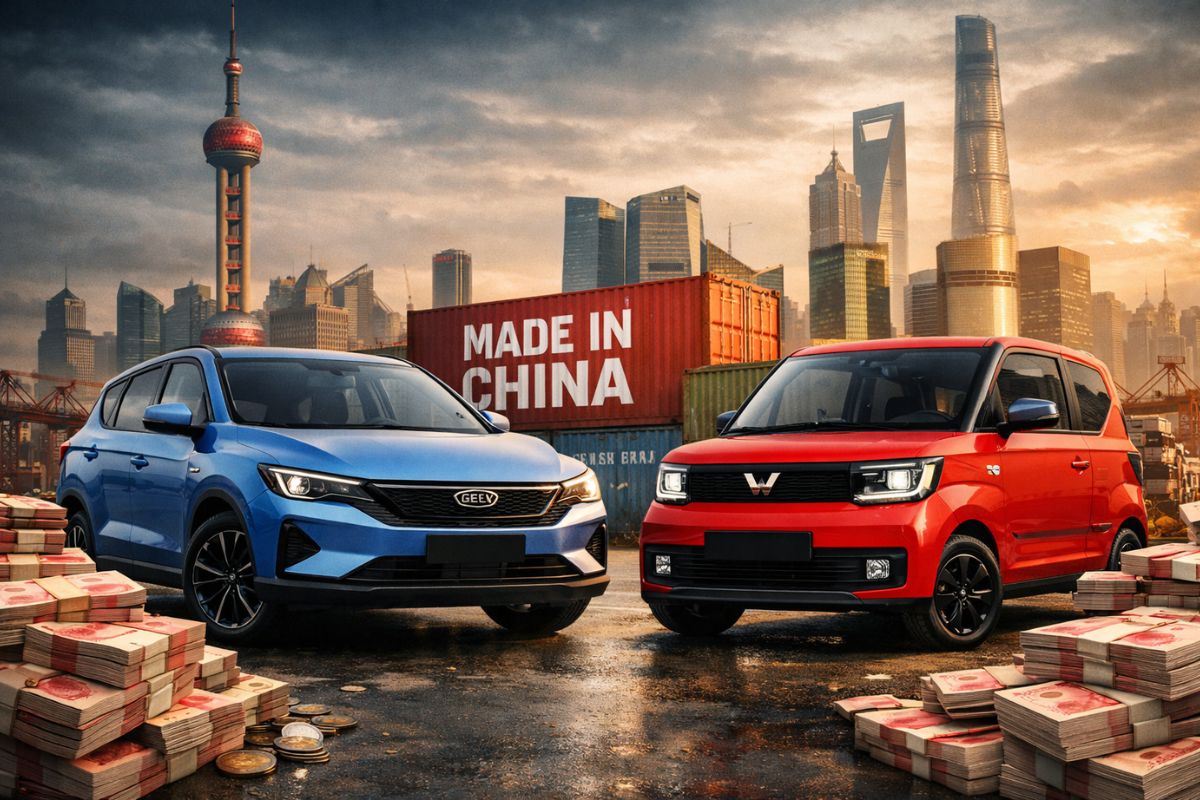


With Electric Vehicles Costing Less Than 100 Thousand Yuans, Geely’s Xingyuan and Wuling’s Hongguang Mini EV Surpassed 400 Thousand Sales Each in 2025, While the Tesla Model Y Fell and the BYD Seagull Dropped Amid Rules Against Discounts and a New Tax in China.
Electric vehicles in China entered 2025 with a clear message for consumers: price can speak louder than the name on the grille. It was in this environment that two models below 100 thousand yuans, from Geely and Wuling, ended the year at the top of the ranking.
At the same time, brands that had been dominating the global conversation about electric mobility, such as Tesla and BYD, felt the weight of a more aggressive and sophisticated competition. The competition shifted from just technology to cost, margin, and volume mathematics, with direct impacts on the purchasing pace.
The Ranking That Exposed the Power of Price
In 2025, the Xingyuan, from Geely, was the best-selling electric vehicle in mainland China, with over 459,000 units sold.
-
Motorola launched the Signature with a gold seal from DxOMark, tying with the iPhone 17 Pro in camera performance, Snapdragon 8 Gen 5 that surpassed 3 million in benchmarks, and a zoom that impresses even at night.

-
Satellites reveal beneath the Sahara a giant river buried for thousands of kilometers: study shows that the largest hot desert on the planet was once traversed by a river system comparable to the largest on Earth.

-
Scientists have captured something never seen in space: newly born stars are creating gigantic rings of light a thousand times larger than the distance between the Earth and the Sun, and this changes everything we knew about stellar birth.

-
Geologists find traces of a continent that disappeared 155 million years ago after separating from Australia and reveal that it did not sink, but broke into fragments scattered across Southeast Asia.

The jump is noteworthy because, in the previous year, this volume had been 52,570, showing how a model can rapidly scale when it gets the right combination of proposal, availability, and final cost to the buyer.
Just behind, the Hongguang Mini EV, from Wuling, also below 100,000 yuans, totaled 427,000 units and grew 55% compared to the previous year.
Two leaders with similar pricing and accessible positioning helped to solidify the perception that, at certain market moments, the “brand” becomes just one variable in a larger equation.
How Much It Costs to Lead: The Range Below 100 Thousand Yuans
The aggressiveness of these leaders first shows in their pricing. The Xingyuan was sold between 68,800 and 98,800 yuans (with a reference of US$ 9,960 on the low end), remaining entirely below 100 thousand yuans.
This psychological threshold matters because it reduces the entry barrier for those looking to switch to electric vehicles while still viewing the car as a household expense, not as an aspirational investment.
In the case of Wuling, the essential data is the same: price below 100,000 yuans and scale in the hundreds of thousands of units.
When the volume reaches this level, the game changes, because the factory gains leverage to negotiate components, accelerate production, and maintain competitiveness without solely relying on occasional promotions.
Tesla and BYD: Fall in the Ranking, Different Pressures
The Tesla Model Y finished 2025 in third place, but with sales of 382,300 units, a drop of nearly 21% year-on-year.
The decline occurred despite the launch of various payment plans to try to boost volume, in a much higher price range, between 260,000 and 310,000 yuans, which increases the distance from the “sub 100 thousand” leaders.
At BYD, the Seagull, which had been the second best-selling electric vehicle in 2024, fell to fourth place in 2025 after a 31% decline, totaling 307,000 units.
It also operates in an affordable range, between 69,800 and 85,800 yuans, and thus the drop is noteworthy: not always is “cheap” a guarantee of stability when competition improves rapidly.
Meanwhile, BYD reported a 32% decline in net profit for the third quarter of 2025, signaling that pressure on profitability is not abstract; it shows in the results.
Regulation and Economic Policy: The Brake on Discounts and the “Invisible Cost” of Tax
The intensity of the competition has brought the issue into the regulatory sphere. Political authorities have been insisting that automakers cease relying on discounts in a context of deflationary pressures and start using alternatives like pricing updated versions at lower values and implementing subsidized purchase plans with payment terms of up to seven years.
In mid-February, the State Administration for Market Regulation (SAMR) prohibited automakers from selling new cars for less than the cost of production, including through discounts and subsidies.
In practice, this aims to limit the most destructive “price war” and push companies toward real efficiency: cutting structural costs, adjusting the mix of versions, and accelerating stock turnover without crossing the line of assumed losses.
Where Quality Comes In: When Cheap No Longer Looks “Cheap”
Part of the success of affordable electric vehicles is attributed to improvements in low-cost models, with automakers attracting buyers with higher quality vehicles without raising prices.
This is crucial because it changes the perception of value, especially for those comparing the total cost of entry with what they receive in terms of range and daily use.
At this point, direct comparison helps. The Geely Xingyuan has a range of 310 km to 410 km, while the BYD Seagull delivers 305 km to 405 km, with similar prices.
When the range figures are close, and the pricing is already compressed, the consumer’s decision tends to shift to practical details, availability, payment conditions, and trust in the model’s evolution over time.
The Signal for 2026 Began in January and It Is Not “Just About Cars”
The start of the year brought an additional warning: according to Nomura, demand for electric vehicles in China has dropped to a concerning level.
In January, monthly sales of passenger electric vehicles reached 596,000 units, a decrease of nearly 20% compared to the previous year, and the penetration of electric vehicles fell to 38.3%, in a report released on February 16.
Among the cited factors is the gradual elimination of tax incentives. Since January, buyers of electric vehicles in mainland China have had to pay a 5% tax, which was previously set to zero, and a return to 10% is expected in 2028.
When price is the main argument, any change in the final cost becomes a market driver, affecting purchase timing, inventory, and the need for automakers to adjust strategies quickly.
What This Turnaround Says About “Brand” in a Market That Has Turned into a Laboratory
What 2025 showed, with Geely and Wuling at the forefront, is that brand does not disappear, but can lose priority when consumers see functional equivalence and a clear financial advantage.
The decline of the Model Y, even with payment plans, and the loss of position of the Seagull, even competing in an affordable range, suggest that the competition has become so intense that it requires more than just fame or recent history.
At the same time, regulation against selling below cost and the reintroduction of tax create a scenario where the next round of competition may be less about “price burning” and more about cost engineering, production efficiency, portfolio adjustments, and financing methods that make sense without violating the new rules.
If the price war continues, it is likely to be more strategic and selective, as margins become a scarce resource.
The leadership of electric vehicles below 100 thousand yuans in 2025 was not a “ranking accident”; it was a reflection of how China is pushing the market to a point where price, sufficient range, and purchase conditions can outweigh the weight of the logo.
And when taxes change, rules tighten, and consumption shows signs of slowing down, even giants need to recalculate.
If these affordable electric vehicles entered your market with such a large price difference, would you switch a famous brand for a cheaper option?
What would weigh most in your decision: brand trust, range, maintenance cost, or the monthly installment? And for you, would a 5% purchase tax be enough to delay replacing your car?








Trocaria sim. Desde que no país de origem a marca tenha uma boa reputação e entregue muito mais por muito menos eu estou dentro.