





 Portuguese
  English
  Spanish
  5 min of reading
  0 comments


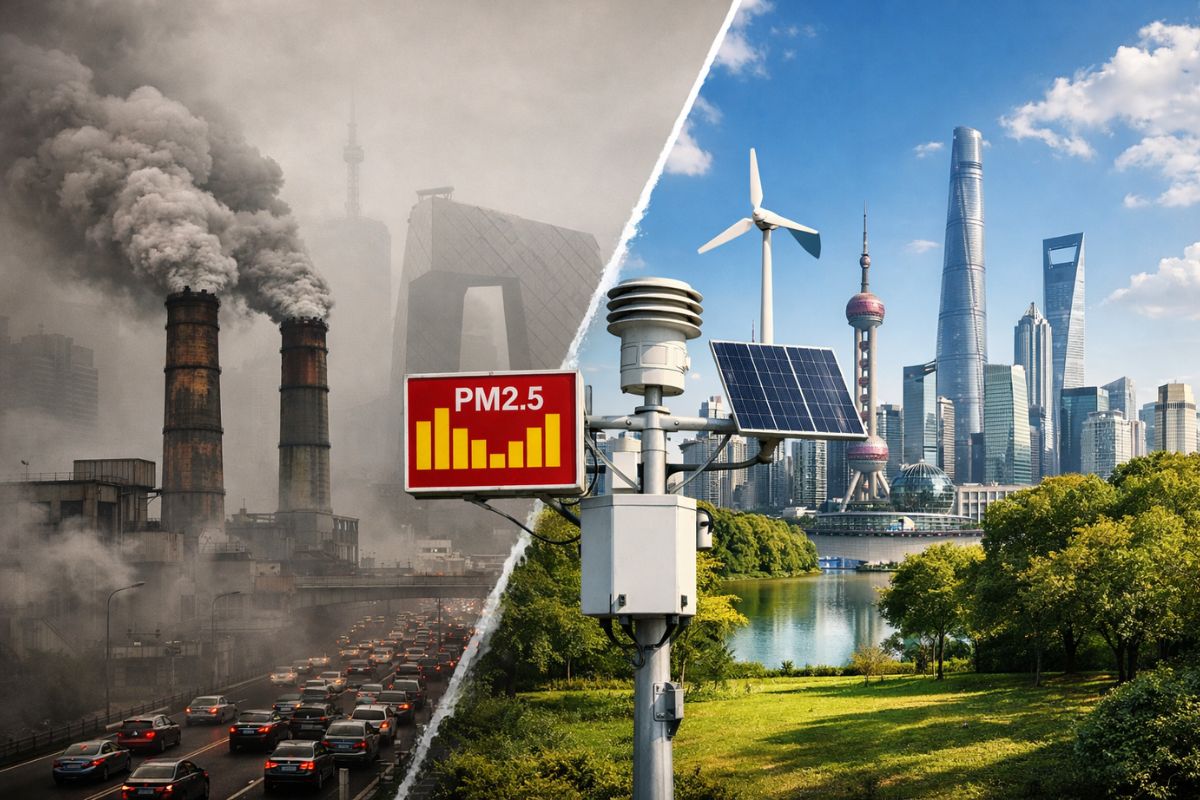
Launched by the Ministry of Ecology and Environment, China’s new rules reduce the annual PM2.5 limit to 25 µg/m³, with a provisional stage of 30 until 2030. The change, the first since 2012, reinforces the policy of non-retrogression after a historic drop in pollution and pressures local governments.
China has decided to tighten, once again, the screw that measures the air we breathe, and this changes more than just a line in a technical manual. The revised guidelines from the Ministry of Ecology and Environment reduce the average annual PM2.5 concentration limit from 35 to 25 micrograms per cubic meter, officially coming into effect on March 1.
The gesture follows a decade of campaigning that eliminated the “toxic haze” that once choked major cities, but also opens a transitional phase: from March 1, 2026, until the end of 2030, a provisional limit of 30 micrograms is applicable; the full standard of 25 will only come into effect nationwide on January 1, 2031.
What Changes When China Lowers the Annual PM2.5 Limit

PM2.5 is the name given to fine particles used as a central reference in these standards, and the point is simple: China chose to make the benchmark more stringent, reducing the annual allowed limit from 35 to 25 micrograms per cubic meter.
-
Motorola launched the Signature with a gold seal from DxOMark, tying with the iPhone 17 Pro in camera performance, Snapdragon 8 Gen 5 that surpassed 3 million in benchmarks, and a zoom that impresses even at night.

-
Satellites reveal beneath the Sahara a giant river buried for thousands of kilometers: study shows that the largest hot desert on the planet was once traversed by a river system comparable to the largest on Earth.

-
Scientists have captured something never seen in space: newly born stars are creating gigantic rings of light a thousand times larger than the distance between the Earth and the Sun, and this changes everything we knew about stellar birth.

-
Geologists find traces of a continent that disappeared 155 million years ago after separating from Australia and reveal that it did not sink, but broke into fragments scattered across Southeast Asia.

In practice, this reorganizes what is considered “compliance” and what becomes “still insufficient.” An official from the ministry acknowledged that, with stricter criteria, the percentage of “compliant” cities may decrease, but insisted that this does not indicate a deterioration of air quality: it indicates higher expectations and, above all, Beijing’s determination to maintain continuous environmental improvement.
Why the Review Now, 14 Years After the 2012 Milestone
The previous standards, adopted in 2012, were described as a milestone: during that period, a dense haze frequently covered regions of China, mainly in autumn and winter.
The country formally began incorporating a parameter that had already dominated public conversation, but which was not yet officially monitored, creating a discrepancy between reported indices and visible pollution.
In 2012, China set 35 micrograms as the limit for PM2.5, aligning with the World Health Organization’s (WHO) softer transition target.
The new package replaces this set of “2012” parameters, reinforcing the view that the adjustment cycle has entered a different stage: less tolerant of a return to the past.
The Numbers Behind the Campaign That Reduced the Toxic Haze
The political and technical justification of China is supported by numbers showing a significant decline over time. According to the information presented, rigorous measures reduced the national average concentration of PM2.5 from 68 micrograms in 2013 to 28 micrograms in 2025.
In Beijing, the change was even more symbolic: concentrations are reported to have fallen from 89.5 to 27 micrograms in the same period.
This pace is presented as one of the fastest improvements in air quality in the world, and helps explain why, in 2024, almost three-quarters of the 339 major cities already met the old standards, a scenario that stimulated calls for tightening by academics and industry experts.
The Transition to 2030 and the Bet on “Achievable” Goals for the Economy
Even adopting 25 micrograms as the final goal, China opted for a staircase approach: from March 1, 2026, until the end of 2030, 30 micrograms will apply as a transitional limit; on January 1, 2031, the full standard of 25 will be implemented nationwide.
The transition was designed to avoid “jolts” in compliance rates, allowing time for localities to prepare.
The government itself placed the economy at the center of this design. Li Tianwei, director of the atmospheric environment department, stated that the review aims to avoid negative impact on economic activity, with goals that local governments can achieve “with effort,” provided that financing and technology keep pace.
The acceleration of the process, according to reports, gained momentum after an executive meeting of the State Council on February 6, when authorities were directed to coordinate fiscal, financial, and technological policies to support the new roadmap.
The Public Debate and How 25 Micrograms Still Falls Short of the World
The review also exposes the gap between China and international references mentioned within the Chinese debate itself.
In February 2025, Li Tianwei acknowledged the discrepancy: the WHO guideline is 5 micrograms, while the then-current secondary standard was 35; he noted that the limit in the U.S. is 9 micrograms and in Japan is 15, adding that the Chinese limit would only be more stringent than that of India and Egypt.
This comparison fuels an internal discussion that is not uniform. Ma Jun, director of the Institute of Public and Environmental Affairs (a non-profit organization in Beijing), stated that public opinion is divided: some fear economic pressure from stricter rules, while others consider the old standards too lenient.
From a health protection standpoint, he assessed that even 25 micrograms is still far from being sufficient, but he noted the need for realism in the trajectory.
National Parks, Classes 1 and 2, and the Message of “Non-Retrogression”
In addition to the national number, China has restructured the protection map. The new standards expanded the coverage of untouched areas by explicitly including national parks in “Class 1” zones, subject to a more stringent PM2.5 limit of 10 micrograms.
Meanwhile, most residential and industrial areas remain in “Class 2,” preserving a differentiation of goals by territory type.
For Zhang Shiqiu, an environmental management professor at Peking University, the magnitude of the adjustment may have been smaller than expected, but the speed of the revision is significant, and she expressed hope that the package signals a policy of non-retrogression and accelerates industrial transformation.
China’s decision to tighten air standards may seem technical, but it affects daily routines, local economies, official targets, and the collective memory of a time when the toxic haze dominated the horizon.
The central point is the message: the country wants to continue improving without admitting a return to the past, even if this changes statistics and increases pressure on local governments.
And for you, what is the more convincing balance: accept a long transition to protect the economy or shorten the timeline and force a faster change? Have you experienced days when the “haze” seemed normal and then realized how much that changed your perception of the city?








-

Uma pessoa reagiu a isso.