





 Portuguese
  English
  Spanish
  4 min of reading
  0 comments


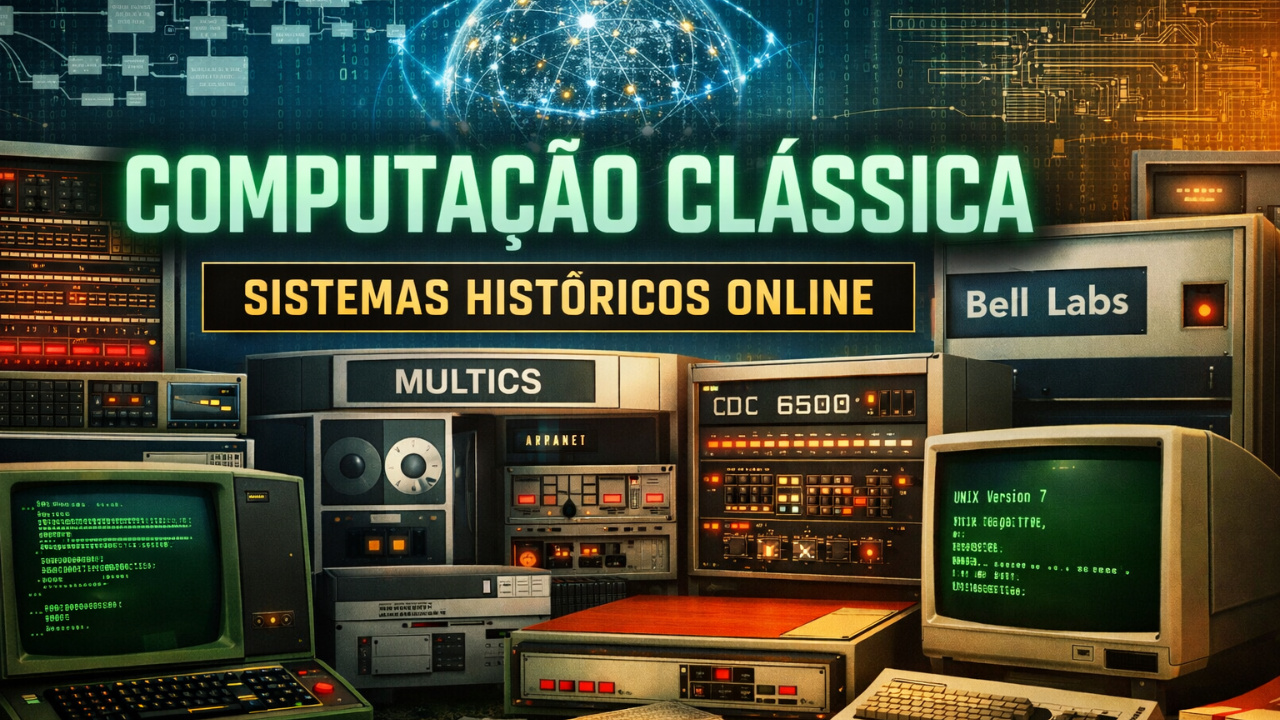
Classic Computing Project Releases 28 Historical Systems on the Internet, Including Multics, Unix, and ARPANET-Linked Platforms.
The classic computing field has just gained an unprecedented showcase on the internet. A partnership between the Interim Computer Museum and SDF.org has launched 28 historical systems that can be accessed for free by anyone, from anywhere in the world.
The project is already available online and allows users to enter digital environments and practically experience platforms that marked the evolution of technology. Just access the portal and type “menu” to start exploring.
Unlike static exhibitions in museums, the initiative is not limited to showing images or technical descriptions.
-
Motorola launched the Signature with a gold seal from DxOMark, tying with the iPhone 17 Pro in camera performance, Snapdragon 8 Gen 5 that surpassed 3 million in benchmarks, and a zoom that impresses even at night.

-
Satellites reveal beneath the Sahara a giant river buried for thousands of kilometers: study shows that the largest hot desert on the planet was once traversed by a river system comparable to the largest on Earth.

-
Scientists have captured something never seen in space: newly born stars are creating gigantic rings of light a thousand times larger than the distance between the Earth and the Sun, and this changes everything we knew about stellar birth.

-
Geologists find traces of a continent that disappeared 155 million years ago after separating from Australia and reveal that it did not sink, but broke into fragments scattered across Southeast Asia.

The public can interact directly with the systems, navigate directories, and even run programs.
Thus, the history of technology ceases to be merely contemplative and becomes a practical and immersive experience.
Classic Computing Beyond Theory: Real Access to Historical Systems
The great differentiator of the project lies precisely in the interactive experience. Some of the systems operate through emulation—a technique that simulates the functioning of old computers on modern machines.
On the other hand, some environments run on restored hardware, preserving original characteristics.
This means that visitors are not just viewing old software but are effectively using structures that shaped the digital world.
Therefore, classic computing ceases to be an abstract concept and becomes something tangible.
Multics and Unix: The Foundations of Modern Computing
Among the highlights is the legendary Multics, created in 1964 by teams from MIT, General Electric, and Bell Labs.
The system is considered one of the most ambitious projects in the history of technology and directly influenced the development of modern Unix.
Unix, in turn, became the foundation for a large part of the operating systems used today.
By allowing access to Multics and classic versions of Unix, the portal offers a true journey to the origins of contemporary digital infrastructure.
Additionally, the PDP-11/70 running the classic Version 7 Unix is available—a fundamental milestone that served as the basis for many subsequent variations.
For students and technology professionals, it is a rare opportunity to understand how current concepts were born.
ARPANET and the Origins of the Internet
Another system available is TOPS-20, linked to the early years of ARPANET, the network that gave rise to the internet as we know it today.
Exploring this environment is like going back to a time when digital communication was still in its infancy.
While today connectivity is instant and global, back then experiments were limited and highly technical.
Nevertheless, they were decisive for the creation of the modern web.
Thus, the historical systems available on the portal help contextualize the evolution of the global network of computers.
They show how experimental ideas transformed into pillars of digital society.
The Legacy of Seymour Cray in Classic Computing
The collection also includes the CDC 6500 with the NOS 1.3 system, a project associated with engineer Seymour Cray, considered one of the fathers of supercomputers.
Cray was responsible for significant advances in high-performance processing.
In this way, the presence of the CDC 6500 broadens the scope of the project, which is not limited only to academic systems but also encompasses milestones in scientific computing.
Why Is This Initiative So Relevant?
Preserving classic computing is preserving the very digital memory of humanity.
Many of the concepts we use daily—such as multi-user systems, file hierarchy, and distributed networks—were born in these pioneering environments.
Moreover, free access democratizes knowledge.
Previously restricted to laboratories or physical museums, these historical systems are now available to students, researchers, and curious individuals.
By offering interactive access, the project also reinforces the importance of experimentation.
Instead of just reading about Multics, Unix, or systems linked to ARPANET, users can explore them directly. This makes learning more dynamic and meaningful.
Classic Computing Alive on the Internet
In summary, the partnership between the Interim Computer Museum and SDF.org transforms digital preservation into a practical experience.
The ability to access 28 historical systems for free represents a milestone for technological education and the memory of innovation.
Thus, more than nostalgia, the initiative offers understanding.
By revisiting Multics, Unix, and ARPANET-connected environments, the public understands how technical decisions made decades ago continue to influence the present.
Classic computing, now alive on the internet, makes it clear that the future of technology also depends on how we preserve the past.
See more at: 28 Classic Computer Systems Are Now Available for Free on the Internet Thanks to an Unprecedented Partnership








Seja o primeiro a reagir!