





 Portuguese
  English
  Spanish
  4 min of reading
  0 comments


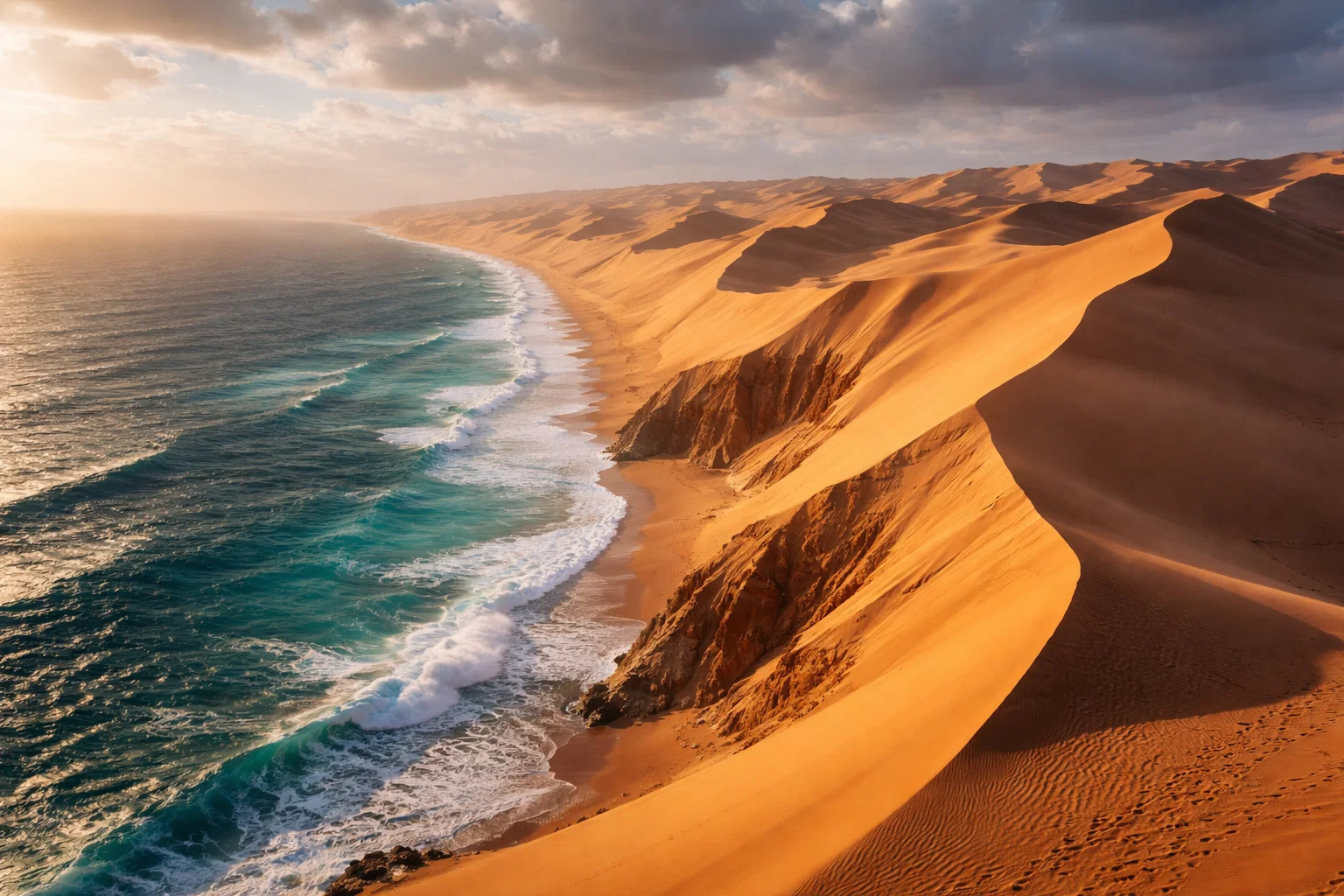
Atacama And Namibe, Coastal Deserts, Prove That Millions of Tons of Water Nearby Don’t Mean Rain, And the Explanation Involves Cold Ocean Currents, Atmospheric Circulation, And Natural Barriers That Shape the Planet’s Climate Map
It is one of the largest paradoxes of world geography. On one side, the ocean stretches as far as the eye can see. On the other, some of the driest places on the planet.
The Atacama Desert in Chile and the Namibe in Southern Africa coexist with the sea. Even so, it hardly ever rains. How is this possible?
The answer is not in the lack of water. It lies in the invisible engineering of the atmosphere, a global system that functions like a gigantic natural thermal machine.
-
Friends have been building a small “town” for 30 years to grow old together, with compact houses, a common area, nature surrounding it, and a collective life project designed for friendship, coexistence, and simplicity.

-
This small town in Germany created its own currency 24 years ago, today it circulates millions per year, is accepted in over 300 stores, and the German government allowed all of this to happen under one condition.

-
Curitiba is shrinking and is expected to lose 97,000 residents by 2050, while inland cities in Paraná such as Sarandi, Araucária, and Toledo are experiencing accelerated growth that is changing the entire state’s map.
-
Tourists were poisoned on Everest in a million-dollar fraud scheme involving helicopters that diverted over $19 million and shocked international authorities.

The Giant Atmospheric Mechanism That Creates Dry Air Belts and Positions Coastal Deserts on the World Map
If you look at the map, you’ll notice a curious pattern. Many deserts are located above or below the equator line.
This happens because the Equator receives the most solar radiation. The air heats up, rises, and creates a low-pressure area. As it ascends, water vapor condenses and causes intense rainfall. That is why the region houses dense forests like the Amazon.
But the cycle does not end there.
This air rises, moves horizontally, and then descends between 20 and 40 degrees north and south. When it descends, it inhibits cloud formation. The result: a dry air belt forms that favors deserts like the Sahara and Kalahari.
Now comes the detail that changes everything in coastal areas.
The Secret of Cold Ocean Currents That Block Clouds and Transform the Coastline Into Arid Territory
The ocean doesn’t deliver rain automatically.
In regions like Atacama and Namibe, cold ocean currents flow close to the coast. The air that blows over these waters cools down upon contact with them.
Cold air is stable. It does not rise easily.
Without vertical movement, there is no significant cloud formation. What appears is dense fog in some coastal stretches, but nearly no precipitation.
It’s an impressive scenario: the sea provides moisture, but the physics of the atmosphere prevents that moisture from turning into rain.
The Silent Dispute Between Mountains and Winds That Removes Moisture Before It Reaches the Coastline
As if the thermal blockage weren’t enough, there is still the barrier of the mountains.
In the case of the Atacama, the moisture that advances through South America dumps a large volume of rain on the Amazon. Then, it encounters the Andes Mountains.
As it ascends the mountain, the air cools and releases even more rain on the eastern side. By the time it finally descends to the Chilean side, it is practically dry.
This phenomenon, known as rain shadow, creates an extreme contrast.
To get an idea of the difference a mountain range can make, cities on opposite sides of the same range experience drastically different annual rainfall amounts, according to experts.
It’s as if the mountain squeezes the last drop before releasing the air on the other side.
The Climate Impact That Influences Energy, Environmental Engineering, and Even Water Harvesting Technologies
These coastal deserts are not merely geographical curiosities.
They have a more stable climate and more moderate temperatures than continental deserts. This influences infrastructure projects, climate studies, and even renewable energy research.
In the Namibe, for example, beetles have developed an impressive natural technique. They position their bodies to capture droplets from the fog and turn them into potable water.
Researchers analyze this surface to improve fog harvesting networks, a technology that can help communities in arid regions.
The physics that dries these deserts also drives innovation.
The Same Mechanism That Explains Polar Deserts and Shows That Temperature Is Key in the Moisture Equation
The phenomenon is not limited to warm regions.
A large part of the Antarctica and areas of the Arctic are classified as polar deserts. The difference is that there, the problem is not heat, but extreme cold.
Very cold air cannot hold much moisture. Add to this intense winds and ocean currents that isolate the Antarctic continent, making it difficult for rain systems to reach.
The result is the same: scarcity of precipitation, even surrounded by oceans.
In the end, coastal deserts exist because the planet operates as a complex atmospheric power plant. It is not enough to have water nearby. The air must be able to rise, cool, and condense.
And when that machinery fails, the resulting scenario is surprising.
Did you already know this mechanism that keeps entire regions dry even next to the sea? Do you believe these areas can gain new water harvesting technologies in the coming years? Share your thoughts in the comments.









-

-

-

-

-

25 pessoas reagiram a isso.