





 Portuguese
  English
  Spanish
  7 min of reading
  0 comments


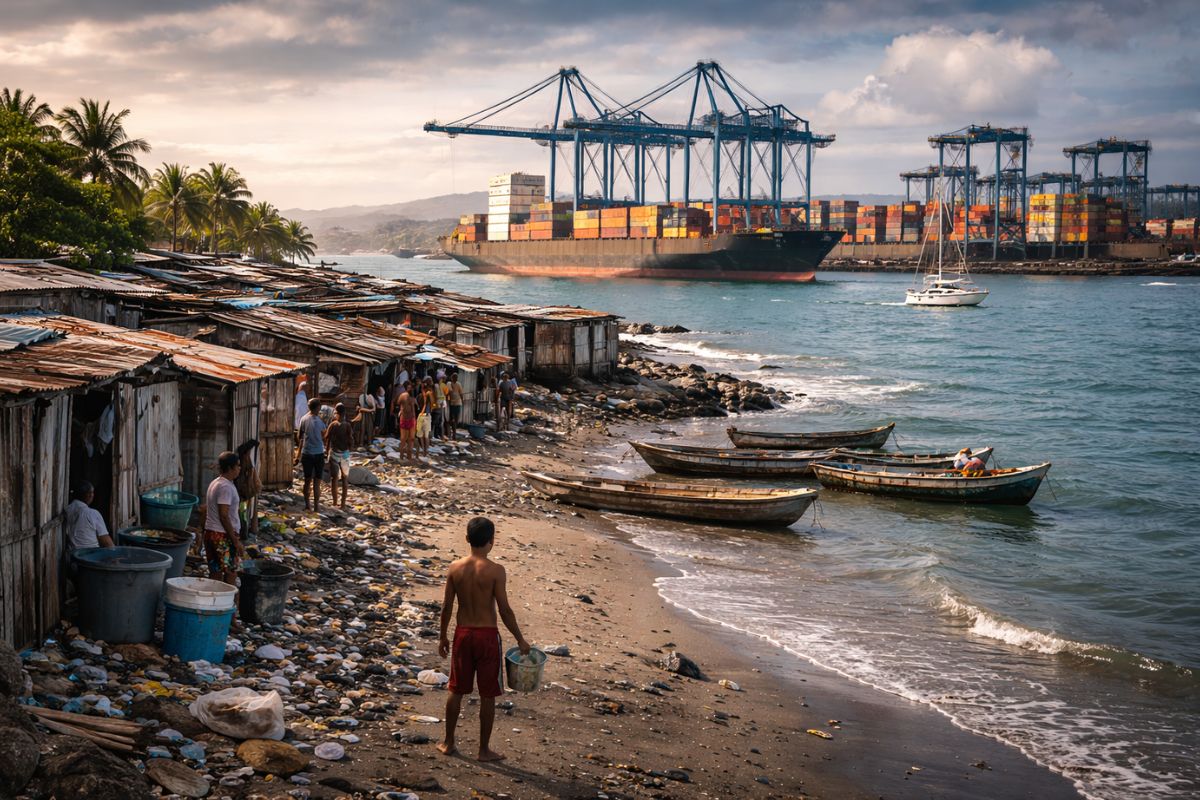
In Colombia, the combination of colonial heritage, geographical barriers, historical concentration of investments in the Andean interior, and use of the coast as an export corridor helps to explain why strategic coastal regions, including in the Pacific and the Caribbean, remain with high poverty and low state integration to the rest of the country.
The Colombia occupies a geographical position that, in theory, would allow for a greater territorial balance between external trade and internal development. The country has access to the Caribbean and the Pacific, hosts relevant ports, and participates in global trade routes, but the prosperity generated by this logistical role has not spread proportionally through coastal cities.
In practice, what appears is a persistent contrast. While the Andean interior has concentrated administrative centers, production, capital, and services over time, a significant part of the coast has remained with insufficient infrastructure, low state presence, and fragile social indicators, even in areas that handle cargo, tourists, and customs revenues.
The Historical Root of the Imbalance Between Coast and Interior in Colombia

The imbalance did not begin with modern ports. It relates to how the territory was occupied since colonization, when regions of the Andean interior began to concentrate administrative and economic interests. The milder climate, the presence of plateaus and valleys, and fewer exposures to certain tropical diseases favored the permanence of European settlers compared to more difficult coastal areas.
-
The government requests the Federal Revenue Service for a new system to automate the income tax declaration, reducing errors, time, and bureaucracy for millions of Brazilians.

-
Pix in installments, international Pix, and contactless payment without internet: the Central Bank revealed the new features coming to the tool that is already used by almost every adult in Brazil.

-
Mercado Livre has just started selling medications with delivery in up to three hours to your door, and this move could completely change the way Brazilians buy medicines on a daily basis.

-
In Dubai, rising tensions from the war in the Middle East are causing super-rich individuals to leave the Gulf and direct their fortunes to a new financial refuge in Asia.


Additionally, the exploitation of gold and other mineral wealth in the interior reinforced this movement. When colonial power organizes taxes, logistics, and political control from the centers that concentrate extraction and administration, the map of development tends to follow this same direction for a long time. This process helped cities like Bogotá and Medellín to consolidate as decision-making and trade hubs.
Over the centuries, the interior also diversified its activities more consistently. Agriculture in fertile areas and later the advancement of coffee deepened capital accumulation and urban growth in Andean zones. This cycle expanded internal networks, strengthened economic elites, and consolidated a structure that continued attracting public and private investment.
The result was an unequal trajectory from early on. The coast, in many stretches, was treated primarily as a gateway for the colony, with military and commercial functions. This generated strategic importance, but not necessarily robust urbanization, social inclusion, or a diversified production base for the local population.
Strategic Ports Do Not Mean Automatic Development of Coastal Cities

The presence of relevant ports in the Caribbean and the Pacific often suggests local wealth, but the Colombian experience shows that this relationship is not automatic. The coast is connected to international trade and global routes; however, a large part of the value generated by the flow of goods is captured by economic chains and decision centers located outside these cities.
In the Caribbean strip, cities like Cartagena had a strategic role since the colonial period in transatlantic trade and in the defense of the empire. Still, the port function was strongly linked to the outflow of riches extracted from the interior. When the city operates as a transit platform, the benefits may be concentrated in a few sectors and not reach the urban and social structure widely.
In the Pacific, this pattern appears even more acute. Buenaventura serves as the main link between Colombia and the Asian market and concentrates enormous regional economic relevance. The port handles cargo on a national scale, generates direct and indirect jobs, and occupies a central position in the country’s external logistics.
Even so, social indicators remain severe. The most cited statistic in this contrast is Buenaventura, with around 400,000 inhabitants and approximately two-thirds living in poverty. This is the core of the Colombian paradox on the coast: wealth circulates, but it does not convert into local well-being at the same rate.
Difficult Geography, Physical Isolation, and High Cost of Integration
The geography of Colombia weighs decisively in this scenario. The Andes mountain range cuts through the country and creates natural barriers that hinder integration between coast and interior. In practical terms, this increases the cost of infrastructure, transportation, route maintenance, and expansion of public services, especially in regions with dense forest and complex terrain.
In the Colombian Pacific, areas like Chocó and the vicinity of Buenaventura have faced severe historical obstacles for connection works and continuous state presence. It’s not just about distance on the map, but real accessibility, logistical costs, and the ability to maintain public policies in difficult territories. This prolonged isolation has limited the formation of stronger local markets and more diversified productive chains.
Meanwhile, the Andean interior continued to receive most of the modernization policies, economic integration, and productive expansion. The import substitution industrialization in the 20th century reinforced this trend, with interior cities becoming industrial and financial hubs in sectors such as textiles, food, and metallurgy.
This movement expanded urban jobs and consolidated the Andean economic centrality, but it also deepened the relative distance from the coast in various indicators. When infrastructure grows in a concentrated manner, the peripheral territory not only falls behind, it becomes even more dependent on decisions made outside of it.
Coffee, Growth Cycles, and Concentration of Economic Power
Colombia has had moments of strong economic dynamism, especially with the expansion of coffee. In the early decades of the 20th century, the increase in international demand helped the country raise exports and gain global prominence. Colombia’s participation in the world coffee market, according to the presented data, rose from 3 percent to 10 percent in just over a decade.
This cycle generated an influx of resources, strengthened the trade balance, and expanded state financing capacity. Total exports doubled between 1900 and 1919, reaching over 112 million dollars, with coffee accounting for about 80 percent of this volume. But the macroeconomic gain did not resolve territorial inequality, because the main engine of growth continued to be anchored in the interior.
There was also an important social effect in coffee-growing regions, with strengthening of small and medium landowners in some areas and energizing local markets. This base helped build social mobility and regional entrepreneurship, in addition to pushing for infrastructure aimed at the outflow of production.
Still, Colombia’s own history shows the limits of this model. The 1929 crisis exposed the vulnerability of an economy dependent on coffee prices. Later, industrialization expanded the productive base, but again with concentration in already strengthened interior cities. The historical sequence reinforced a pattern in which cycles of prosperity passed through the coast but rarely took root in it.
State, Violence, and Social Vulnerability in the Colombian Coast
Coastal poverty in Colombia cannot be explained solely by geography and economic history. The low state presence in sensitive areas, combined with social exclusion and insufficient infrastructure, has opened space for violence and armed groups to operate at different times. This dimension undermines investments, reduces predictability, and directly affects the daily lives of the population.
The impact is greater in territories with historically marginalized communities, including indigenous peoples and Afro-descendant populations, especially in areas of later colonization and limited integration. Without consistent public policies in education, health, mobility, sanitation, and security, the port can grow without the surrounding city advancing at the same pace.
This environment of vulnerability also appears in recent episodes. In January 2025, Colombia recorded a strong wave of violence, with at least 100 dead and 36,000 displaced, centered in Catatumbo, on the border with Venezuela and near the Colombian Caribbean. Even when the focus is not directly on a port, the national effect on trust, displacement, and territorial governance is significant.
Therefore, the debate about the Colombian coast goes far beyond foreign trade. The central question is how to transform strategic position into local social development, and not just the circulation of goods. Without this leap, the country maintains two economic rhythms within the same map.
What Needs to Change for the Coast of Colombia to Stop Being a Passing Zone
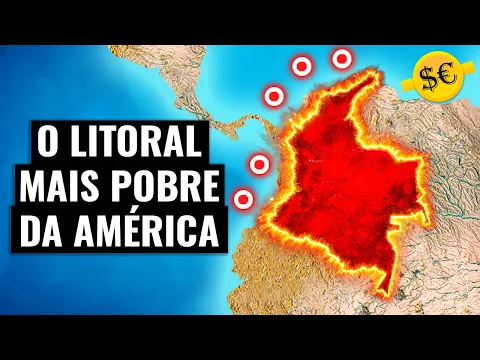

Reversing this scenario requires long-term policy, not just isolated works. Colombia would need to combine physical integration with economic and social integration, better connecting the coast to the interior without treating the coast merely as a logistics corridor. This includes transportation infrastructure, sanitation, energy, access to services, and permanent administrative capacity.
It would also be necessary to expand the local productive base. Strong ports can be part of the solution, but the distributive effect tends to be limited when the urban economy relies almost exclusively on customs activity, cargo handling, and associated services. Without local industry, regional linkages, and income policies, the port city remains vulnerable to the role of intermediary.
Another point is territorial governance. For the value that passes through the ports to produce more visible social outcomes, better coordination would be needed between the state, municipalities, urban planning, and social investment. This applies both to Caribbean areas and to the Pacific, where physical isolation is compounded by a long history of relative abandonment.
The geographical advantage of Colombia still exists. The problem is not a lack of strategic position but the unequal way the country has distributed infrastructure, political power, investment, and opportunities over time. The Colombian coast is not poor due to a lack of relevance, but due to an excess of relevance used by other centers.
Colombia brings together a rare combination of maritime geography, strategic ports, and connection to major trade routes, but territorial development has followed a path concentrated in the Andean interior. Colonial history, the physical barrier of the Andes, the economic cycles of coffee and industrialization, and the fragility of public policies on the coast help explain why coastal cities continue to be on the margins of the wealth that crosses their territories.
If you had to choose a priority to reduce this inequality on the Colombian coast, would you start with connection infrastructure, local industry tied to the ports, permanent social policies, or a new model of distribution of the revenues generated in these cities? I want to read concrete answers, with your order of priority and the reason.









Seja o primeiro a reagir!