





 Portuguese
  English
  Spanish
  4 min of reading
  0 comments


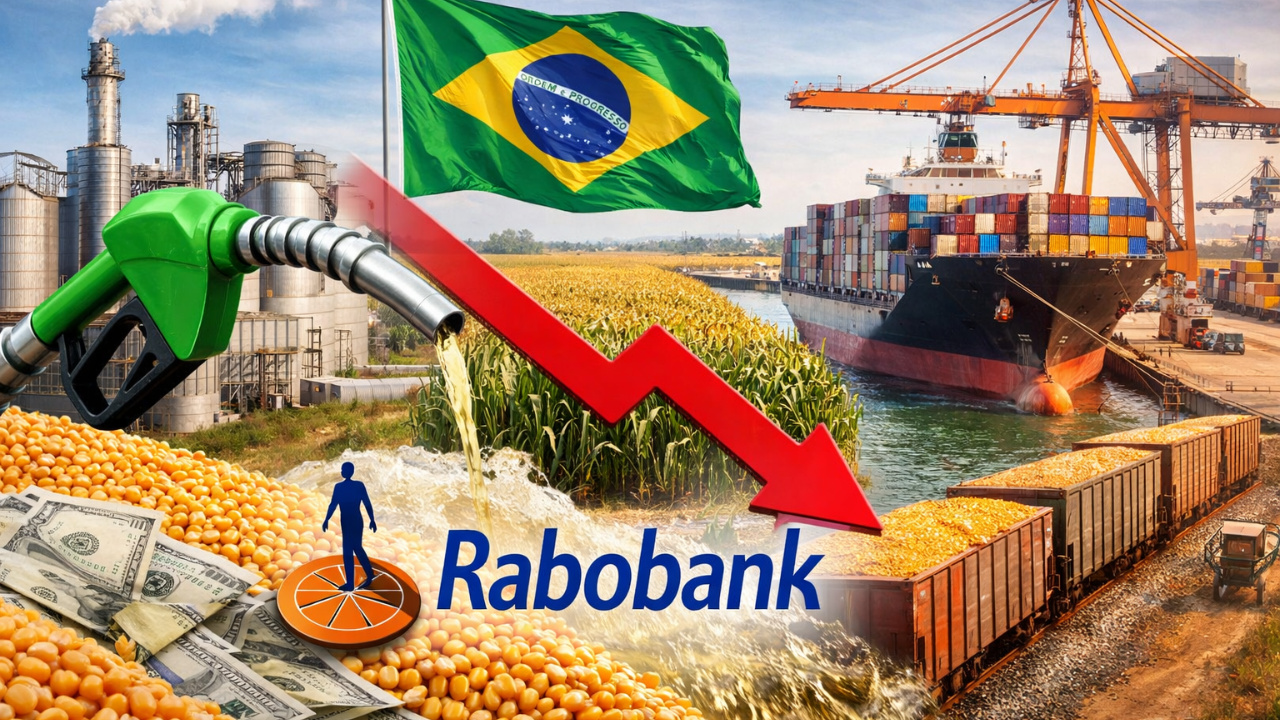
With Mills Close to Farms, Corn Ethanol Strengthens the Domestic Market and Reduces Corn Exports, Says Rabobank Analysis.
The advance of corn ethanol is reshaping the destination of Brazilian production and limiting corn exports, according to Rabobank’s assessment.
The analysis was presented by grain specialist Marcela Marini, who points to structural changes in the sector in recent years, especially in Brazil.
This movement occurs amid the expansion of mills, increased storage capacity, and logistical advantages, strengthening the domestic market and altering the traditional dynamics of shipments abroad.
-
The sugar-energy sector advances with agricultural technology, but agricultural productivity still raises concerns.

-
The eggshell that almost everyone throws away is made up of about 95% calcium carbonate and can help enrich the soil when crushed, slowly releasing nutrients and being reused in home gardens and vegetable patches.

-
This farm in the United States does not use sunlight, does not use soil, and produces 500 times more food per square meter than traditional agriculture: the secret lies in 42,000 LEDs, hydroponics, and a system that recycles even the heat from the lamps.

-
The water that almost everyone throws away after cooking potatoes carries nutrients released during the preparation and can be reused to help in the development of plants when used correctly at the base of gardens and pots, at no additional cost and without changing the routine.


According to the analyst, the growth of industrial plants near producing areas reduces costs and makes the mills more competitive in the grain competition.
Moreover, the anticipation of sales and self-storage enhances these industries’ purchasing power.
As a consequence, the flow of corn for export loses momentum.
Corn Ethanol Gains Strength and Affects Corn Exports
The expansion of corn ethanol has triggered a silent but profound transformation in the production chain.
With units installed close to the farms, transportation costs decrease drastically.
“These ethanol plants are very close to corn production, significantly reducing exposure to freight.
An exporter in Mato Grosso, for example, needs to transport this corn about 2,000 kilometers to the port,” she said to Money Times.
This logistical difference creates a clear competitive advantage.
While exporters face long distances to the ports, the mills buy directly at the source, offering more attractive prices to the producer.
Thus, corn exports face a more challenging environment, especially during times of intense competition with major global players.
Record in 2023 and New Market Dynamics
After reaching a historic record in 2023, Brazilian shipments began to lose momentum. According to the Rabobank specialist, the change is not momentary but structural.
“Exports reached a significant record in 2023, and since then, we have seen a substantial reduction in that volume,” she affirms and details:
“In the export market, we work with opportunistic windows. It becomes very difficult to compete with the U.S. and Argentina in this market. If we add all this change in the dynamics of the Brazilian market, it tends to further limit Brazil’s shipments.”
In other words, Brazil remains relevant in global trade but faces greater competition and now a more robust domestic demand.
The strengthening of the domestic market makes the sector less dependent on external factors.
Domestic Market Strengthens Corn Against Soy
Historically treated as a secondary crop, corn has gained prominence in rural producers’ income.
Currently, the grain accounts for about 48% of revenue, while soybeans represent 52%.
This balance shows a significant change compared to the past. “In 2013, we were talking about corn at R$ 12 per sack.
Today, the contract for March 2026 at B3 hovers around R$ 70.95.
Corn was practically marginalized by the producer.
Now, with the expansion of the domestic market, it has become an increasingly relevant commodity in income composition,” Marini assesses.
The advance of corn ethanol directly contributes to this appreciation.
Besides increasing demand, the biofuel also makes the sector less vulnerable to geopolitical crises, unlike soybeans, which rely more on international trade.
Price Volatility Requires Caution from the Producer
Despite the positive outlook for the domestic market, the moment is marked by strong price volatility.
Various external factors influence prices and increase uncertainty.
Among them are the determination of the planted area in the United States starting in March, the pace of U.S. planting in April, weather conditions in Argentina, and the performance of the summer crop in Brazil.
This set of variables creates frequent fluctuations in futures contracts.
For the producer, this means a higher risk in decision-making.
In this context, the recommendation is clear: advance in marketing and use protective mechanisms, such as futures contracts and price locks, to reduce exposure to fluctuations.
New Design for Brazilian Corn
The growth of corn ethanol is, therefore, promoting a new design for the sector.
Corn exports remain relevant but now share space with a more structured and competitive domestic market.
At the same time, the higher domestic demand brings relative stability, even though price volatility remains a factor of attention.
For rural producers, the scenario is one of opportunities, but also of strategy.
With a more complex and dynamic market, planning and risk management become as important as productivity in the field.
See more at: Ethanol Boom Points to a New Design in Corn Shipments, Says Rabobank










Seja o primeiro a reagir!