





 Portuguese
  English
  Spanish
  8 min of reading
  1 comment


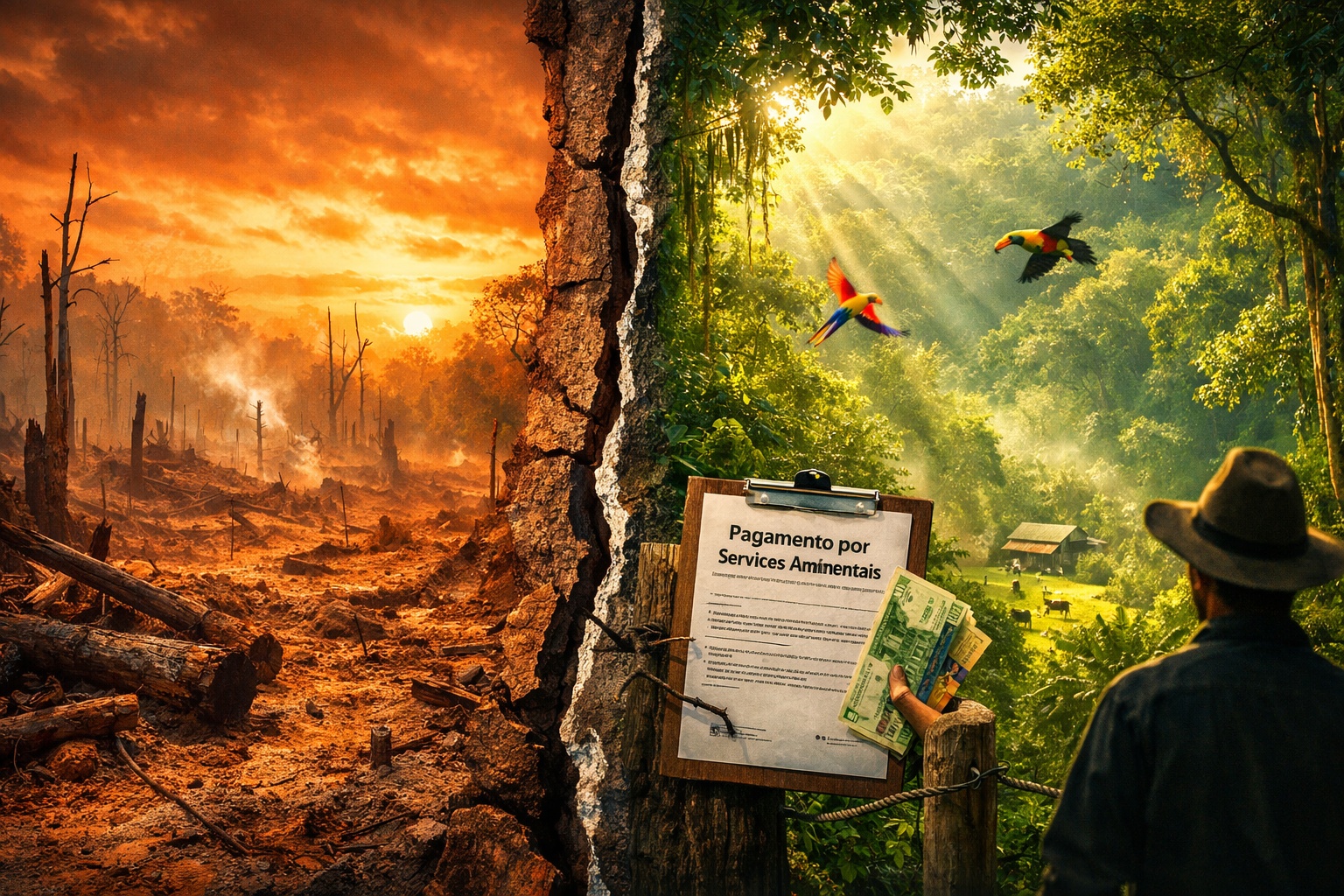


After Losing Half of Its Forests Between 1940 and 1980, Costa Rica Reversed Deforestation with Innovative Public Policies and Raised Forest Cover from 26% to Over 50% of the National Territory.
Between 1940 and 1980, Costa Rica lost half of its mature forests in one of the fastest deforestation processes in Latin America. The main cause was the expansion of livestock farming, encouraged by million-dollar loans from the United States for meat production. In the 1960s, the country had one of the highest deforestation rates in the world. However, from the 1980s onwards, a series of public policies completely transformed this catastrophic scenario.
The transformation began when the Costa Rican government realized it was destroying its own future. In 1983, only 26% of the national territory still had forest cover. The annual deforestation rate was reaching 50,000 hectares per year — equivalent to 70,000 football fields being devastated every 12 months.
How Costa Rica Turned the Tide and Initiated Deforestation Reversal
The first step was as simple as it was radical: eliminate government subsidies that encouraged forest clearing. For decades, the government had offered money and tax benefits for farmers to convert forested areas into pasture for cattle. This policy made immediate economic sense — producing meat for export generated revenue — but completely ignored the long-term environmental consequences.
-
Friends have been building a small “town” for 30 years to grow old together, with compact houses, a common area, nature surrounding it, and a collective life project designed for friendship, coexistence, and simplicity.

-
This small town in Germany created its own currency 24 years ago, today it circulates millions per year, is accepted in over 300 stores, and the German government allowed all of this to happen under one condition.

-
Curitiba is shrinking and is expected to lose 97,000 residents by 2050, while inland cities in Paraná such as Sarandi, Araucária, and Toledo are experiencing accelerated growth that is changing the entire state’s map.

-
Tourists were poisoned on Everest in a million-dollar fraud scheme involving helicopters that diverted over $19 million and shocked international authorities.


When the United States began offering millions of dollars in loans to meat producers in Costa Rica during the 1960s, the devastation accelerated even further. Pastures for cattle expanded 62% in just a few decades, swallowing entire tropical forests. In the 1970s and 1980s, Costa Rica had one of the highest deforestation rates in all of Latin America.
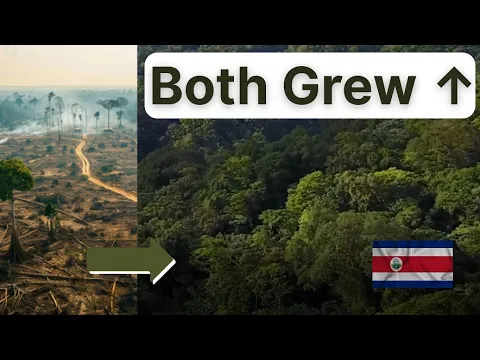

However, in the 1980s, three combined factors forced a change in mindset. First, the international meat market collapsed, making it economically unfeasible to maintain that aggressive expansion of pastures.
Second, the growth of tourism showed that preserved forests could be worth more financially than cleared land. Third, a new generation of political leaders began to see environmental devastation as an existential threat to the country’s future.
Payment for Environmental Services (PSA): The Program That Pays Those Who Preserve Forests
In 1996, the Costa Rican government created a law that established the revolutionary concept of “environmental services.” The idea was simple but powerful: acknowledging that forests provide valuable services to society — such as producing clean water, capturing carbon from the atmosphere, protecting biodiversity, and regulating the climate; those who maintain these forests must be compensated for it.
The following year, in 1997, the Payment for Environmental Services (PSA) Program was officially born. The program works like this: rural landowners who maintain preserved forests on their land, or who recover degraded areas by planting native trees, receive a direct payment from the government. This is not charity — it is a voluntary contract where the farmer commits to protecting or recovering the vegetation, and the state pays for this conservation work.
The average payment is US$ 64 per hectare per year for basic protection of existing forests. It may seem small, but for thousands of small farmers, it represents a significant additional income. And there is an added benefit: program participants can engage in selective logging of timber in reforested areas, generating additional income without destroying the ecosystem.
How the PSA is Funded: Fuel Tax and Water and Energy Companies
The brilliance of the Costa Rican system lies in its funding. Instead of relying solely on the government’s general budget that could be easily cut in times of crisis, the PSA program is mainly funded by a tax on fossil fuels. Those who pollute pay for those who conserve.
The logic is unyielding: vehicles burning gasoline and diesel emit CO2, and forests capture this CO2 from the atmosphere. Therefore, it makes sense that part of the money generated from fuel sales is directed to pay for those who maintain the forests that neutralize these emissions.
In addition to the fuel tax, the program receives resources from water and electricity companies. Hydroelectric plants and supply companies rely directly on healthy watersheds, protected by forests. Therefore, these companies pay rural landowners to preserve the riparian forests and springs on their properties.
Since 1997, the PSA program has paid US$ 524 million to rural landowners. More than 1 million hectares of forests have been saved from devastation, and 7 million trees have been planted in degraded areas.
Results of Environmental Policy: Forest Cover Rises from 26% to Over 50%
The results are significant. Forest cover in Costa Rica jumped from 21% in the 1980s to 26% in 1983, then to 52% in 2012, and reached 57% in 2020. This means that more than half of the national territory — small in size, but immense in biodiversity — is covered by forests.
To give an idea of the scale of this recovery: between 1997 and today, Costa Rica has reforested the equivalent of approximately 10 million football fields. Areas that were once dry, degraded pastures have returned to being dense tropical forests, teeming with wildlife.
An emblematic example is the Sarapiquí region in the northeast of the country. Farmer Carlos García has worked for 36 years on a 7-hectare plot that was completely deforested. Today, his property is a dense forest refuge where hundreds of species live, from sloths to strawberry poison dart frogs.
García continues to produce foods like organic peppers and pineapples, but now within an agroforestry system that reconciles agriculture and conservation.
“I feel proud when I walk through the forest, not just for myself, but for my whole family,” said Elicinio Flores, another farmer who replanted 7 hectares of trees with the help of the PSA program. “When I am no longer here, I know my children will continue to take care of this.”
Green Economy: Tourism, Forest GDP, and Carbon Credits Transform the Country
Contrary to the common narrative that environmental protection harms the economy, Costa Rica has proven exactly the opposite. According to measurements from the World Bank, forests contribute 2% of the Costa Rican GDP, a much higher figure than previously thought. In comparison, the traditional timber industry (which cuts down trees) represents only 0.2% of the GDP.
Sustainable tourism has become one of the main sources of revenue for the country. Visitors from all over the world come to Costa Rica specifically to see its tropical forests, national parks, and lush biodiversity. This ecological tourism generates billions in annual revenue and thousands of direct and indirect jobs.

Moreover, Costa Rica is now able to sell carbon credits in the international market. In 2020, the country received US$ 54 million from the Green Climate Fund in recognition of having captured 14.7 million tons of CO2 between 2014 and 2015. In the same year, it closed another US$ 60 million agreement with the World Bank for emissions reduction.
“Nobody recognized us for capturing carbon emissions — that was a gift Costa Rica was giving to the world,” explained Carlos Manuel Rodríguez, the country’s Minister of Environment and Energy. “Now, instead of just ‘giving’ this benefit for free, we began to price it and receive funding for it.”
Historic Decline in Deforestation and the Reversal of Trend After 1997
The program worked. Between 1960 and 1980, the annual deforestation rate in Costa Rica was brutal: 3.86% of the forests disappeared each year. After the launch of the PSA in 1997, this rate fell to less than 2% per year. And it continued to decline.
According to a study published in the scientific journal PLOS One, more than 90% of all deforestation that occurred in Costa Rica between 1947 and 2014 took place during the periods 1947-1960 and 1960-1980. After 1997, the trend was reversed: degraded areas began to regenerate, and new forests started to grow on abandoned land.
In 2019, Costa Rica became the first tropical country in the world to officially reverse deforestation. While the rest of the tropics lost 12 million hectares of forest per year — equivalent to 30 football fields per minute, Costa Ricans were planting trees and watching their forests grow.
Monitoring and Transparency: GPS, QR Code, and Audit to Ensure Results
To ensure that public money is well spent, the PSA program has a rigorous monitoring system. All planted pits are geo-marked with GPS coordinates. The seedlings receive QR codes that allow individual tracking. The entire process is recorded online, and auditors periodically verify that the landowners are fulfilling their contracts.
This transparency has been fundamental in maintaining the credibility of the program over more than 25 years. Even with changes in government, the PSA continued to operate because it demonstrated concrete and measurable results.
The survival rate of the planted trees is approximately 60% — a figure considered good for large-scale reforestation projects. Many seedlings die due to lack of water, fungal attacks, or lack of maintenance, but most thrive and become part of secondary forests that eventually mature.
Global Lessons: Why the Costa Rican Model Became a Global Reference
The case of Costa Rica has become a global reference. Guatemala, Mexico, Rwanda, Cameroon, and India have already committed to restoring at least 1 million hectares of forests through the Bonn Challenge — a global initiative aimed at restoring 350 million hectares of degraded ecosystems by 2030.
However, according to Stewart Maginnis, the global director of the Nature-Based Solutions Group of the International Union for Conservation of Nature (IUCN), what sets Costa Rica apart from these other countries is the “coherence and consistency of environmental policy over time.” It is not enough to create a beautiful program on paper; it is essential to keep it operational for decades, regardless of who is in power.
“It’s remarkable,” Maginnis told CNN. “In the 1970s and 1980s, Costa Rica had one of the highest deforestation rates in Latin America, but it managed to reverse this in a relatively short period.”
Minister Carlos Manuel Rodríguez acknowledges that the Costa Rican strategy can be applied anywhere in the world but warns that “principles and values” are also necessary. “Good governance, strong democracy, respect for human rights, and a solid educational system are vital for success.”
Or, in the direct words of another program official: “We learned that the wallet is the quickest way to reach the heart.”
Existing Challenges: Livestock, Emissions, and Pressure for New Areas
Despite the enormous success, Costa Rica still faces challenges. The population pressure continues to increase, and landless people keep migrating to rural and forested areas in search of survival. The government does not always have enough resources to monitor all protected areas and enforce environmental legislation.
Moreover, 35.5% of the territory of Costa Rica is still used for cattle pastures, and livestock farming is responsible for 30% of the country’s greenhouse gas emissions. There is still a lot of work ahead.
But the trajectory is clear: from a country that devastated its own forests to produce cheap meat, Costa Rica has transformed into a global leader in conservation. The Payment for Environmental Services model has proven that it is possible to reconcile economic development with nature protection — as long as there is political will, consistent funding, and a system that rewards those who care for the environment.
The final message is crystal clear: standing forests are worth more than cut-down trees. Not just for global climate and biodiversity, but also for the local economy. Costa Rica has built its prosperity on this principle, and any country can do the same.










O governo brasileiro deveria gradualmente retirar o subsídio do agro, o pessoal do agro está gordo e ovado. O dinheiro público contribuí para o desmate brutal de nossas florestas. Engraçado trombeteiam que somos os maiores produtores de carne e nos não podemos e nem temos condições de comer carne barata diariamente. Temos que fazer como a Nova Zelândia acabou com subsídio e ficou somente o pessoal do agro competente.