





 Portuguese
  English
  Spanish
  5 min of reading
  3 comments


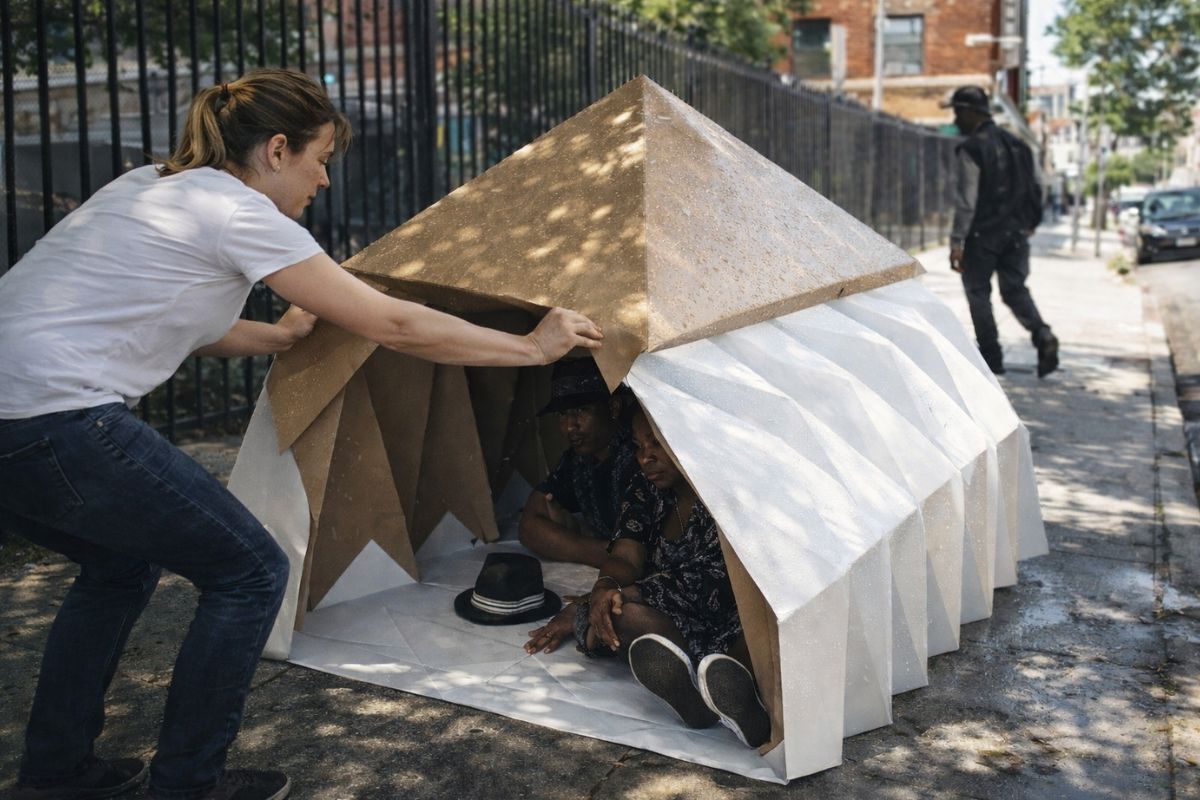


The Cardborigami, a collapsible cardboard shelter inspired by origami, is designed as a temporary alternative for people experiencing homelessness. Created by Tina Hovsepian in 2007, the project was developed specifically to address the large population of people experiencing homelessness in Los Angeles; it has versions 1.0 and 2.0; the portable version weighs 10.5 pounds, opens in one minute by itself, and receives a water-resistant and fire-retardant coating.
The Cardborigami collapsible shelter appears as a practical response to an urgency that remains exposed on the sidewalks: while structural solutions do not arrive, some attempt to reduce the immediate damage of sleeping outdoors. The proposal does not promise to “solve” the homelessness issue, but to offer an intermediate, transitional step, with quick assembly.
By betting on folded cardboard, water-resistant and fire-retardant finishes, and a format that opens without requiring tools, the designer focuses on something simple to understand: if the problem is now, protection also needs to be now. Still, the project is in prototype phase and depends on partnerships and funding to come to fruition.
A Transitional Shelter for a Problem That Insists on Staying

The idea behind Cardborigami arises from a direct diagnosis: the homeless situation is widespread and is not going to disappear anytime soon.
-
Friends have been building a small “town” for 30 years to grow old together, with compact houses, a common area, nature surrounding it, and a collective life project designed for friendship, coexistence, and simplicity.

-
This small town in Germany created its own currency 24 years ago, today it circulates millions per year, is accepted in over 300 stores, and the German government allowed all of this to happen under one condition.

-
Curitiba is shrinking and is expected to lose 97,000 residents by 2050, while inland cities in Paraná such as Sarandi, Araucária, and Toledo are experiencing accelerated growth that is changing the entire state’s map.

-
Tourists were poisoned on Everest in a million-dollar fraud scheme involving helicopters that diverted over $19 million and shocked international authorities.


In this interval between the reality of the streets and the possibility of permanent housing, the collapsible shelter emerges as an attempt to improve the minimum conditions for survival, offering coverage and a basic barrier against the environment.
When talking about a transitional shelter, the central point is time: it is not “the house,” but a temporary resource. This shifts the expectation and also makes the public dilemma more evident: any emergency solution helps, but does not replace long-term policies.
The Cardborigami enters precisely this space, where what is often lacking is something quick to use and easy to transport.
Who Created Cardborigami and Why Origami Became a Reference

The Cardborigami is a creation of designer Tina Hovsepian from Los Angeles. The declared inspiration comes from origami, the Japanese art of folding paper.
It is not an aesthetic detail, it is a matter of logic: folding well is what allows a stiff sheet to be transformed into a structure with shape, volume, and support, without relying on loose parts.
This connection with origami also suggests a practical goal: reducing steps. In projects aimed at people experiencing homelessness, each extra step can become an obstacle, whether due to time, lack of guidance, reduced mobility, or adverse conditions. By proposing a collapsible shelter that “reveals itself” from the fold itself, the designer tries to bring the real use closer to the ideal: open, assemble, and protect oneself, without bureaucracy and without tools.
How the Collapsible Shelter Works and What Changes Between Versions 1.0 and 2.0
The Cardborigami is produced in two versions. Version 1.0 is described as larger and designed for humanitarian crisis scenarios, where the need often involves shelter for many people in a short time. Version 2.0 was designed to be more portable, focusing on individual use by people experiencing homelessness, which shifts the priority to transport and speed.
It is in this version 2.0 that the most concrete numbers appear: the collapsible shelter weighs 10.5 pounds (almost 5 kg) and is designed to fold and open easily.
The promise of use is straightforward: a single person can set it up in under a minute, without requiring “assembly” in the traditional sense, because the structure is already integrated into the folded shape.
Water Resistance and Fire Retardant: Why These Finishes Matter
In model 2.0, the collapsible shelter receives water-resistant and fire-retardant coatings. Practically speaking, this points to two common risks in the daily life of those sleeping outdoors: exposure to moisture, which accelerates material wear and worsens discomfort, and the presence of nearby heat sources, which can exist for multiple reasons in the urban environment.
Here, it’s worth separating promise from result: the project describes finishes with these properties, but the Cardborigami is still a prototype, so the more responsible discussion is about intention and direction. In a temporary shelter, these coatings are more than just “extras”: they define whether the idea can transition from concept to routine, because real use is repeated, variable, and often in difficult conditions.
Additionally, the choice of cardboard as the base reinforces the importance of the finish. The material has evident advantages in availability and ease of handling, but also carries known limits, especially in the face of water and wear.
Therefore, the project’s logic becomes clear: it is not enough to fold quickly; it is necessary to minimally withstand the outside world.
From Prototype to Real Use: Guidance, Support Center, and Funding
The Cardborigami units are treated as part of a broader approach. The designer also plans to create the Cardborigami Support Center, a space where people experiencing homelessness would learn how to properly use the collapsible shelter and receive help to move towards more permanent housing.
This layer is relevant because it acknowledges a point often overlooked: distributing an item does not guarantee correct use, continuity, or access to support networks.
At the current stage, however, Cardborigami is still in the prototype phase. Hovsepian seeks to collaborate with organizations and investors with similar visions to bring the project to life, and the initiative aims for a crowdfunding campaign on GoFundMe.
A presentation video shows the structure being assembled and offers details on how the collapsible shelter opens and takes shape. It is the type of demonstration that seeks to prove speed and simplicity, but the leap to scale depends on partnerships, production, and implementation.


The Cardborigami raises an uncomfortable question: while definitive solutions do not arrive, what is acceptable as minimal protection for those sleeping outdoors?
By proposing a collapsible shelter inspired by origami, with assembly in under a minute, weighing 10.5 pounds, and finishes that are water-resistant and fire-retardant, the idea attempts to be simple enough to function outside of paper, even while still being a prototype.
I want to know how you see this in practice: would such a collapsible shelter make a real difference in your city or would it run into other more urgent problems, such as safety and support?
And, if you could choose, what should come first in a transitional project: weather resistance, ease of transport, or the support of a center to guide use and direct towards housing?










So p facilitar a vida dos usuários de crack. Causar uma enorme poluição visual na cidade. Sem falar que isso dará uma sensação de propriedade do local ao usuário de crack. Morador de rua na sua maioria são fugitivos da **** e ou usuários de crack. Tem albergue p isso. C abrigo e comida. Porem tem hora de entrar, nao pode sair e naonpode usar droga la dentro, por isso os usuarios preferam ficar emporcalhando as ruas. Internação tinha que ser obrigatória. Quem tiver dó deles, é membros dos direitos humanos que os levem p dentro de suas casas… Quero ver se leva…
Troca de lugar com ele….
A porrnha da porta do albergue está aberto para baú caiúdos mas não querem ficar aí jogados aí na rua não adianta lacradorzinho peidorreiro vir aqui tretar não porque isso é verdade tá bom não adianta vim mentir não tomar no ç com u rapaz!?