





 Portuguese
  English
  Spanish
  5 min of reading
  0 comments


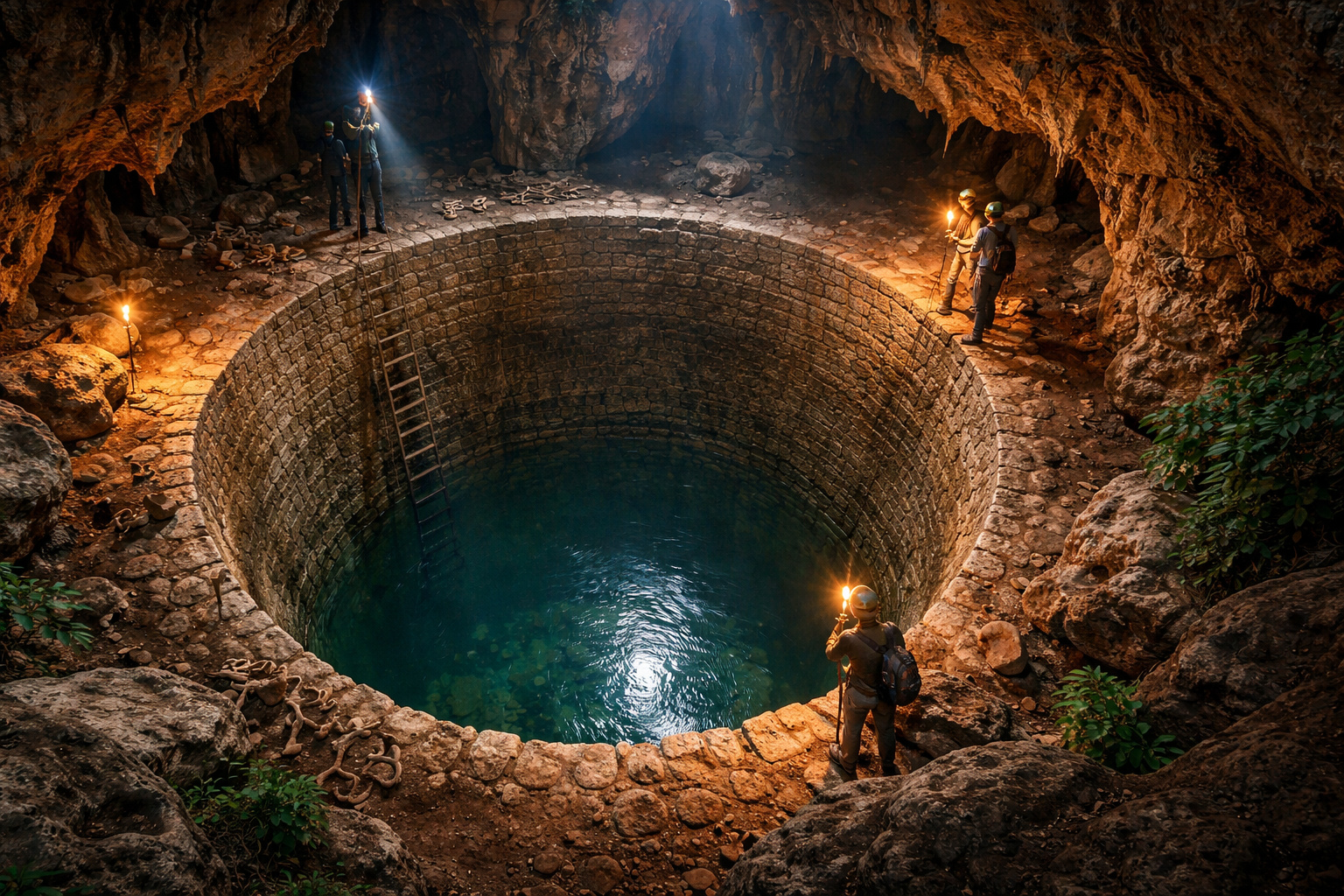
Archeologists from INAH Found an 8 Meter by 8 Meter Chultun in a Cave in Tulum National Park, the Construction May Have Been Built Between 1250 and 1520, Started as a Water Tank and Then Gained Signs of Ritual.
What seemed like just another cavity in the underground of Tulum turned into a finding that touches on two obsessions of Mexico, water and tourism. Researchers located a Mayan construction made to capture rain, a type of reservoir excavated and planned with precision.
And the size grabs attention; it is not just any hole. It is 8 meters in diameter and 8 meters deep, inside a cave in one of the most preserved points of the region.
The Construction of the 8 Meter Reservoir That Changes the Conversation About Ancient Engineering, When Water Was Worth More Than Gold in Cities Surrounded by Limestone
The construction of the chultun is not a museum piece by chance. In practice, it was an engineering solution to a tough problem, storing water in a region where limestone soil absorbs a lot of water and where rain determines the rhythm of life.
-
Friends have been building a small “town” for 30 years to grow old together, with compact houses, a common area, nature surrounding it, and a collective life project designed for friendship, coexistence, and simplicity.

-
This small town in Germany created its own currency 24 years ago, today it circulates millions per year, is accepted in over 300 stores, and the German government allowed all of this to happen under one condition.

-
Curitiba is shrinking and is expected to lose 97,000 residents by 2050, while inland cities in Paraná such as Sarandi, Araucária, and Toledo are experiencing accelerated growth that is changing the entire state’s map.

-
Tourists were poisoned on Everest in a million-dollar fraud scheme involving helicopters that diverted over $19 million and shocked international authorities.


The finding in Tulum has the scale of a construction. Eight meters by eight means volume, planning, and coordinated work, something that requires knowledge of the terrain and the behavior of water.
What intrigues is the location. The structure was inside a cave in Tulum National Park, a setting where any mistake in excavation during construction can lead to collapse, internal landslides, or loss of access.
The Twist No One Expected, Human Bones and Burnt Stones Indicate That the “Water Tank” May Have Become a Ritual Stage
The story does not stop at practical use. After serving as a reservoir, researchers point out that the chultun may have had repurposing.
The reason appears in the type of evidence found there. Human bones and burnt stones were found, signs that shift the narrative to another territory, the symbolic.
Here is where the finding gains tension. A structure designed to ensure survival, water for drinking, cooking, and planting, may have been redefined when the community changed, when pressure increased, or when the place began to carry another type of value.
The Technical Secret Behind Caves, Why the Underground Becomes a Natural Laboratory for Archaeology, Geology, and Even Exploration Strategies
A cave is a vault and a trap at the same time. It preserves but also hides. That is why caves are so valuable for archaeological research.
The case of the cave in Tulum connects with other recent findings made underground. In France, scientists announced the identification of three dinosaur footprints in the Castelbouc cave, on the Causse Méjean plateau, in the south of the country.
The estimate presented by researchers is that the marks are 168 million years old and are preserved with rare details, including claws. The size also impresses; each footprint would be 1.25 meters long, associated with some of the largest dinosaurs in the world.
When science meets rock and time, the underground becomes a contest for prominence. On one side, archaeology showing water solutions that seem modern. On the other, paleontology exhibiting giant traces that cross eras.
The Race for Depth and Records, the Deepest Cave on the Planet Became a “Testing Ground” That Requires Technique, Risk, and Heavy Logistics
Not every cave enters history for an archaeological finding. Some enter for their size and difficulty of exploration.
The Veryovkina, in the Arabika Massif in the Russian Republic of Abkhazia, is cited as the deepest measured on Earth to date, with 2,223 meters. It underwent decades of expeditions until it was explored to its lowest point in 2018.
The detail that gives the human dimension of the story appears in the timeline. The cave was discovered in 1968, reached 115 meters at that time, then a team from Moscow reached 440 meters in 1986, and new incursions from the Speleo di Perovo group starting in 2015 brought the system to successive records, with a network of tunnels that exceeds 6,000 meters.
These figures are not just vanity. They translate the technical leap that underground exploration requires, ropes, mapping, physical endurance, logistics, and decision-making in an extreme environment.
From Mexico to Brazil, the Caves That Became Attractions and Businesses, and the Domino Effect on Tourism, Preservation, and Local Infrastructure
When a cave makes headlines, it often attracts a line. There comes public interest, visitation, and with that come demands for control, safety, and infrastructure.
The text circulating about curiosities cites famous spots in various countries, such as Mammoth Cave in the United States, Reed Flute Cave in China, Waitomo Glowworm in New Zealand, Hölloch in Switzerland, the Naica cave in Mexico, and Eisriesenwelt in Austria.
Brazil also enters this conversation strongly, with the Toca da Boa Vista in Bahia, the largest Brazilian cave with 100 km in length, and the Devil’s Cave in Eldorado, São Paulo, with 8,650 meters in length and 600 meters accessible to tourism.
What happens in the cave of Tulum has this same potential for a domino effect. A finding of Mayan engineering could redefine visitation routes, strengthen preservation policies, and increase pressure for management of the surroundings, because where there is interest, there is a dispute for access and narrative.
In the end, what caught attention was the rare mix of things that move the real world: water, engineering, risk, and buried history. A Mayan reservoir inside a cave is not just the past; it is a reminder that the most valuable technology often arises when the most basic resource is threatened to run out.
Share your thoughts in the comments: do you think structures like this chultun should be restricted to research, or is controlled tourism the way to protect and fund preservation?










-

-

-

-

20 pessoas reagiram a isso.