





 Portuguese
  English
  Spanish
  4 min of reading
  0 comments


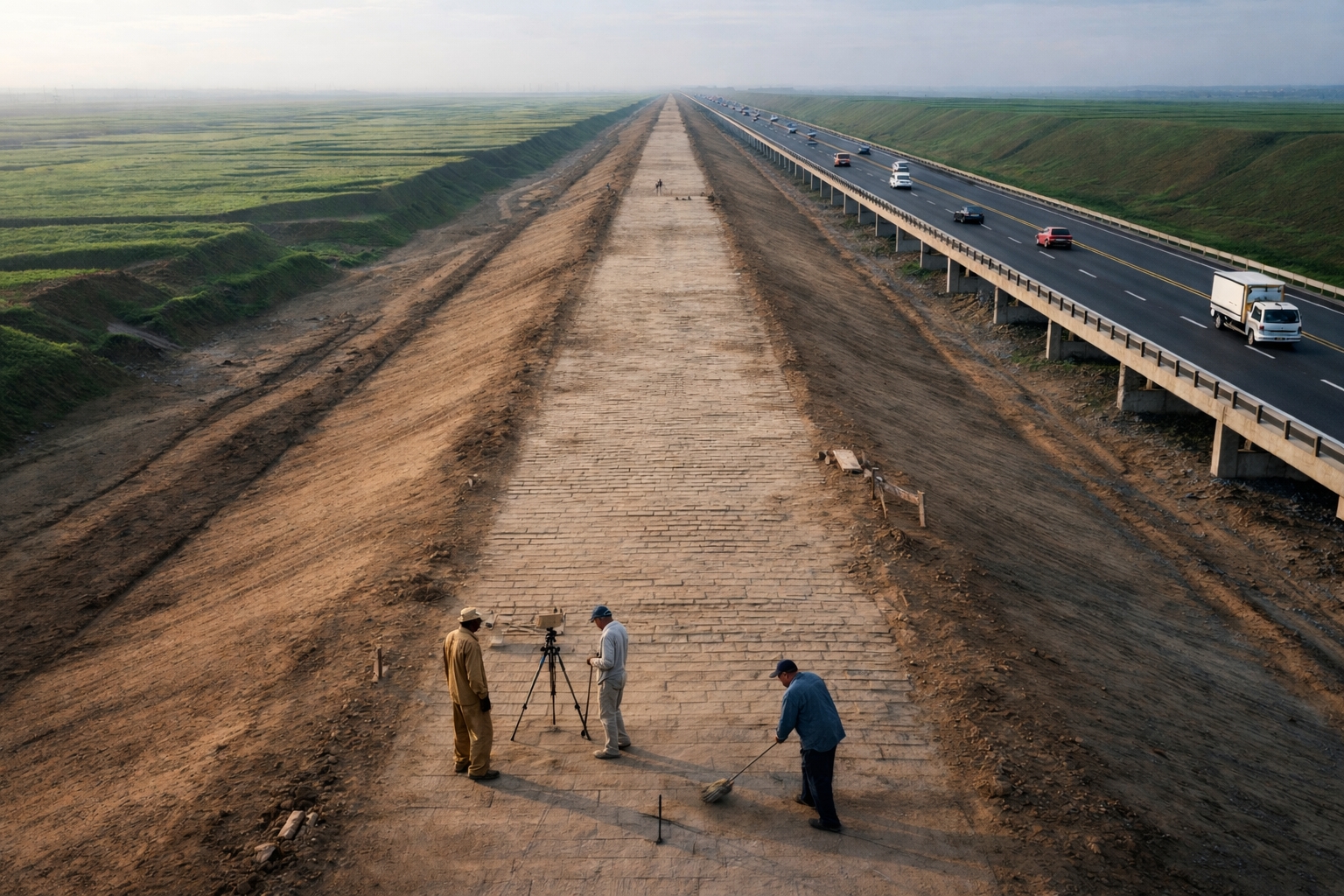
New Discovery About a Giant Imperial Road Construction Attributed to the First Emperor of China Puts Ancient Engineering in the Center of the Conversation, and Raises Current Questions for Logistics, Public Works, and Maintenance Costs
A road disappears for centuries in China and, when it reappears, it doesn’t ask for permission. Recent discoveries about a giant imperial road construction around 2,200 years old, linked to the era of Qin Shi Huang, have circulated again in videos and articles from 2025 and 2026.
The reason is obvious: the engineering feat behind this type of ancient work still causes discomfort in any infrastructure debate.
Because every city knows the opposite route. The road is born, wears out, gets patched, reopens, and becomes a project again. And the costs keep flowing.
-
Friends have been building a small “town” for 30 years to grow old together, with compact houses, a common area, nature surrounding it, and a collective life project designed for friendship, coexistence, and simplicity.

-
This small town in Germany created its own currency 24 years ago, today it circulates millions per year, is accepted in over 300 stores, and the German government allowed all of this to happen under one condition.

-
Curitiba is shrinking and is expected to lose 97,000 residents by 2050, while inland cities in Paraná such as Sarandi, Araucária, and Toledo are experiencing accelerated growth that is changing the entire state’s map.

-
Tourists were poisoned on Everest in a million-dollar fraud scheme involving helicopters that diverted over $19 million and shocked international authorities.


The Mystery That Affects Any Engineer: How an Ancient Road Construction in China Still Leaves Signs of Design and Not Just Ruins
When talking about ancient roads, many people imagine loose stones and improvised trails.
But the idea of a giant road points to something else: planning, standards, and terrain control. And this clashes with a modern dilemma, the difference between building quickly and building to last.
Even without exact data, the word that keeps coming up is logistics, a route designed to connect critical points of the empire and reduce travel time.
The Engineering Trick of Construction That Appears Where Almost No One Looks: The Soil Base and The Path Design Before Any Pavement
A lasting project starts with what doesn’t show up in the photo.
What stands out in the descriptions of these discoveries is the logic of stabilizing the path, focusing on leveling and terrain resistance. In construction terms, it is the type of care that separates a design that withstands season after season from a section that starts to develop holes in the first rainy season.
According to experts, ancient projects that leave marks of durability tend to have two strong points: soil preparation and smart route design. It’s not always sophisticated technology. Often, it’s execution discipline.
And this is where the silent rivalry is born. On one side, current solutions that depend on constant maintenance. On the other, an ancient work that still makes the ground tell the story.

Qin Shi Huang Built a State Machine: Standardization, Infrastructure, and Control to Accelerate Trade and Mobilization
Qin Shi Huang unified China in 221 BC and didn’t stop at conquest. He implemented reforms that standardized writing, currency, weights, and measures, a turn that, in practice, works as a technical norm for the entire empire.
When you put everything to the same standard, the impact appears quickly: less friction in trade, more predictability in taxes, more control in the flow of goods.
This same drive explains the major works attributed to him, the connection of fortifications that formed the base of the Great Wall and the construction of the Terracotta Army to guard his mausoleum.
And it enters heavy infrastructure, roads and canals to integrate economy and command. For an empire, this is not a detail. It is strategy.
The Road as a Tool of Power: Why Road Works Determine Who Dominates Logistics and Who Wastes Time and Money
A road serves not just to go back and forth. A road defines who delivers first.
In today’s world, this is supply chain, logistical cost, market price, and industrial competitiveness. In imperial logic, it was the same calculation with different language: move resources, react quickly, maintain borders, and impose presence.
When an archaeological discovery highlights a road attributed to a strong central government, it raises a modern alert. Major works aren’t just concrete. They are political decisions, choices of standards, and construction methods.
And those who work with transport and energy know: when the route fails, everything gets more expensive.
Why This News Has Returned with Strength Now: The Domino Effect in the Debate About Works That Are Expensive to Raise and Even More Expensive to Maintain
The subject gained new momentum in 2025 and 2026 because it touches on a sensitive point: durability has become a budget topic.
Regarding the original cost of this ancient road, there is no data, and it wouldn’t make sense to compare values directly. What can be compared is the principle: infrastructure made to reduce maintenance changes the game for any government and any sector that depends on transport.
The discovery also fuels a type of curiosity that doesn’t fade quickly. If an empire from 2,200 years ago thought in terms of scale, standardization, and logistics, what is missing today when modern roads deteriorate so soon?
In the end, this story caught attention because it combines two things that rarely go hand in hand: archaeology and heavy construction, with a legacy that seems designed to disturb the present.
Tell us in the comments what surprised you most about this discovery: the idea of an ancient giant road, the weight of logistics in the power of an empire, or the discussion about why so much current infrastructure is under maintenance?










-

-

-

-

-

5 pessoas reagiram a isso.