





 Portuguese
  English
  Spanish
  7 min of reading
  0 comments


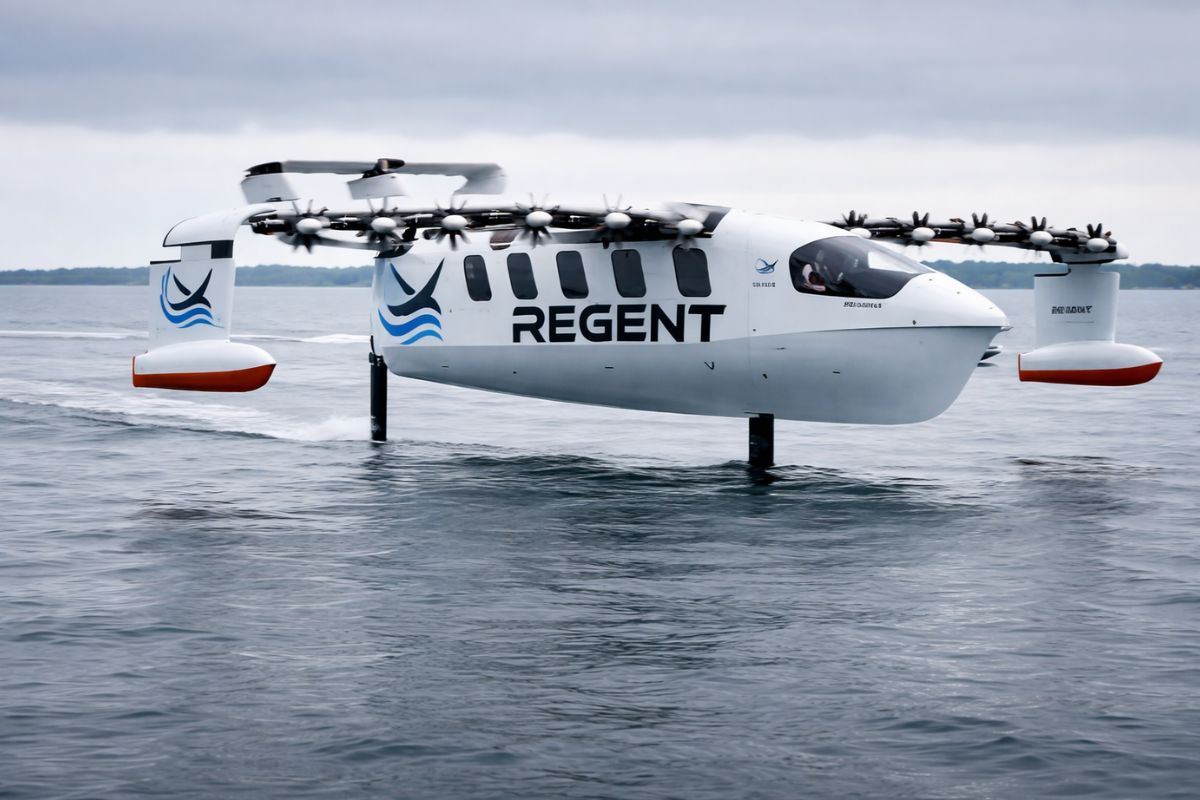
Capable of Carrying 12 Passengers at Speeds Up to 300 km/h, the Electric Flying Boat from Regent Craft, Brought in by a Latin American Transportation Company, Promises to Transform the Use of the Sea Between Santos, São Sebastião, and Ilhabela.
An Electric Flying Boat Capable of Carrying 12 Passengers at Speeds Up to 300 km/h, Without Consuming Fossil Fuels, Already Has a Prototype in Testing and Could, in a Few Years, Shorten the Journey Between Santos and Cities Like São Sebastião and Ilhabela to Between 20 and 30 Minutes, Opening Up Space for New Routes, New Business Opportunities, and a Totally Different Use of the Sea in Brazil.
Born in Brazil and now present in several countries in Latin America, a transportation company has signed an agreement with the American company Regent Craft, developer and manufacturer of the Seaglider vessels, to bring this Electric Flying Boat to South and Central America. The contract provides for the acquisition of 10 units of the Viceroy Sea Glider model and aims for a future where fast transport of passengers and light cargo along the coast becomes a daily operation rather than a distant promise.
What Is an Electric Flying Boat, After All?
First and foremost, it is important to understand that this Electric Flying Boat is neither a traditional airplane nor a regular boat with an electric motor.
-
Motorola launched the Signature with a gold seal from DxOMark, tying with the iPhone 17 Pro in camera performance, Snapdragon 8 Gen 5 that surpassed 3 million in benchmarks, and a zoom that impresses even at night.

-
Satellites reveal beneath the Sahara a giant river buried for thousands of kilometers: study shows that the largest hot desert on the planet was once traversed by a river system comparable to the largest on Earth.

-
Scientists have captured something never seen in space: newly born stars are creating gigantic rings of light a thousand times larger than the distance between the Earth and the Sun, and this changes everything we knew about stellar birth.

-
Geologists find traces of a continent that disappeared 155 million years ago after separating from Australia and reveal that it did not sink, but broke into fragments scattered across Southeast Asia.

It belongs to the wing-in-ground effect category, where the wing flies very close to the water’s surface, supported by a kind of air cushion.
When stationary, during boarding, it behaves like a boat. There is a main hull in the water, and at the tip of each wing, floats that ensure stability.
The idea is for passengers to feel a firm platform, without uncomfortable rocking while entering and exiting the vessel. Visually, it appears to be a low and wide boat, with short wings resting on the sea.
The significant difference arises when the Electric Flying Boat begins to gain speed. Under the hull, there are two T-shaped hydrofoils.
As the vessel accelerates, these hydrofoils generate lift in the water and raise the hull, reducing hydrodynamic drag and allowing the whole to accelerate much more efficiently.
How the Electric Flying Boat “Flies” Over Water
After lifting the hull with the help of the hydrofoils, the Electric Flying Boat enters the most impressive phase of the journey, the ground effect flight.
The wing has been specifically designed to trap an air cushion between its lower part and the sea surface, creating additional lift when it maintains a very low height, around half the wingspan.
In practice, this means flying about 10 meters above the water, taking advantage of this aerodynamic effect.
If it rises too much, it loses efficiency because it is not a wing designed to operate like a regular airplane wing at altitude. The idea has always been to optimize flight close to the water, where the ground effect acts with more power.
With this arrangement, the Electric Flying Boat can reach speeds of up to 300 km/h in open sea, far from the coast and the most congested routes.
However, near cities, operations need to be more conservative. The vessel reduces speed, the hull returns to touch the water, and the movement resembles more that of a fast boat than a low-flying aircraft, until it comes to a complete stop.
Electric Motors, Zero Fuel, and Lesser Environmental Impact
One of the most striking points of this project is the choice of electric propulsion. The Electric Flying Boat utilizes 12 electric motors, six on each side, eliminating the use of fossil fuels during operation.
This brings two immediate impacts. The first is environmental, as there is no direct burning of fuel on board, reducing local emissions and aligning the system more with decarbonization goals in transportation.
The second is comfort: electric motors tend to generate less noise and vibration, making the passenger experience smoother than that of traditional high-speed vessels.
Of course, all these advantages depend on the source of the energy used to charge the batteries, the design of the infrastructure, and the economic operation model.
But from a technical standpoint, the Electric Flying Boat is already born with a different environmental footprint than diesel-powered vessels that currently dominate high-speed transport.
Santos, São Sebastião, Ilhabela: Coast in Half an Hour


In practice, what draws attention is the potential of the Electric Flying Boat to create new regional routes. The most frequently cited example is the stretch between Santos, São Sebastião, and Ilhabela.
With the capability to reach 300 km/h on suitable stretches, initial estimates indicate an average travel time between 20 minutes and half an hour, depending on factors such as allowed average speed, route definitions by the Navy, Harbor Master’s Office, and other authorities, in addition to sea conditions.
Even with speed reductions near the coast, the time savings compared to road travel tend to be significant.
Instead of relying solely on congested highways, tolls, and traffic, a passenger could board in Santos, cross the sea at high speed, and disembark close to the final destination on the northern coast.
On a regional scale, this means bringing coastal cities closer together, shortening distances, and creating a network of fast connections that simply does not exist today.
From Passengers to Express Cargo: New Usage Possibilities
Although the original project of the Electric Flying Boat focuses on 12 passengers, the Viceroy Sea Glider also allows configurations aimed at cargo.
The idea is to transport small pallets, similar to those used on airplanes to carry cargo in the holds.
In this format, the Electric Flying Boat can serve very specific niches: higher-value goods, urgent packages, medications, emergency items, components that cannot wait for slow land transport.
This is not about traditional cabotage in large volumes, but rather a type of “maritime air bridge” for quick cargo.
Imagine, for example, an operation between Santos and São Sebastião where an e-commerce or logistics company could send batches of urgent orders, reducing hours of road travel to minutes of sea crossing. For certain types of products, this difference could justify the cost of operating such a fast system.
Control Technology to Face Waves and Wind
Operating an Electric Flying Boat at high speed and low altitude over the sea requires more than a good hull and powerful motors.
The dynamic behavior of the vessel in ground effect is controlled by a set of control laws and software that continuously monitor the operation.
Sensors, onboard computers, and algorithms constantly adjust the control surfaces and the thrust of the motors to maintain stability, compensate for waves, wind changes, and subtle altitude variations.
Within predefined limits of wave height and wind intensity, the promise is of a smooth journey, with a sense of stability and safety.
Of course, there are restrictions. In extreme conditions, with very rough seas or winds outside of the established parameters, the Electric Flying Boat should not operate.
The project’s idea is not to challenge storms but to take advantage of safe operating windows with the support of advanced control technology all the time.
When Can the Electric Flying Boat Become a Reality?
Clider already has a prototype in testing, which raises curiosity about when the Electric Flying Boat might enter commercial operation.
The stated forecast is that the model could potentially be available by 2029, meaning it is not something for “tomorrow morning,” but it is also not a distant science-fiction dream.
Until then, there is a long way to go. It is necessary to mature the business model, finalize investment equations, operation costs, maintenance and recharging infrastructure, in addition to going through all regulatory processes related to the Navy, the Harbor Master’s Office, and other authorities responsible for defining routes and safety rules.
Interest, however, has already emerged. Companies in different parts of the world are following the tests and evaluating where an Electric Flying Boat makes sense within their routes.
If this technology is produced at scale, the trend is that costs will decrease and new applications will emerge, both for passengers and for special cargo.
A New Way to View the Brazilian Sea
More than a curious vehicle, the Electric Flying Boat represents a shift in perspective about how we use the coast.
Instead of seeing the sea merely as a barrier or a backdrop, it becomes an active part of a fast regional transportation system, connecting cities, shortening distances, and creating logistical opportunities that today rely almost solely on highways.
If the technology delivers on its promises, it could pave the way for a new generation of electric coastal routes, with high speed, lower environmental impact, and a focus on both passengers and urgent cargo. In this scenario, Santos, São Sebastião, and Ilhabela would be just the beginning of a much larger network.
And you, looking at the traffic on the roads and the potential of our coastline, would you board an electric flying boat to cross the Santos–São Sebastião stretch in less than half an hour, or would you still be skeptical about seeing a “wing” flying close to the water?







-

6 pessoas reagiram a isso.